

152
Chapter 3
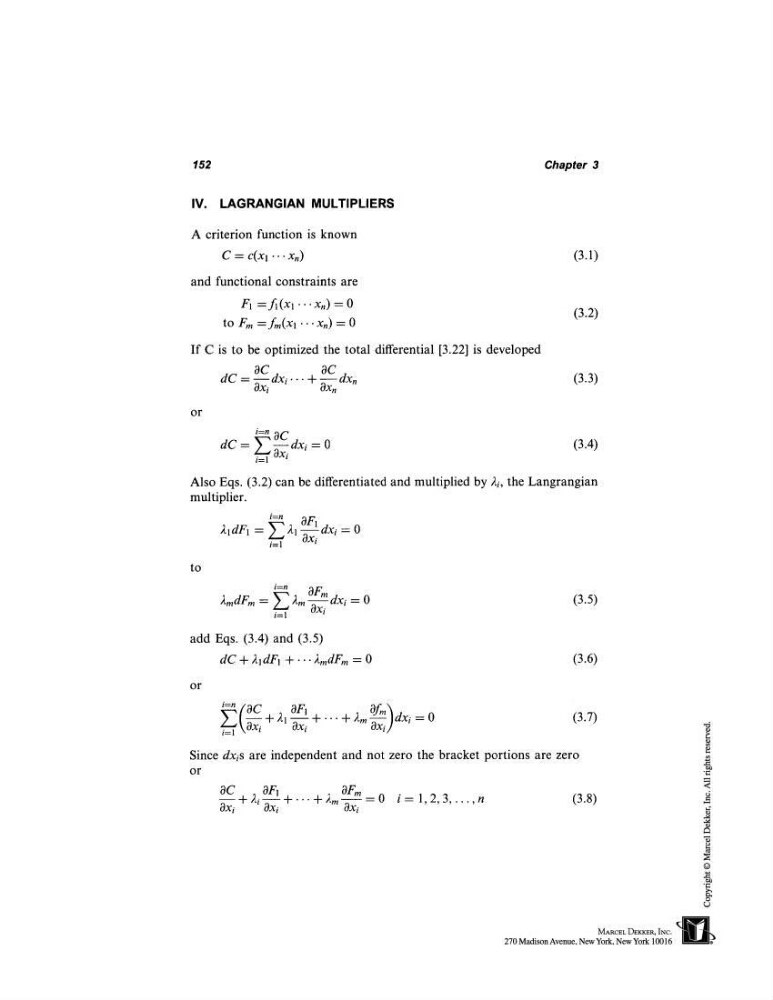
IV. LAGRANGIAN MULTIPLIERS
A criterion function is known
C = £(x I "’" Xn)
(3.1)
and functional constraints are
F1 =ji(xl...x,)
=
to Fm = fm(Xl " " " Xn) =
(3.2)
If C is to be optimized the total differential [3.22] is developed
0C
0C
dC = 7-- dxi . . . + ~ dxn
oxi
OXn
(3.3)
or
i=n OC
dE : ~dx i : 0
(3.4)
~=~ Oxi
Also Eqs. (3.2) can be differentiated and multiplied by 2i, the Langrangian
multiplier.
)q dF1
~ axi : 0
i= 1
OXi
to
,~mdFm = Z 2m. dxi = 0
(3.5)
i=1
add Eqs. (3.4) and (3.5)
dC + 21dFl +... 2mdFm = 0
(3.6)
or
i:n
1/0C
OFI ’
/~m ~fm~ dxi
= 0
i~=l~iXiAl-~l-~xi
1-’’’’~OXi~ ]
(3.7)
Since dxis are independent and not zero the bracket portions are zero
or
OC OF1
OFm = 0 i = 1, 2, 3 ..... n
(3.8)
ON i ~- 2i ~xi "~- " "" "~- ~m OX
i
Chapter 3
IV. LAGRANGIAN MULTIPLIERS
A criterion function is known
C = £(x I "’" Xn)
(3.1)
and functional constraints are
F1 =ji(xl...x,)
=
to Fm = fm(Xl " " " Xn) =
(3.2)
If C is to be optimized the total differential [3.22] is developed
0C
0C
dC = 7-- dxi . . . + ~ dxn
oxi
OXn
(3.3)
or
i=n OC
dE : ~dx i : 0
(3.4)
~=~ Oxi
Also Eqs. (3.2) can be differentiated and multiplied by 2i, the Langrangian
multiplier.
)q dF1
~ axi : 0
i= 1
OXi
to
,~mdFm = Z 2m. dxi = 0
(3.5)
i=1
add Eqs. (3.4) and (3.5)
dC + 21dFl +... 2mdFm = 0
(3.6)
or
i:n
1/0C
OFI ’
/~m ~fm~ dxi
= 0
i~=l~iXiAl-~l-~xi
1-’’’’~OXi~ ]
(3.7)
Since dxis are independent and not zero the bracket portions are zero
or
OC OF1
OFm = 0 i = 1, 2, 3 ..... n
(3.8)
ON i ~- 2i ~xi "~- " "" "~- ~m OX
i