

92
Chapter 2
12
R10
~ 6
E=4._E
~ 20
10 ~
10 4
A
Acetat resin (1800
B
cycles per rain)
_
Nylon
(1200 cycles
per rain)
-A Repeated tension
B Repeated bending
Polyethylene
1
,4
t (1200 cycles per rain)
lO s
lO s
10 ~
Cycles to failure
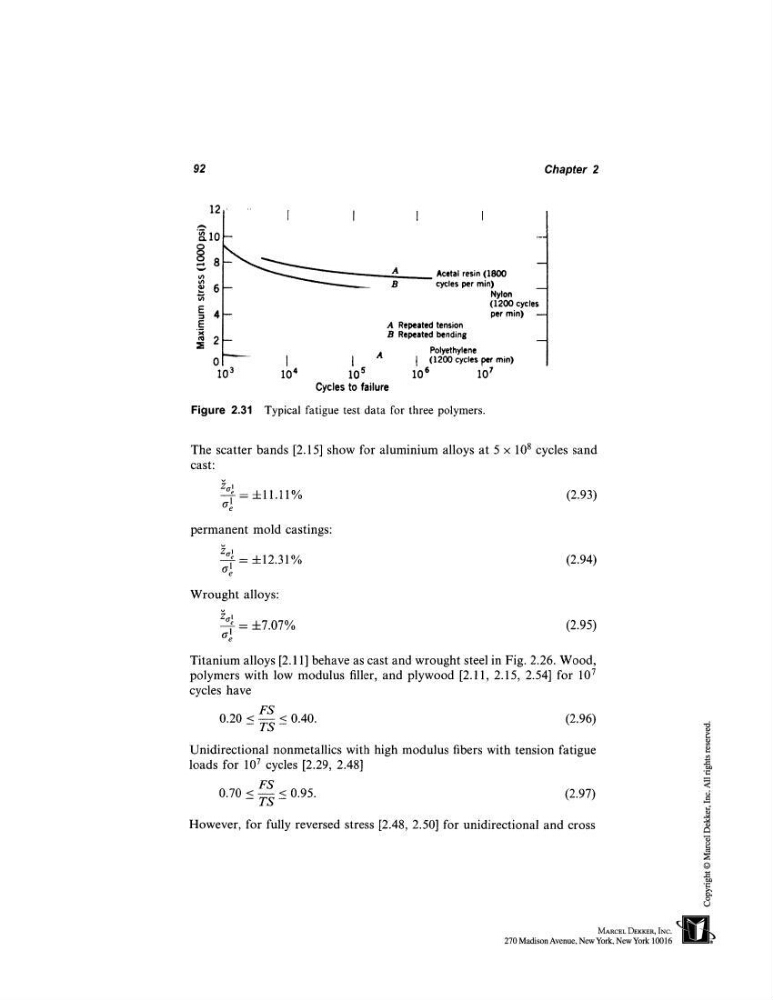
Figure 2.31 Typical fatigue test data for three polymers.
The scatter bands [2.15] show for aluminium alloys at 5 × 10⁸ cycles sand
cast:
--= ±11.11%
(2.93)
permanent mold castings:
~ -- +12.31%
(2.94)
Wrought alloys:
~°e~ - +7.07%
(2.95)
Titanium alloys [2.11] behave as cast and wrought steel in Fig. 2.26. Wood,
polymers with low modulus filler, and plywood [2.11, 2.15, 2.54] for 107
cycles have
FS
0.20 < ~ < 0.40.
(2.96)
Unidirectional nonmetallics with high modulus fibers with tension fatigue
loads for 107 cycles [2.29, 2.48]
FS
0.70 < -- < 0.95.
(2.97)
-TSHowever, for fully reversed stress [2.48, 2.50] for unidirectional and cross
Chapter 2
12
R10
~ 6
E=4._E
~ 20
10 ~
10 4
A
Acetat resin (1800
B
cycles per rain)
_
Nylon
(1200 cycles
per rain)
-A Repeated tension
B Repeated bending
Polyethylene
1
,4
t (1200 cycles per rain)
lO s
lO s
10 ~
Cycles to failure
Figure 2.31 Typical fatigue test data for three polymers.
The scatter bands [2.15] show for aluminium alloys at 5 × 10⁸ cycles sand
cast:
--= ±11.11%
(2.93)
permanent mold castings:
~ -- +12.31%
(2.94)
Wrought alloys:
~°e~ - +7.07%
(2.95)
Titanium alloys [2.11] behave as cast and wrought steel in Fig. 2.26. Wood,
polymers with low modulus filler, and plywood [2.11, 2.15, 2.54] for 107
cycles have
FS
0.20 < ~ < 0.40.
(2.96)
Unidirectional nonmetallics with high modulus fibers with tension fatigue
loads for 107 cycles [2.29, 2.48]
FS
0.70 < -- < 0.95.
(2.97)
-TSHowever, for fully reversed stress [2.48, 2.50] for unidirectional and cross