

Application of Probability to Mechanical Design
89
vendor. Information can also be obtained from [2.1, 2.63, 2.64, 2.66] as well
as from publications like Machine Design, Modern Plastics, and Materials
Engineering, which publish data yearly. Most organizations that publish
standards and mechanical strength properties such as SAE, ASME, AISC,
AITC, and others are listed in [2.60].
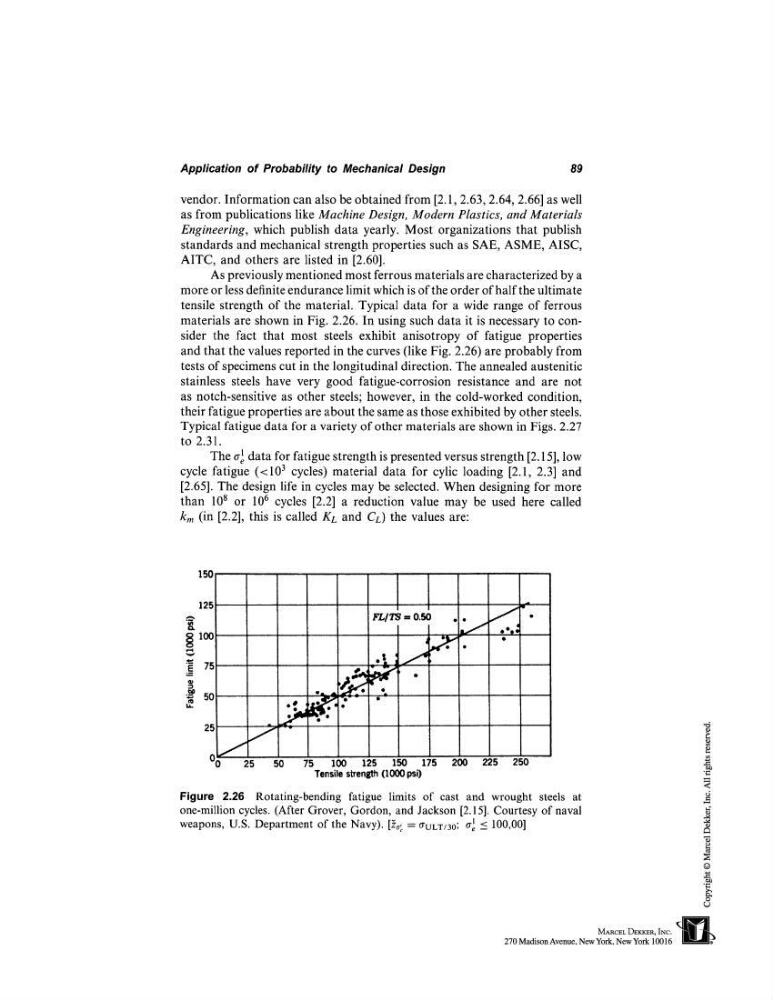
As previously mentioned most ferrous materials are characterized by a
more or less definite endurance limit which is of the order of half the ultimate
tensile strength of the material. Typical data for a wide range of ferrous
materials are shown in Fig. 2.26. In using such data it is necessary to consider the fact that most steels exhibit anisotropy of fatigue properties
and that the values reported in the curves (like Fig. 2.26) are probably from
tests of specimens cut in the longitudinal direction. The annealed austenitic
stainless steels have very good fatigue-corrosion resistance and are not
as notch-sensitive as other steels; however, in the cold-worked condition,
their fatigue properties are about the same as those exhibited by other steels.
Typical fatigue data for a variety of other materials are shown in Figs. 2.27
to 2.31.
The o-~ data for fatigue strength is presented versus strength [2.15], low
cycle fatigue (<103 cycles) material data for cylic loading [2.1, 2.3] and
[2.65]. The design life in cycles may be selected. When designing for more
than 108 or 106 cycles [2.2] a reduction value may be used here called
km (in [2.2], this is called K/~ and CL) the values are:
150
125
25
FLIT~ = 0.50
.,
O0
25 50
75 100 125 150 175 200 225 250
Tensile strength (1000 psi)
Figure 2.26 Rotating-bending fatigue limits of cast and wrought steels at
one-million cycles. (After Grover, Gordon, and Jackson [2.15]. Courtesy of naval
n _< 100,00]
weapons, U.S. Department of the Navy). [-~ = ~rULT/30; ~r
e
89
vendor. Information can also be obtained from [2.1, 2.63, 2.64, 2.66] as well
as from publications like Machine Design, Modern Plastics, and Materials
Engineering, which publish data yearly. Most organizations that publish
standards and mechanical strength properties such as SAE, ASME, AISC,
AITC, and others are listed in [2.60].
As previously mentioned most ferrous materials are characterized by a
more or less definite endurance limit which is of the order of half the ultimate
tensile strength of the material. Typical data for a wide range of ferrous
materials are shown in Fig. 2.26. In using such data it is necessary to consider the fact that most steels exhibit anisotropy of fatigue properties
and that the values reported in the curves (like Fig. 2.26) are probably from
tests of specimens cut in the longitudinal direction. The annealed austenitic
stainless steels have very good fatigue-corrosion resistance and are not
as notch-sensitive as other steels; however, in the cold-worked condition,
their fatigue properties are about the same as those exhibited by other steels.
Typical fatigue data for a variety of other materials are shown in Figs. 2.27
to 2.31.
The o-~ data for fatigue strength is presented versus strength [2.15], low
cycle fatigue (<103 cycles) material data for cylic loading [2.1, 2.3] and
[2.65]. The design life in cycles may be selected. When designing for more
than 108 or 106 cycles [2.2] a reduction value may be used here called
km (in [2.2], this is called K/~ and CL) the values are:
150
125
25
FLIT~ = 0.50
.,
O0
25 50
75 100 125 150 175 200 225 250
Tensile strength (1000 psi)
Figure 2.26 Rotating-bending fatigue limits of cast and wrought steels at
one-million cycles. (After Grover, Gordon, and Jackson [2.15]. Courtesy of naval
n _< 100,00]
weapons, U.S. Department of the Navy). [-~ = ~rULT/30; ~r
e