

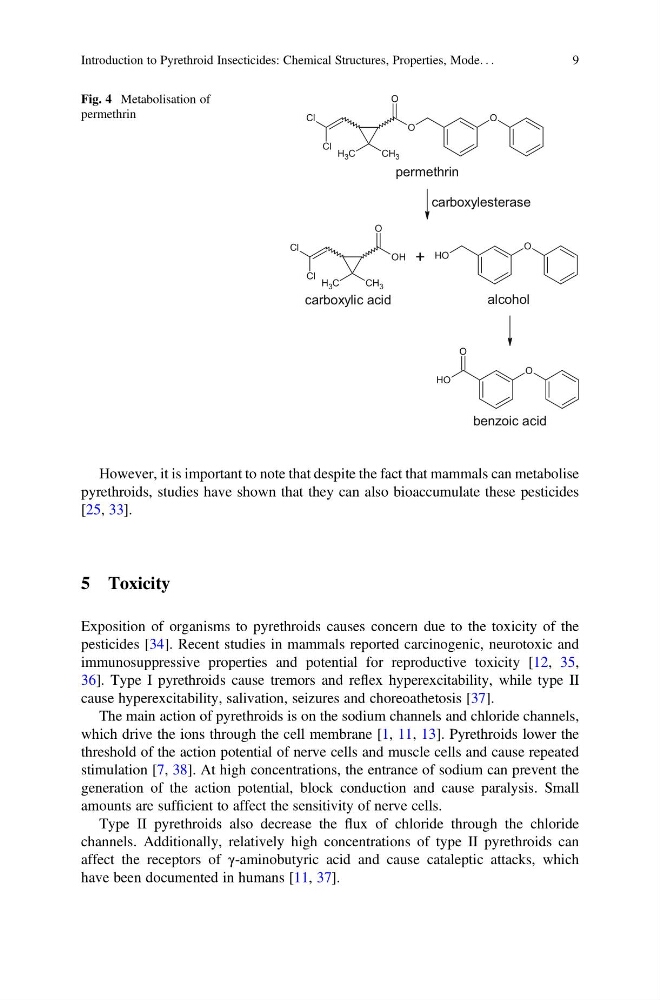
However, it is important to note that despite the fact that mammals can metabolise
pyrethroids, studies have shown that they can also bioaccumulate these pesticides
[25, 33].
5 Toxicity
Exposition of organisms to pyrethroids causes concern due to the toxicity of the
pesticides [34]. Recent studies in mammals reported carcinogenic, neurotoxic and
immunosuppressive properties and potential for reproductive toxicity [12, 35,
36]. Type I pyrethroids cause tremors and reflex hyperexcitability, while type II
cause hyperexcitability, salivation, seizures and choreoathetosis [37].
The main action of pyrethroids is on the sodium channels and chloride channels,
which drive the ions through the cell membrane [1, 11, 13]. Pyrethroids lower the
threshold of the action potential of nerve cells and muscle cells and cause repeated
stimulation [7, 38]. At high concentrations, the entrance of sodium can prevent the
generation of the action potential, block conduction and cause paralysis. Small
amounts are sufficient to affect the sensitivity of nerve cells.
Type II pyrethroids also decrease the flux of chloride through the chloride
channels. Additionally, relatively high concentrations of type II pyrethroids can
affect the receptors of γ-aminobutyric acid and cause cataleptic attacks, which
have been documented in humans [11, 37].
O
O
O
CH 3
C
H 3
Cl
Cl
OH
O
CH 3
C
H 3
Cl
Cl
O
H
O
+
O
H
O
O
permethrin
carboxylesterase
carboxylic acid
alcohol
benzoic acid
Fig. 4 Metabolisation of
permethrin
Introduction to Pyrethroid Insecticides: Chemical Structures, Properties, Mode. . .
9
pyrethroids, studies have shown that they can also bioaccumulate these pesticides
[25, 33].
5 Toxicity
Exposition of organisms to pyrethroids causes concern due to the toxicity of the
pesticides [34]. Recent studies in mammals reported carcinogenic, neurotoxic and
immunosuppressive properties and potential for reproductive toxicity [12, 35,
36]. Type I pyrethroids cause tremors and reflex hyperexcitability, while type II
cause hyperexcitability, salivation, seizures and choreoathetosis [37].
The main action of pyrethroids is on the sodium channels and chloride channels,
which drive the ions through the cell membrane [1, 11, 13]. Pyrethroids lower the
threshold of the action potential of nerve cells and muscle cells and cause repeated
stimulation [7, 38]. At high concentrations, the entrance of sodium can prevent the
generation of the action potential, block conduction and cause paralysis. Small
amounts are sufficient to affect the sensitivity of nerve cells.
Type II pyrethroids also decrease the flux of chloride through the chloride
channels. Additionally, relatively high concentrations of type II pyrethroids can
affect the receptors of γ-aminobutyric acid and cause cataleptic attacks, which
have been documented in humans [11, 37].
O
O
O
CH 3
C
H 3
Cl
Cl
OH
O
CH 3
C
H 3
Cl
Cl
O
H
O
+
O
H
O
O
permethrin
carboxylesterase
carboxylic acid
alcohol
benzoic acid
Fig. 4 Metabolisation of
permethrin
Introduction to Pyrethroid Insecticides: Chemical Structures, Properties, Mode. . .
9