

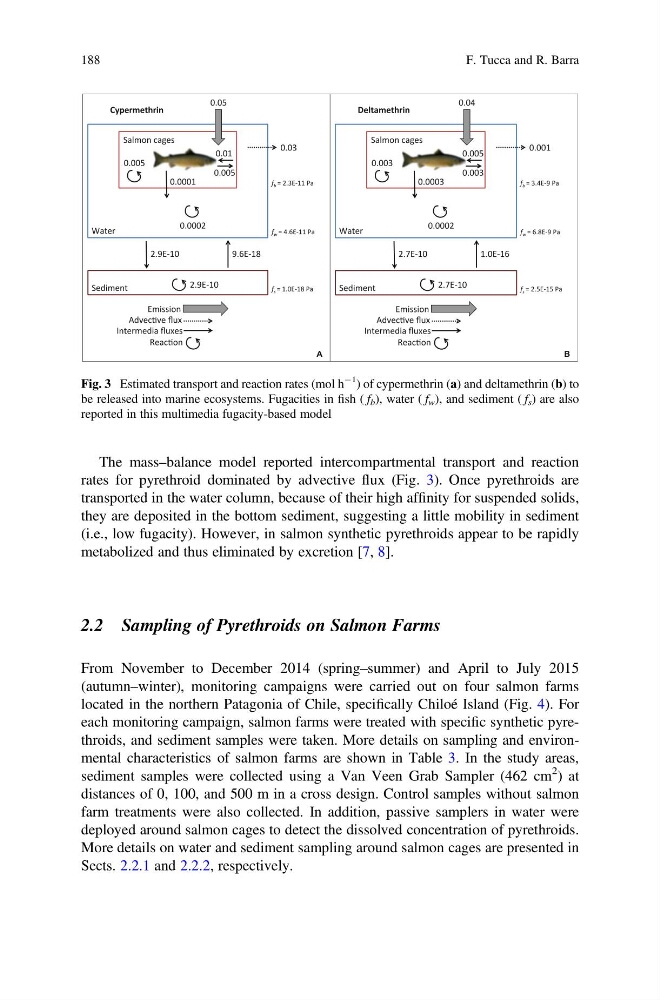
The mass–balance model reported intercompartmental transport and reaction
rates for pyrethroid dominated by advective flux (Fig. 3). Once pyrethroids are
transported in the water column, because of their high affinity for suspended solids,
they are deposited in the bottom sediment, suggesting a little mobility in sediment
(i.e., low fugacity). However, in salmon synthetic pyrethroids appear to be rapidly
metabolized and thus eliminated by excretion [7, 8].
2.2 Sampling of Pyrethroids on Salmon Farms
From November to December 2014 (spring–summer) and April to July 2015
(autumn–winter), monitoring campaigns were carried out on four salmon farms
located in the northern Patagonia of Chile, specifically Chiloé Island (Fig. 4). For
each monitoring campaign, salmon farms were treated with specific synthetic pyrethroids, and sediment samples were taken. More details on sampling and environmental characteristics of salmon farms are shown in Table 3. In the study areas,
sediment samples were collected using a Van Veen Grab Sampler (462 cm
2 ) at
distances of 0, 100, and 500 m in a cross design. Control samples without salmon
farm treatments were also collected. In addition, passive samplers in water were
deployed around salmon cages to detect the dissolved concentration of pyrethroids.
More details on water and sediment sampling around salmon cages are presented in
Sects. 2.2.1 and 2.2.2, respectively.
A
B
Fig. 3 Estimated transport and reaction rates (mol h
À1
) of cypermethrin (a) and deltamethrin (b) to
be released into marine ecosystems. Fugacities in fish ( f b ), water ( f w ), and sediment ( f s ) are also
reported in this multimedia fugacity-based model
188
F. Tucca and R. Barra
rates for pyrethroid dominated by advective flux (Fig. 3). Once pyrethroids are
transported in the water column, because of their high affinity for suspended solids,
they are deposited in the bottom sediment, suggesting a little mobility in sediment
(i.e., low fugacity). However, in salmon synthetic pyrethroids appear to be rapidly
metabolized and thus eliminated by excretion [7, 8].
2.2 Sampling of Pyrethroids on Salmon Farms
From November to December 2014 (spring–summer) and April to July 2015
(autumn–winter), monitoring campaigns were carried out on four salmon farms
located in the northern Patagonia of Chile, specifically Chiloé Island (Fig. 4). For
each monitoring campaign, salmon farms were treated with specific synthetic pyrethroids, and sediment samples were taken. More details on sampling and environmental characteristics of salmon farms are shown in Table 3. In the study areas,
sediment samples were collected using a Van Veen Grab Sampler (462 cm
2 ) at
distances of 0, 100, and 500 m in a cross design. Control samples without salmon
farm treatments were also collected. In addition, passive samplers in water were
deployed around salmon cages to detect the dissolved concentration of pyrethroids.
More details on water and sediment sampling around salmon cages are presented in
Sects. 2.2.1 and 2.2.2, respectively.
A
B
Fig. 3 Estimated transport and reaction rates (mol h
À1
) of cypermethrin (a) and deltamethrin (b) to
be released into marine ecosystems. Fugacities in fish ( f b ), water ( f w ), and sediment ( f s ) are also
reported in this multimedia fugacity-based model
188
F. Tucca and R. Barra