

1. To be persistent in the environment. POPs have half-lives greater than 2 months
in water or greater than 6 months in soil and sediment.
2. To bioaccumulate. POPs have bioconcentration factors (BCFs) or
bioaccumulation factors (BAFs) in aquatic species greater than 5,000 or, when
unknown, their log K ow is greater than 5.
3. To have potential for long-range transport. POPs are detected far from the
emission source; data show they have been transported via air (half-live in air
over 2 days), water or migratory species.
4. To have adverse effects. POPs are proved to have adverse effects on human
health or on the environment.
The original list of the Stockholm Convention included 12 POPs that were
banned or restricted. Eight of them were organochlorinated pesticides: aldrin, endrin,
dieldrin, chlordane, DDT, heptachlor, mirex and toxaphene. These pesticides were
considered safe when they first entered the market, but data proved them to cause
long-term adverse effects on human health and on the environment. New compounds have been added to the list throughout the years.
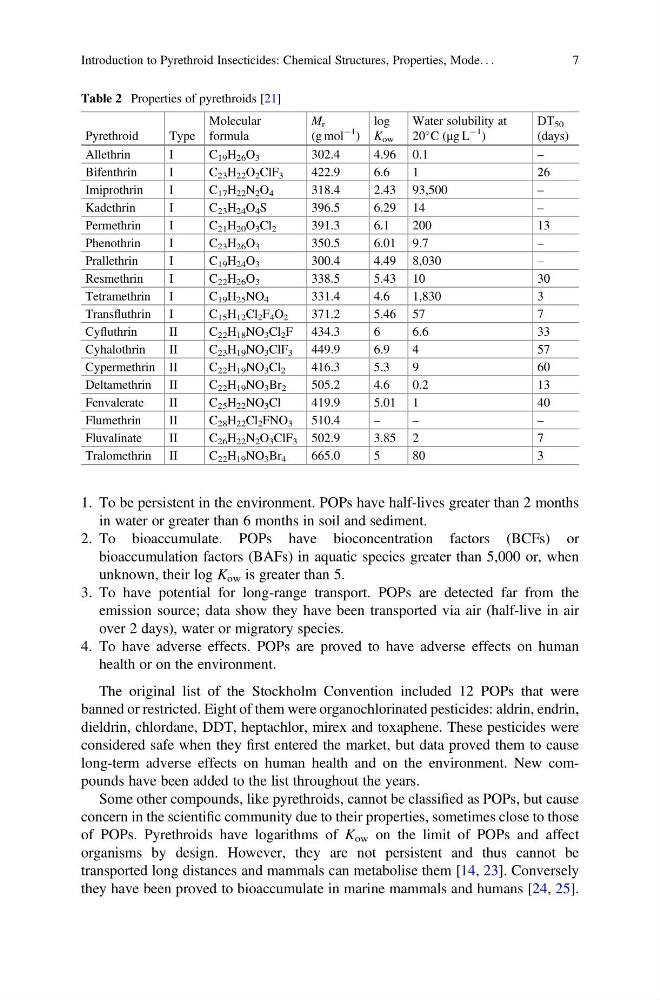
Some other compounds, like pyrethroids, cannot be classified as POPs, but cause
concern in the scientific community due to their properties, sometimes close to those
of POPs. Pyrethroids have logarithms of K ow on the limit of POPs and affect
organisms by design. However, they are not persistent and thus cannot be
transported long distances and mammals can metabolise them [14, 23]. Conversely
they have been proved to bioaccumulate in marine mammals and humans [24, 25].
Table 2 Properties of pyrethroids [21]
Pyrethroid
Type
Molecular
formula
M r
(g mol
À1
)
log
K ow
Water solubility at
20
C (μg L
À1
)
DT 50
(days)
Allethrin
I
C 19 H 26 O 3
302.4
4.96 0.1
–
Bifenthrin
I
C 23 H 22 O 2 ClF 3
422.9
6.6
1
26
Imiprothrin
I
C 17 H 22 N 2 O 4
318.4
2.43 93,500
–
Kadethrin
I
C 23 H 24 O 4 S
396.5
6.29 14
–
Permethrin
I
C 21 H 20 O 3 Cl 2
391.3
6.1
200
13
Phenothrin
I
C 23 H 26 O 3
350.5
6.01 9.7
–
Prallethrin
I
C 19 H 24 O 3
300.4
4.49 8,030
–
Resmethrin
I
C 22 H 26 O 3
338.5
5.43 10
30
Tetramethrin I
C 19 H 25 NO 4
331.4
4.6
1,830
3
Transfluthrin I
C 15 H 12 Cl 2 F 4 O 2
371.2
5.46 57
7
Cyfluthrin
II
C 22 H 18 NO 3 Cl 2 F 434.3
6
6.6
33
Cyhalothrin
II
C 23 H 19 NO 3 ClF 3 449.9
6.9
4
57
Cypermethrin II
C 22 H 19 NO 3 Cl 2
416.3
5.3
9
60
Deltamethrin II
C 22 H 19 NO 3 Br 2
505.2
4.6
0.2
13
Fenvalerate
II
C 25 H 22 NO 3 Cl
419.9
5.01 1
40
Flumethrin
II
C 28 H 22 Cl 2 FNO 3 510.4
–
–
–
Fluvalinate
II
C 26 H 22 N 2 O 3 ClF 3 502.9
3.85 2
7
Tralomethrin II
C 22 H 19 NO 3 Br 4
665.0
5
80
3
Introduction to Pyrethroid Insecticides: Chemical Structures, Properties, Mode. . .
7
in water or greater than 6 months in soil and sediment.
2. To bioaccumulate. POPs have bioconcentration factors (BCFs) or
bioaccumulation factors (BAFs) in aquatic species greater than 5,000 or, when
unknown, their log K ow is greater than 5.
3. To have potential for long-range transport. POPs are detected far from the
emission source; data show they have been transported via air (half-live in air
over 2 days), water or migratory species.
4. To have adverse effects. POPs are proved to have adverse effects on human
health or on the environment.
The original list of the Stockholm Convention included 12 POPs that were
banned or restricted. Eight of them were organochlorinated pesticides: aldrin, endrin,
dieldrin, chlordane, DDT, heptachlor, mirex and toxaphene. These pesticides were
considered safe when they first entered the market, but data proved them to cause
long-term adverse effects on human health and on the environment. New compounds have been added to the list throughout the years.
Some other compounds, like pyrethroids, cannot be classified as POPs, but cause
concern in the scientific community due to their properties, sometimes close to those
of POPs. Pyrethroids have logarithms of K ow on the limit of POPs and affect
organisms by design. However, they are not persistent and thus cannot be
transported long distances and mammals can metabolise them [14, 23]. Conversely
they have been proved to bioaccumulate in marine mammals and humans [24, 25].
Table 2 Properties of pyrethroids [21]
Pyrethroid
Type
Molecular
formula
M r
(g mol
À1
)
log
K ow
Water solubility at
20
C (μg L
À1
)
DT 50
(days)
Allethrin
I
C 19 H 26 O 3
302.4
4.96 0.1
–
Bifenthrin
I
C 23 H 22 O 2 ClF 3
422.9
6.6
1
26
Imiprothrin
I
C 17 H 22 N 2 O 4
318.4
2.43 93,500
–
Kadethrin
I
C 23 H 24 O 4 S
396.5
6.29 14
–
Permethrin
I
C 21 H 20 O 3 Cl 2
391.3
6.1
200
13
Phenothrin
I
C 23 H 26 O 3
350.5
6.01 9.7
–
Prallethrin
I
C 19 H 24 O 3
300.4
4.49 8,030
–
Resmethrin
I
C 22 H 26 O 3
338.5
5.43 10
30
Tetramethrin I
C 19 H 25 NO 4
331.4
4.6
1,830
3
Transfluthrin I
C 15 H 12 Cl 2 F 4 O 2
371.2
5.46 57
7
Cyfluthrin
II
C 22 H 18 NO 3 Cl 2 F 434.3
6
6.6
33
Cyhalothrin
II
C 23 H 19 NO 3 ClF 3 449.9
6.9
4
57
Cypermethrin II
C 22 H 19 NO 3 Cl 2
416.3
5.3
9
60
Deltamethrin II
C 22 H 19 NO 3 Br 2
505.2
4.6
0.2
13
Fenvalerate
II
C 25 H 22 NO 3 Cl
419.9
5.01 1
40
Flumethrin
II
C 28 H 22 Cl 2 FNO 3 510.4
–
–
–
Fluvalinate
II
C 26 H 22 N 2 O 3 ClF 3 502.9
3.85 2
7
Tralomethrin II
C 22 H 19 NO 3 Br 4
665.0
5
80
3
Introduction to Pyrethroid Insecticides: Chemical Structures, Properties, Mode. . .
7