

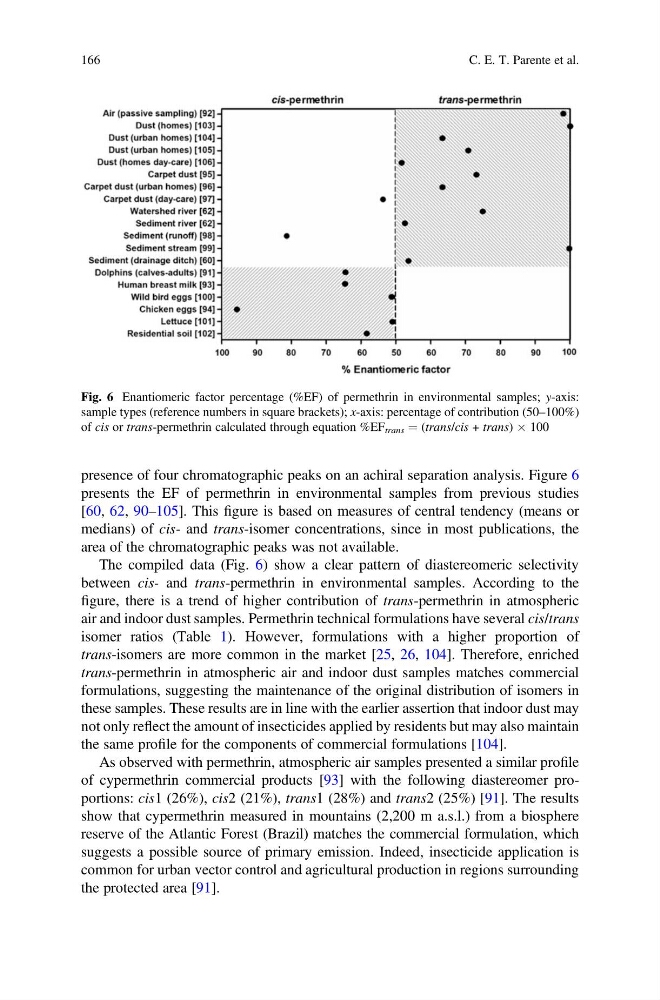
presence of four chromatographic peaks on an achiral separation analysis. Figure 6
presents the EF of permethrin in environmental samples from previous studies
[60, 62, 90–105]. This figure is based on measures of central tendency (means or
medians) of cis- and trans-isomer concentrations, since in most publications, the
area of the chromatographic peaks was not available.
The compiled data (Fig. 6) show a clear pattern of diastereomeric selectivity
between cis- and trans-permethrin in environmental samples. According to the
figure, there is a trend of higher contribution of trans-permethrin in atmospheric
air and indoor dust samples. Permethrin technical formulations have several cis/trans
isomer ratios (Table 1). However, formulations with a higher proportion of
trans-isomers are more common in the market [25, 26, 104]. Therefore, enriched
trans-permethrin in atmospheric air and indoor dust samples matches commercial
formulations, suggesting the maintenance of the original distribution of isomers in
these samples. These results are in line with the earlier assertion that indoor dust may
not only reflect the amount of insecticides applied by residents but may also maintain
the same profile for the components of commercial formulations [104].
As observed with permethrin, atmospheric air samples presented a similar profile
of cypermethrin commercial products [93] with the following diastereomer proportions: cis1 (26%), cis2 (21%), trans1 (28%) and trans2 (25%) [91]. The results
show that cypermethrin measured in mountains (2,200 m a.s.l.) from a biosphere
reserve of the Atlantic Forest (Brazil) matches the commercial formulation, which
suggests a possible source of primary emission. Indeed, insecticide application is
common for urban vector control and agricultural production in regions surrounding
the protected area [91].
Fig. 6 Enantiomeric factor percentage (%EF) of permethrin in environmental samples; y-axis:
sample types (reference numbers in square brackets); x-axis: percentage of contribution (50–100%)
of cis or trans-permethrin calculated through equation %EF trans ¼ (trans/cis + trans) Â 100
166
C. E. T. Parente et al.
presents the EF of permethrin in environmental samples from previous studies
[60, 62, 90–105]. This figure is based on measures of central tendency (means or
medians) of cis- and trans-isomer concentrations, since in most publications, the
area of the chromatographic peaks was not available.
The compiled data (Fig. 6) show a clear pattern of diastereomeric selectivity
between cis- and trans-permethrin in environmental samples. According to the
figure, there is a trend of higher contribution of trans-permethrin in atmospheric
air and indoor dust samples. Permethrin technical formulations have several cis/trans
isomer ratios (Table 1). However, formulations with a higher proportion of
trans-isomers are more common in the market [25, 26, 104]. Therefore, enriched
trans-permethrin in atmospheric air and indoor dust samples matches commercial
formulations, suggesting the maintenance of the original distribution of isomers in
these samples. These results are in line with the earlier assertion that indoor dust may
not only reflect the amount of insecticides applied by residents but may also maintain
the same profile for the components of commercial formulations [104].
As observed with permethrin, atmospheric air samples presented a similar profile
of cypermethrin commercial products [93] with the following diastereomer proportions: cis1 (26%), cis2 (21%), trans1 (28%) and trans2 (25%) [91]. The results
show that cypermethrin measured in mountains (2,200 m a.s.l.) from a biosphere
reserve of the Atlantic Forest (Brazil) matches the commercial formulation, which
suggests a possible source of primary emission. Indeed, insecticide application is
common for urban vector control and agricultural production in regions surrounding
the protected area [91].
Fig. 6 Enantiomeric factor percentage (%EF) of permethrin in environmental samples; y-axis:
sample types (reference numbers in square brackets); x-axis: percentage of contribution (50–100%)
of cis or trans-permethrin calculated through equation %EF trans ¼ (trans/cis + trans) Â 100
166
C. E. T. Parente et al.