

2 The Compounds
The first pyrethroid pesticide, allethrin, was identified in 1949 [11]. It is a type I
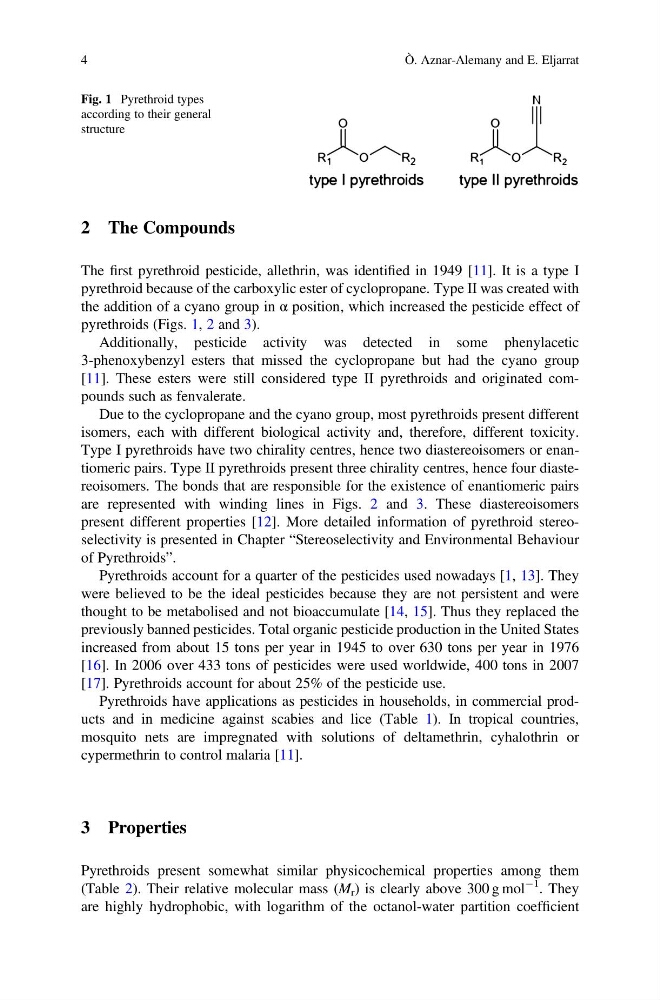
pyrethroid because of the carboxylic ester of cyclopropane. Type II was created with
the addition of a cyano group in α position, which increased the pesticide effect of
pyrethroids (Figs. 1, 2 and 3).
Additionally, pesticide activity was detected in some phenylacetic
3-phenoxybenzyl esters that missed the cyclopropane but had the cyano group
[11]. These esters were still considered type II pyrethroids and originated compounds such as fenvalerate.
Due to the cyclopropane and the cyano group, most pyrethroids present different
isomers, each with different biological activity and, therefore, different toxicity.
Type I pyrethroids have two chirality centres, hence two diastereoisomers or enantiomeric pairs. Type II pyrethroids present three chirality centres, hence four diastereoisomers. The bonds that are responsible for the existence of enantiomeric pairs
are represented with winding lines in Figs. 2 and 3. These diastereoisomers
present different properties [12]. More detailed information of pyrethroid stereoselectivity is presented in Chapter “Stereoselectivity and Environmental Behaviour
of Pyrethroids”.
Pyrethroids account for a quarter of the pesticides used nowadays [1, 13]. They
were believed to be the ideal pesticides because they are not persistent and were
thought to be metabolised and not bioaccumulate [14, 15]. Thus they replaced the
previously banned pesticides. Total organic pesticide production in the United States
increased from about 15 tons per year in 1945 to over 630 tons per year in 1976
[16]. In 2006 over 433 tons of pesticides were used worldwide, 400 tons in 2007
[17]. Pyrethroids account for about 25% of the pesticide use.
Pyrethroids have applications as pesticides in households, in commercial products and in medicine against scabies and lice (Table 1). In tropical countries,
mosquito nets are impregnated with solutions of deltamethrin, cyhalothrin or
cypermethrin to control malaria [11].
3 Properties
Pyrethroids present somewhat similar physicochemical properties among them
(Table 2). Their relative molecular mass (M r ) is clearly above 300 g mol
À1 . They
are highly hydrophobic, with logarithm of the octanol-water partition coefficient
Fig. 1 Pyrethroid types
according to their general
structure
4
Ò. Aznar-Alemany and E. Eljarrat
The first pyrethroid pesticide, allethrin, was identified in 1949 [11]. It is a type I
pyrethroid because of the carboxylic ester of cyclopropane. Type II was created with
the addition of a cyano group in α position, which increased the pesticide effect of
pyrethroids (Figs. 1, 2 and 3).
Additionally, pesticide activity was detected in some phenylacetic
3-phenoxybenzyl esters that missed the cyclopropane but had the cyano group
[11]. These esters were still considered type II pyrethroids and originated compounds such as fenvalerate.
Due to the cyclopropane and the cyano group, most pyrethroids present different
isomers, each with different biological activity and, therefore, different toxicity.
Type I pyrethroids have two chirality centres, hence two diastereoisomers or enantiomeric pairs. Type II pyrethroids present three chirality centres, hence four diastereoisomers. The bonds that are responsible for the existence of enantiomeric pairs
are represented with winding lines in Figs. 2 and 3. These diastereoisomers
present different properties [12]. More detailed information of pyrethroid stereoselectivity is presented in Chapter “Stereoselectivity and Environmental Behaviour
of Pyrethroids”.
Pyrethroids account for a quarter of the pesticides used nowadays [1, 13]. They
were believed to be the ideal pesticides because they are not persistent and were
thought to be metabolised and not bioaccumulate [14, 15]. Thus they replaced the
previously banned pesticides. Total organic pesticide production in the United States
increased from about 15 tons per year in 1945 to over 630 tons per year in 1976
[16]. In 2006 over 433 tons of pesticides were used worldwide, 400 tons in 2007
[17]. Pyrethroids account for about 25% of the pesticide use.
Pyrethroids have applications as pesticides in households, in commercial products and in medicine against scabies and lice (Table 1). In tropical countries,
mosquito nets are impregnated with solutions of deltamethrin, cyhalothrin or
cypermethrin to control malaria [11].
3 Properties
Pyrethroids present somewhat similar physicochemical properties among them
(Table 2). Their relative molecular mass (M r ) is clearly above 300 g mol
À1 . They
are highly hydrophobic, with logarithm of the octanol-water partition coefficient
Fig. 1 Pyrethroid types
according to their general
structure
4
Ò. Aznar-Alemany and E. Eljarrat