

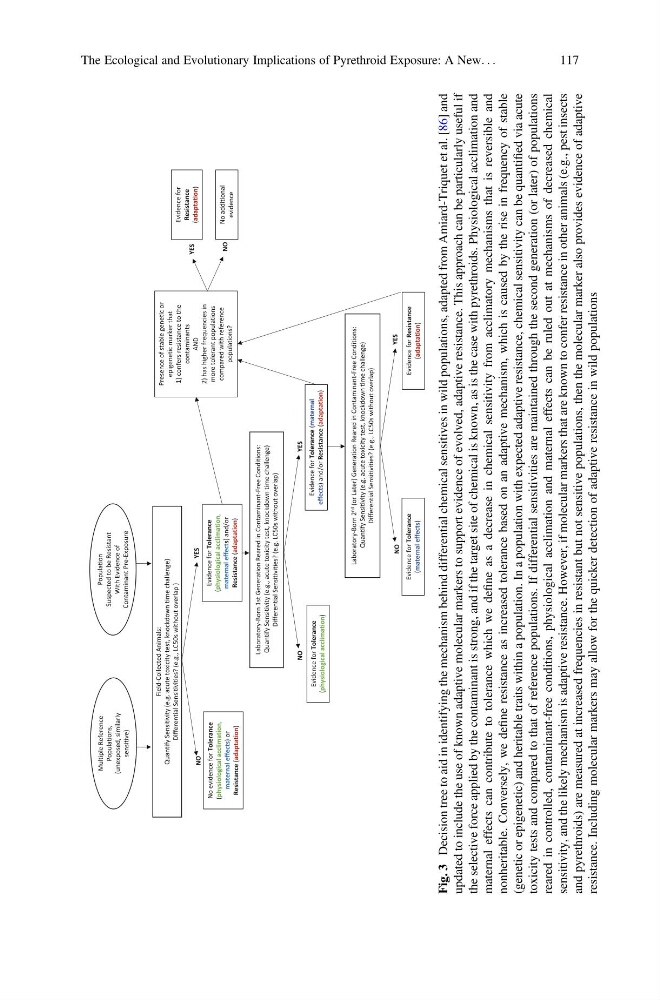
Fig. 3
Decision tree to aid in identifying the mechanism behind differential chemical sensitives in wild populations, adapted from Amiard-Triquet et al. [86] and
updated to include the use of known adaptive molecular markers to support evidence of evolved, adaptive resistance. This approach can be particularly useful if
the selective force applied by the contaminant is strong, and if the target site of chemical is known, as is the case with pyrethroids. Physiological acclimation and
maternal effects can contribute to tolerance which we define as a decrease in chemical sensitivity from acclimatory mechanisms that is reversible and
nonheritable. Conversely, we define resistance as increased tolerance based on an adaptive mechanism, which is caused by the rise in frequency of stable
(genetic or epigenetic) and heritable traits within a population. In a population with expected adaptive resistance, chemical sensitivity can be quantified via acute
toxicity tests and compared to that of reference populations. If differential sensitivities are maintained through the second generation (or later) of populations
reared in controlled, contaminant-free conditions, physiological acclimation and maternal effects can be ruled out at mechanisms of decreased chemical
sensitivity, and the likely mechanism is adaptive resistance. However, if molecular markers that are known to confer resistance in other animals (e.g., pest insects
and pyrethroids) are measured at increased frequencies in resistant but not sensitive populations, then the molecular marker also provides evidence of adaptive
resistance. Including molecular markers may allow for the quicker detection of adaptive resistance in wild populations
The Ecological and Evolutionary Implications of Pyrethroid Exposure: A New. . .
117
Decision tree to aid in identifying the mechanism behind differential chemical sensitives in wild populations, adapted from Amiard-Triquet et al. [86] and
updated to include the use of known adaptive molecular markers to support evidence of evolved, adaptive resistance. This approach can be particularly useful if
the selective force applied by the contaminant is strong, and if the target site of chemical is known, as is the case with pyrethroids. Physiological acclimation and
maternal effects can contribute to tolerance which we define as a decrease in chemical sensitivity from acclimatory mechanisms that is reversible and
nonheritable. Conversely, we define resistance as increased tolerance based on an adaptive mechanism, which is caused by the rise in frequency of stable
(genetic or epigenetic) and heritable traits within a population. In a population with expected adaptive resistance, chemical sensitivity can be quantified via acute
toxicity tests and compared to that of reference populations. If differential sensitivities are maintained through the second generation (or later) of populations
reared in controlled, contaminant-free conditions, physiological acclimation and maternal effects can be ruled out at mechanisms of decreased chemical
sensitivity, and the likely mechanism is adaptive resistance. However, if molecular markers that are known to confer resistance in other animals (e.g., pest insects
and pyrethroids) are measured at increased frequencies in resistant but not sensitive populations, then the molecular marker also provides evidence of adaptive
resistance. Including molecular markers may allow for the quicker detection of adaptive resistance in wild populations
The Ecological and Evolutionary Implications of Pyrethroid Exposure: A New. . .
117