

82
9.3
Keep Track of Progress?
Take the example of that book you currently hold in your hands (or read on the
screen): it includes section names on the header of each page (e.g. Introduction,
Animations, Graphs, Structure, etc.) Such a feature is useful in a reference book, to
assist readers finding the information they need, when looking for something
specific.
But do you need such visual reminders of which ‘section’ you are up to, in a
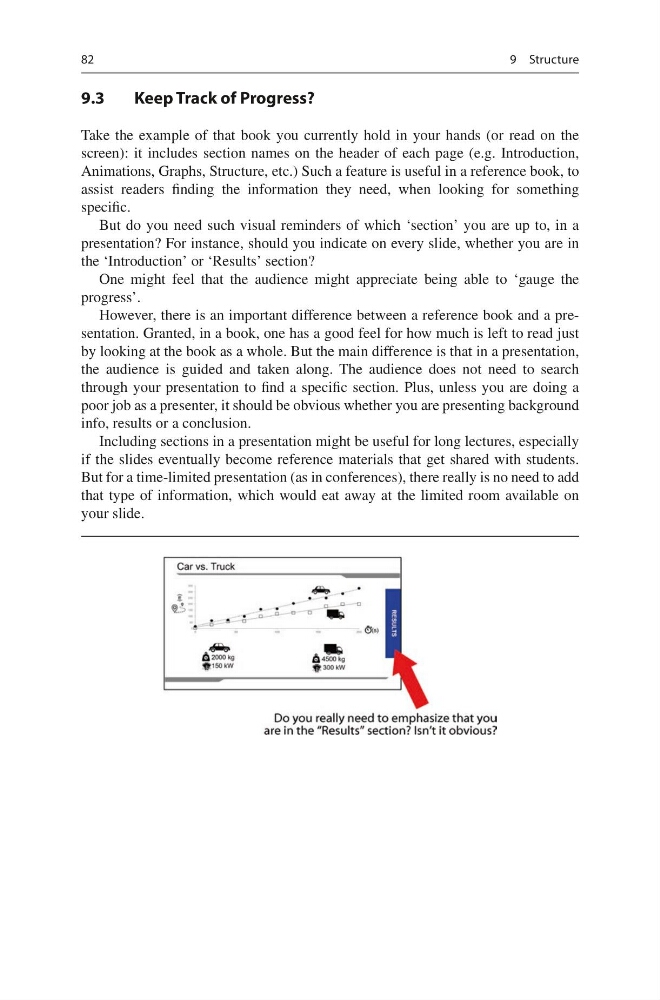
presentation? For instance, should you indicate on every slide, whether you are in
the ‘Introduction’ or ‘Results’ section?
One might feel that the audience might appreciate being able to ‘gauge the
progress’.
However, there is an important difference between a reference book and a presentation. Granted, in a book, one has a good feel for how much is left to read just
by looking at the book as a whole. But the main difference is that in a presentation,
the audience is guided and taken along. The audience does not need to search
through your presentation to find a specific section. Plus, unless you are doing a
poor job as a presenter, it should be obvious whether you are presenting background
info, results or a conclusion.
Including sections in a presentation might be useful for long lectures, especially
if the slides eventually become reference materials that get shared with students.
But for a time-limited presentation (as in conferences), there really is no need to add
that type of information, which would eat away at the limited room available on
your slide.
9 Structure
9.3
Keep Track of Progress?
Take the example of that book you currently hold in your hands (or read on the
screen): it includes section names on the header of each page (e.g. Introduction,
Animations, Graphs, Structure, etc.) Such a feature is useful in a reference book, to
assist readers finding the information they need, when looking for something
specific.
But do you need such visual reminders of which ‘section’ you are up to, in a
presentation? For instance, should you indicate on every slide, whether you are in
the ‘Introduction’ or ‘Results’ section?
One might feel that the audience might appreciate being able to ‘gauge the
progress’.
However, there is an important difference between a reference book and a presentation. Granted, in a book, one has a good feel for how much is left to read just
by looking at the book as a whole. But the main difference is that in a presentation,
the audience is guided and taken along. The audience does not need to search
through your presentation to find a specific section. Plus, unless you are doing a
poor job as a presenter, it should be obvious whether you are presenting background
info, results or a conclusion.
Including sections in a presentation might be useful for long lectures, especially
if the slides eventually become reference materials that get shared with students.
But for a time-limited presentation (as in conferences), there really is no need to add
that type of information, which would eat away at the limited room available on
your slide.
9 Structure