

24
D. Luecken and S. Napelenok
routes complicates efforts to identify and quantify sources of HCHO, and hence to
develop actions to reduce HCHO concentrations. The goal of this study is to use sensitivity tools within an Air Quality Model, CMAQ-DDM, to determine which sources
and hydrocarbons have the largest impacts on ambient HCHO concentrations.
4.2 Modeling Methods
This study applied the CMAQ version 5.02 air quality model, configured as in the
2011 NATA ([6], using 12 × 12 km
2 grids over the continental US and parts of
Canada and Mexico, and 24 vertical layers. Simulations were performed for two
entire months covering January and July, 2011. Chemistry was modeled with the
CB05tu mechanism [8] with additional HAPs. More details are given in Luecken
et al. [3].
Sensitivity coefficients were calculated with DDM-3D [2] within CMAQ [4].
Sensitivity is defined as the response of a model variable (concentrations of HCHO
and O 3 ) due to a change in a specified model parameter (nitrogen oxides (NO x ) and
hydrocarbon emissions from anthropogenic emission categories and natural emissions, and emissions of eight hydrocarbon model species groupings). Emissions
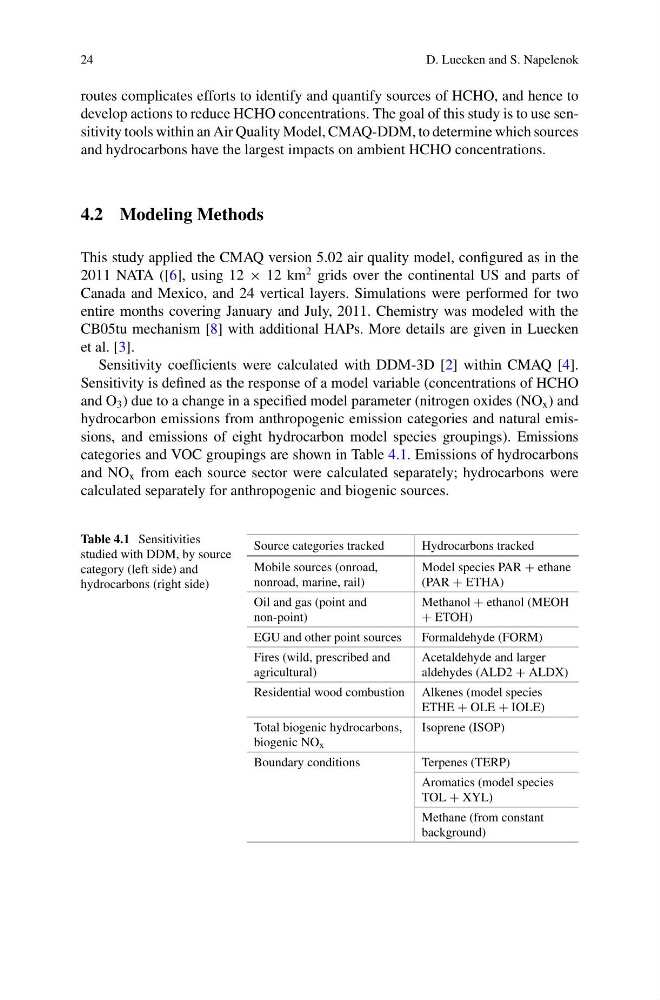
categories and VOC groupings are shown in Table 4.1. Emissions of hydrocarbons
and NO x from each source sector were calculated separately; hydrocarbons were
calculated separately for anthropogenic and biogenic sources.
Table 4.1 Sensitivities
studied with DDM, by source
category (left side) and
hydrocarbons (right side)
Source categories tracked
Hydrocarbons tracked
Mobile sources (onroad,
nonroad, marine, rail)
Model species PAR + ethane
(PAR + ETHA)
Oil and gas (point and
non-point)
Methanol + ethanol (MEOH
+ ETOH)
EGU and other point sources
Formaldehyde (FORM)
Fires (wild, prescribed and
agricultural)
Acetaldehyde and larger
aldehydes (ALD2 + ALDX)
Residential wood combustion Alkenes (model species
ETHE + OLE + IOLE)
Total biogenic hydrocarbons,
biogenic NO x
Isoprene (ISOP)
Boundary conditions
Terpenes (TERP)
Aromatics (model species
TOL + XYL)
Methane (from constant
background)
D. Luecken and S. Napelenok
routes complicates efforts to identify and quantify sources of HCHO, and hence to
develop actions to reduce HCHO concentrations. The goal of this study is to use sensitivity tools within an Air Quality Model, CMAQ-DDM, to determine which sources
and hydrocarbons have the largest impacts on ambient HCHO concentrations.
4.2 Modeling Methods
This study applied the CMAQ version 5.02 air quality model, configured as in the
2011 NATA ([6], using 12 × 12 km
2 grids over the continental US and parts of
Canada and Mexico, and 24 vertical layers. Simulations were performed for two
entire months covering January and July, 2011. Chemistry was modeled with the
CB05tu mechanism [8] with additional HAPs. More details are given in Luecken
et al. [3].
Sensitivity coefficients were calculated with DDM-3D [2] within CMAQ [4].
Sensitivity is defined as the response of a model variable (concentrations of HCHO
and O 3 ) due to a change in a specified model parameter (nitrogen oxides (NO x ) and
hydrocarbon emissions from anthropogenic emission categories and natural emissions, and emissions of eight hydrocarbon model species groupings). Emissions
categories and VOC groupings are shown in Table 4.1. Emissions of hydrocarbons
and NO x from each source sector were calculated separately; hydrocarbons were
calculated separately for anthropogenic and biogenic sources.
Table 4.1 Sensitivities
studied with DDM, by source
category (left side) and
hydrocarbons (right side)
Source categories tracked
Hydrocarbons tracked
Mobile sources (onroad,
nonroad, marine, rail)
Model species PAR + ethane
(PAR + ETHA)
Oil and gas (point and
non-point)
Methanol + ethanol (MEOH
+ ETOH)
EGU and other point sources
Formaldehyde (FORM)
Fires (wild, prescribed and
agricultural)
Acetaldehyde and larger
aldehydes (ALD2 + ALDX)
Residential wood combustion Alkenes (model species
ETHE + OLE + IOLE)
Total biogenic hydrocarbons,
biogenic NO x
Isoprene (ISOP)
Boundary conditions
Terpenes (TERP)
Aromatics (model species
TOL + XYL)
Methane (from constant
background)