

452
J. Liu et al.
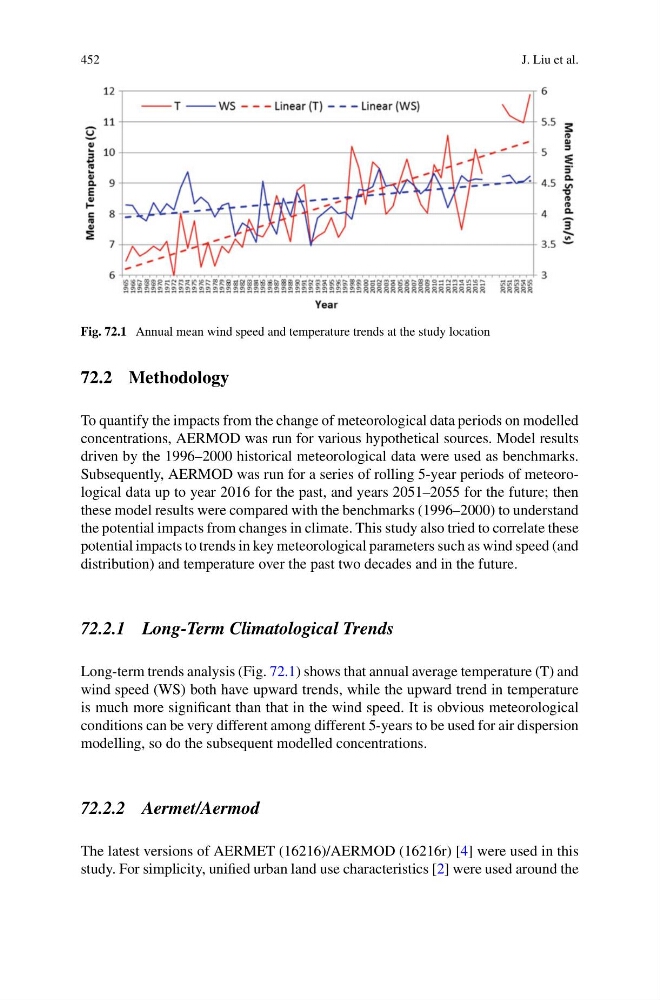
Fig. 72.1 Annual mean wind speed and temperature trends at the study location
72.2 Methodology
To quantify the impacts from the change of meteorological data periods on modelled
concentrations, AERMOD was run for various hypothetical sources. Model results
driven by the 1996–2000 historical meteorological data were used as benchmarks.
Subsequently, AERMOD was run for a series of rolling 5-year periods of meteorological data up to year 2016 for the past, and years 2051–2055 for the future; then
these model results were compared with the benchmarks (1996–2000) to understand
the potential impacts from changes in climate. This study also tried to correlate these
potential impacts to trends in key meteorological parameters such as wind speed (and
distribution) and temperature over the past two decades and in the future.
72.2.1 Long-Term Climatological Trends
Long-term trends analysis (Fig. 72.1) shows that annual average temperature (T) and
wind speed (WS) both have upward trends, while the upward trend in temperature
is much more significant than that in the wind speed. It is obvious meteorological
conditions can be very different among different 5-years to be used for air dispersion
modelling, so do the subsequent modelled concentrations.
72.2.2 Aermet/Aermod
The latest versions of AERMET (16216)/AERMOD (16216r) [4] were used in this
study. For simplicity, unified urban land use characteristics [2] were used around the
J. Liu et al.
Fig. 72.1 Annual mean wind speed and temperature trends at the study location
72.2 Methodology
To quantify the impacts from the change of meteorological data periods on modelled
concentrations, AERMOD was run for various hypothetical sources. Model results
driven by the 1996–2000 historical meteorological data were used as benchmarks.
Subsequently, AERMOD was run for a series of rolling 5-year periods of meteorological data up to year 2016 for the past, and years 2051–2055 for the future; then
these model results were compared with the benchmarks (1996–2000) to understand
the potential impacts from changes in climate. This study also tried to correlate these
potential impacts to trends in key meteorological parameters such as wind speed (and
distribution) and temperature over the past two decades and in the future.
72.2.1 Long-Term Climatological Trends
Long-term trends analysis (Fig. 72.1) shows that annual average temperature (T) and
wind speed (WS) both have upward trends, while the upward trend in temperature
is much more significant than that in the wind speed. It is obvious meteorological
conditions can be very different among different 5-years to be used for air dispersion
modelling, so do the subsequent modelled concentrations.
72.2.2 Aermet/Aermod
The latest versions of AERMET (16216)/AERMOD (16216r) [4] were used in this
study. For simplicity, unified urban land use characteristics [2] were used around the