

62 Sea Spray Effects on Marine and Coastal Boundary Layer
391
62.3 Case Study
In order to examine the aforementioned approaches, a sensitivity experiment in North
Sea is considered. The case refers to 4–8 December, 2013. During this period, a winter
storm took place in the area under study, accompanied with strong winds that favor
wave breaking. The storm started from south Greenland on the 4th of December and
moving east, entered North Sea. Two types of simulations have been performed. One
with the impact of sea spray thermodynamics and a second one without. Model setup
and initial conditions are the same for both cases.
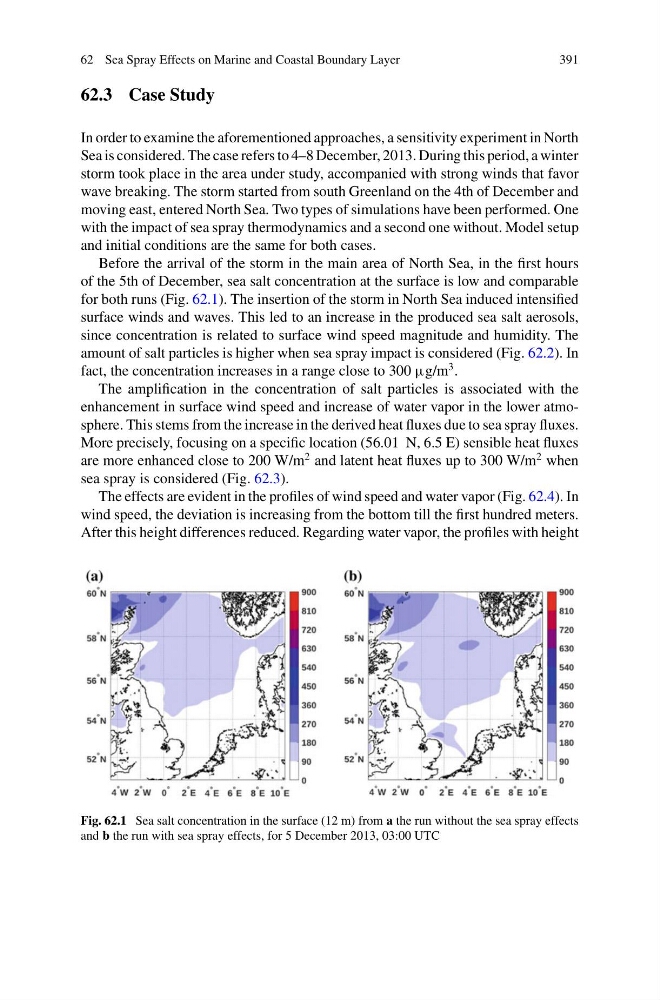
Before the arrival of the storm in the main area of North Sea, in the first hours
of the 5th of December, sea salt concentration at the surface is low and comparable
for both runs (Fig. 62.1). The insertion of the storm in North Sea induced intensified
surface winds and waves. This led to an increase in the produced sea salt aerosols,
since concentration is related to surface wind speed magnitude and humidity. The
amount of salt particles is higher when sea spray impact is considered (Fig. 62.2). In
fact, the concentration increases in a range close to 300 µg/m
3 .
The amplification in the concentration of salt particles is associated with the
enhancement in surface wind speed and increase of water vapor in the lower atmosphere. This stems from the increase in the derived heat fluxes due to sea spray fluxes.
More precisely, focusing on a specific location (56.01 N, 6.5 E) sensible heat fluxes
are more enhanced close to 200 W/m
2 and latent heat fluxes up to 300 W/m
2 when
sea spray is considered (Fig. 62.3).
The effects are evident in the profiles of wind speed and water vapor (Fig. 62.4). In
wind speed, the deviation is increasing from the bottom till the first hundred meters.
After this height differences reduced. Regarding water vapor, the profiles with height
Fig. 62.1 Sea salt concentration in the surface (12 m) from a the run without the sea spray effects
and b the run with sea spray effects, for 5 December 2013, 03:00 UTC
391
62.3 Case Study
In order to examine the aforementioned approaches, a sensitivity experiment in North
Sea is considered. The case refers to 4–8 December, 2013. During this period, a winter
storm took place in the area under study, accompanied with strong winds that favor
wave breaking. The storm started from south Greenland on the 4th of December and
moving east, entered North Sea. Two types of simulations have been performed. One
with the impact of sea spray thermodynamics and a second one without. Model setup
and initial conditions are the same for both cases.
Before the arrival of the storm in the main area of North Sea, in the first hours
of the 5th of December, sea salt concentration at the surface is low and comparable
for both runs (Fig. 62.1). The insertion of the storm in North Sea induced intensified
surface winds and waves. This led to an increase in the produced sea salt aerosols,
since concentration is related to surface wind speed magnitude and humidity. The
amount of salt particles is higher when sea spray impact is considered (Fig. 62.2). In
fact, the concentration increases in a range close to 300 µg/m
3 .
The amplification in the concentration of salt particles is associated with the
enhancement in surface wind speed and increase of water vapor in the lower atmosphere. This stems from the increase in the derived heat fluxes due to sea spray fluxes.
More precisely, focusing on a specific location (56.01 N, 6.5 E) sensible heat fluxes
are more enhanced close to 200 W/m
2 and latent heat fluxes up to 300 W/m
2 when
sea spray is considered (Fig. 62.3).
The effects are evident in the profiles of wind speed and water vapor (Fig. 62.4). In
wind speed, the deviation is increasing from the bottom till the first hundred meters.
After this height differences reduced. Regarding water vapor, the profiles with height
Fig. 62.1 Sea salt concentration in the surface (12 m) from a the run without the sea spray effects
and b the run with sea spray effects, for 5 December 2013, 03:00 UTC