

318
R. Hänninen et al.
Compared with the previous version of the stratospheric module in SILAM [7] we
have now included the effect of inorganic bromine species. Additionally, the model
now includes the effect of CFC-11, CFC-12, CCl 4 , together with methyl chloride and
bromide, plus CH 3 CCl 3 . The simulation results will later be compared with satellite
measurements of ozone, NO 2 , NO 3 , and PM profiles by the GOMOS satellite, and
total ozone column by OMI and TOMS satellite observations.
50.2 Model
Our simulations are based on the SILAM model [7], where the updated stratospheric
module has been further expanded and now includes reactions for both the chlorine
and bromine species. The gas-phase and photolysis reactions are essentially same
than what are present, e.g., in the FinROSE model [4], except with the inclusion of
the 5 organic chlorine species and methyl bromide.
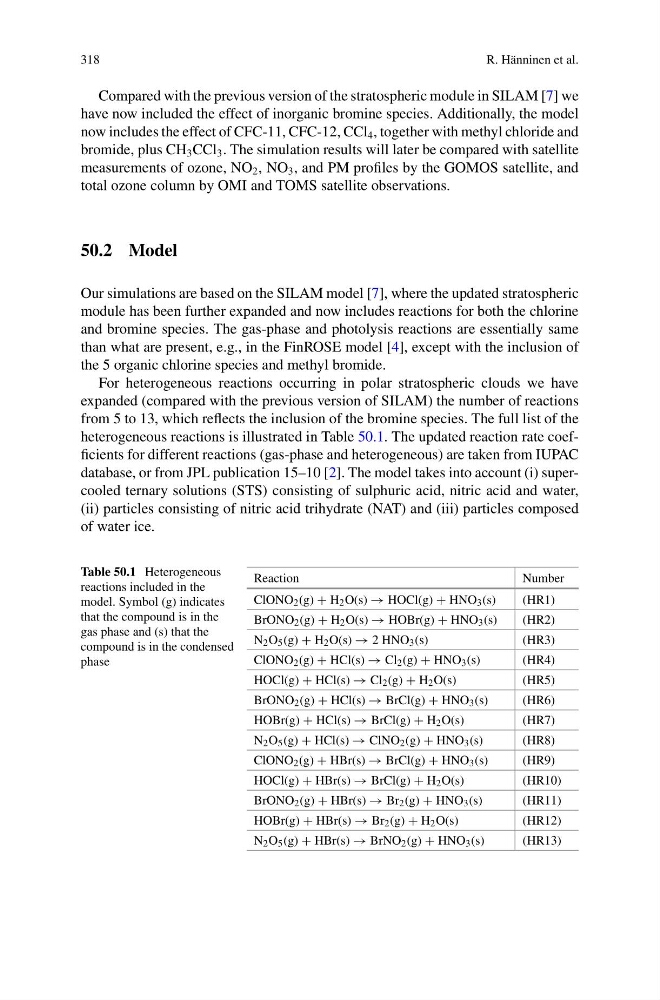
For heterogeneous reactions occurring in polar stratospheric clouds we have
expanded (compared with the previous version of SILAM) the number of reactions
from 5 to 13, which reflects the inclusion of the bromine species. The full list of the
heterogeneous reactions is illustrated in Table 50.1. The updated reaction rate coefficients for different reactions (gas-phase and heterogeneous) are taken from IUPAC
database, or from JPL publication 15–10 [2]. The model takes into account (i) supercooled ternary solutions (STS) consisting of sulphuric acid, nitric acid and water,
(ii) particles consisting of nitric acid trihydrate (NAT) and (iii) particles composed
of water ice.
Table 50.1 Heterogeneous
reactions included in the
model. Symbol (g) indicates
that the compound is in the
gas phase and (s) that the
compound is in the condensed
phase
Reaction
Number
ClONO 2 (g) + H 2 O(s) → HOCl(g) + HNO 3 (s)
(HR1)
BrONO 2 (g) + H 2 O(s) → HOBr(g) + HNO 3 (s)
(HR2)
N 2 O 5 (g) + H 2 O(s) → 2 HNO 3 (s)
(HR3)
ClONO 2 (g) + HCl(s) → Cl 2 (g) + HNO 3 (s)
(HR4)
HOCl(g) + HCl(s) → Cl 2 (g) + H 2 O(s)
(HR5)
BrONO 2 (g) + HCl(s) → BrCl(g) + HNO 3 (s)
(HR6)
HOBr(g) + HCl(s) → BrCl(g) + H 2 O(s)
(HR7)
N 2 O 5 (g) + HCl(s) → ClNO 2 (g) + HNO 3 (s)
(HR8)
ClONO 2 (g) + HBr(s) → BrCl(g) + HNO 3 (s)
(HR9)
HOCl(g) + HBr(s) → BrCl(g) + H 2 O(s)
(HR10)
BrONO 2 (g) + HBr(s) → Br 2 (g) + HNO 3 (s)
(HR11)
HOBr(g) + HBr(s) → Br 2 (g) + H 2 O(s)
(HR12)
N 2 O 5 (g) + HBr(s) → BrNO 2 (g) + HNO 3 (s)
(HR13)
R. Hänninen et al.
Compared with the previous version of the stratospheric module in SILAM [7] we
have now included the effect of inorganic bromine species. Additionally, the model
now includes the effect of CFC-11, CFC-12, CCl 4 , together with methyl chloride and
bromide, plus CH 3 CCl 3 . The simulation results will later be compared with satellite
measurements of ozone, NO 2 , NO 3 , and PM profiles by the GOMOS satellite, and
total ozone column by OMI and TOMS satellite observations.
50.2 Model
Our simulations are based on the SILAM model [7], where the updated stratospheric
module has been further expanded and now includes reactions for both the chlorine
and bromine species. The gas-phase and photolysis reactions are essentially same
than what are present, e.g., in the FinROSE model [4], except with the inclusion of
the 5 organic chlorine species and methyl bromide.
For heterogeneous reactions occurring in polar stratospheric clouds we have
expanded (compared with the previous version of SILAM) the number of reactions
from 5 to 13, which reflects the inclusion of the bromine species. The full list of the
heterogeneous reactions is illustrated in Table 50.1. The updated reaction rate coefficients for different reactions (gas-phase and heterogeneous) are taken from IUPAC
database, or from JPL publication 15–10 [2]. The model takes into account (i) supercooled ternary solutions (STS) consisting of sulphuric acid, nitric acid and water,
(ii) particles consisting of nitric acid trihydrate (NAT) and (iii) particles composed
of water ice.
Table 50.1 Heterogeneous
reactions included in the
model. Symbol (g) indicates
that the compound is in the
gas phase and (s) that the
compound is in the condensed
phase
Reaction
Number
ClONO 2 (g) + H 2 O(s) → HOCl(g) + HNO 3 (s)
(HR1)
BrONO 2 (g) + H 2 O(s) → HOBr(g) + HNO 3 (s)
(HR2)
N 2 O 5 (g) + H 2 O(s) → 2 HNO 3 (s)
(HR3)
ClONO 2 (g) + HCl(s) → Cl 2 (g) + HNO 3 (s)
(HR4)
HOCl(g) + HCl(s) → Cl 2 (g) + H 2 O(s)
(HR5)
BrONO 2 (g) + HCl(s) → BrCl(g) + HNO 3 (s)
(HR6)
HOBr(g) + HCl(s) → BrCl(g) + H 2 O(s)
(HR7)
N 2 O 5 (g) + HCl(s) → ClNO 2 (g) + HNO 3 (s)
(HR8)
ClONO 2 (g) + HBr(s) → BrCl(g) + HNO 3 (s)
(HR9)
HOCl(g) + HBr(s) → BrCl(g) + H 2 O(s)
(HR10)
BrONO 2 (g) + HBr(s) → Br 2 (g) + HNO 3 (s)
(HR11)
HOBr(g) + HBr(s) → Br 2 (g) + H 2 O(s)
(HR12)
N 2 O 5 (g) + HBr(s) → BrNO 2 (g) + HNO 3 (s)
(HR13)