

168
S. Banzhaf et al.
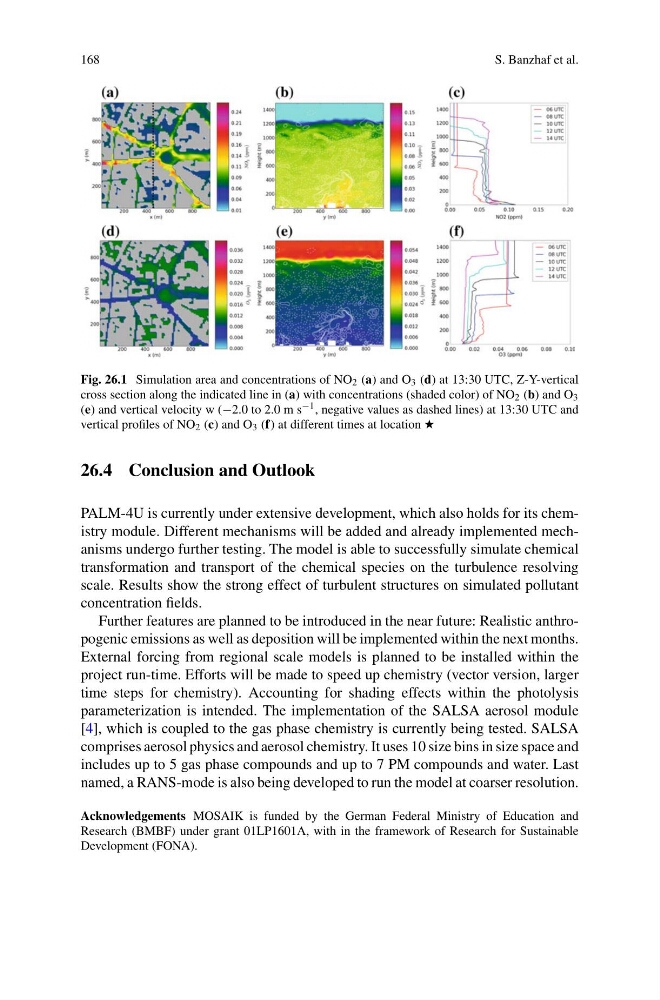
Fig. 26.1 Simulation area and concentrations of NO 2 (a) and O 3 (d) at 13:30 UTC, Z-Y-vertical
cross section along the indicated line in (a) with concentrations (shaded color) of NO 2 (b) and O 3
(e) and vertical velocity w (−2.0 to 2.0 m s −1 , negative values as dashed lines) at 13:30 UTC and
vertical profiles of NO 2 (c) and O 3 (f) at different times at location ★
26.4 Conclusion and Outlook
PALM-4U is currently under extensive development, which also holds for its chemistry module. Different mechanisms will be added and already implemented mechanisms undergo further testing. The model is able to successfully simulate chemical
transformation and transport of the chemical species on the turbulence resolving
scale. Results show the strong effect of turbulent structures on simulated pollutant
concentration fields.
Further features are planned to be introduced in the near future: Realistic anthropogenic emissions as well as deposition will be implemented within the next months.
External forcing from regional scale models is planned to be installed within the
project run-time. Efforts will be made to speed up chemistry (vector version, larger
time steps for chemistry). Accounting for shading effects within the photolysis
parameterization is intended. The implementation of the SALSA aerosol module
[4], which is coupled to the gas phase chemistry is currently being tested. SALSA
comprises aerosol physics and aerosol chemistry. It uses 10 size bins in size space and
includes up to 5 gas phase compounds and up to 7 PM compounds and water. Last
named, a RANS-mode is also being developed to run the model at coarser resolution.
Acknowledgements MOSAIK is funded by the German Federal Ministry of Education and
Research (BMBF) under grant 01LP1601A, with in the framework of Research for Sustainable
Development (FONA).
S. Banzhaf et al.
Fig. 26.1 Simulation area and concentrations of NO 2 (a) and O 3 (d) at 13:30 UTC, Z-Y-vertical
cross section along the indicated line in (a) with concentrations (shaded color) of NO 2 (b) and O 3
(e) and vertical velocity w (−2.0 to 2.0 m s −1 , negative values as dashed lines) at 13:30 UTC and
vertical profiles of NO 2 (c) and O 3 (f) at different times at location ★
26.4 Conclusion and Outlook
PALM-4U is currently under extensive development, which also holds for its chemistry module. Different mechanisms will be added and already implemented mechanisms undergo further testing. The model is able to successfully simulate chemical
transformation and transport of the chemical species on the turbulence resolving
scale. Results show the strong effect of turbulent structures on simulated pollutant
concentration fields.
Further features are planned to be introduced in the near future: Realistic anthropogenic emissions as well as deposition will be implemented within the next months.
External forcing from regional scale models is planned to be installed within the
project run-time. Efforts will be made to speed up chemistry (vector version, larger
time steps for chemistry). Accounting for shading effects within the photolysis
parameterization is intended. The implementation of the SALSA aerosol module
[4], which is coupled to the gas phase chemistry is currently being tested. SALSA
comprises aerosol physics and aerosol chemistry. It uses 10 size bins in size space and
includes up to 5 gas phase compounds and up to 7 PM compounds and water. Last
named, a RANS-mode is also being developed to run the model at coarser resolution.
Acknowledgements MOSAIK is funded by the German Federal Ministry of Education and
Research (BMBF) under grant 01LP1601A, with in the framework of Research for Sustainable
Development (FONA).