

21 Atmospheric Pollution: Experience from Mexico City …
129
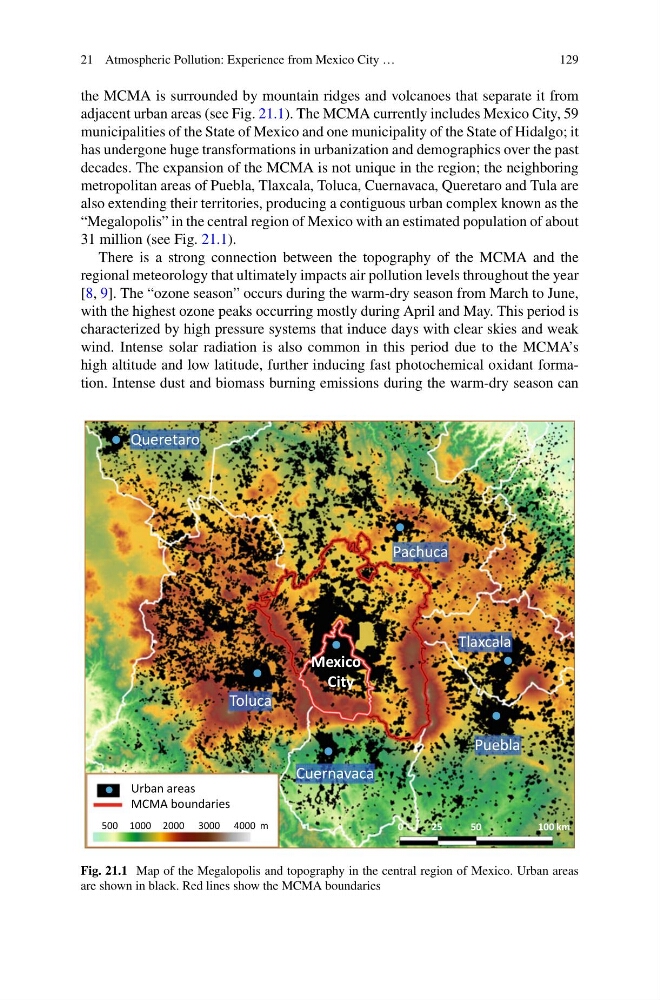
the MCMA is surrounded by mountain ridges and volcanoes that separate it from
adjacent urban areas (see Fig. 21.1). The MCMA currently includes Mexico City, 59
municipalities of the State of Mexico and one municipality of the State of Hidalgo; it
has undergone huge transformations in urbanization and demographics over the past
decades. The expansion of the MCMA is not unique in the region; the neighboring
metropolitan areas of Puebla, Tlaxcala, Toluca, Cuernavaca, Queretaro and Tula are
also extending their territories, producing a contiguous urban complex known as the
“Megalopolis” in the central region of Mexico with an estimated population of about
31 million (see Fig. 21.1).
There is a strong connection between the topography of the MCMA and the
regional meteorology that ultimately impacts air pollution levels throughout the year
[8, 9]. The “ozone season” occurs during the warm-dry season from March to June,
with the highest ozone peaks occurring mostly during April and May. This period is
characterized by high pressure systems that induce days with clear skies and weak
wind. Intense solar radiation is also common in this period due to the MCMA’s
high altitude and low latitude, further inducing fast photochemical oxidant formation. Intense dust and biomass burning emissions during the warm-dry season can
Toluca
Cuernavaca
Mexico
City
Pachuca
Puebla
Tlaxcala
Queretaro
500 1000 2000 3000 4000 m
0
25
50
100 km
Urban areas
MCMA boundaries
Fig. 21.1 Map of the Megalopolis and topography in the central region of Mexico. Urban areas
are shown in black. Red lines show the MCMA boundaries
129
the MCMA is surrounded by mountain ridges and volcanoes that separate it from
adjacent urban areas (see Fig. 21.1). The MCMA currently includes Mexico City, 59
municipalities of the State of Mexico and one municipality of the State of Hidalgo; it
has undergone huge transformations in urbanization and demographics over the past
decades. The expansion of the MCMA is not unique in the region; the neighboring
metropolitan areas of Puebla, Tlaxcala, Toluca, Cuernavaca, Queretaro and Tula are
also extending their territories, producing a contiguous urban complex known as the
“Megalopolis” in the central region of Mexico with an estimated population of about
31 million (see Fig. 21.1).
There is a strong connection between the topography of the MCMA and the
regional meteorology that ultimately impacts air pollution levels throughout the year
[8, 9]. The “ozone season” occurs during the warm-dry season from March to June,
with the highest ozone peaks occurring mostly during April and May. This period is
characterized by high pressure systems that induce days with clear skies and weak
wind. Intense solar radiation is also common in this period due to the MCMA’s
high altitude and low latitude, further inducing fast photochemical oxidant formation. Intense dust and biomass burning emissions during the warm-dry season can
Toluca
Cuernavaca
Mexico
City
Pachuca
Puebla
Tlaxcala
Queretaro
500 1000 2000 3000 4000 m
0
25
50
100 km
Urban areas
MCMA boundaries
Fig. 21.1 Map of the Megalopolis and topography in the central region of Mexico. Urban areas
are shown in black. Red lines show the MCMA boundaries