

46 – Reflection: asking questions and proposing answers
this without also taking into account causes of the end of the Cold
War which are not related to those policies (B). Had the wording of
the topic been more open, say, ‘What brought about the end of the
Cold War?’, we could have treated all sorts of questions raised by
B, if only to reject them. But since our topic is not quite so open,
while we need to treat B, we will do so only insofar as this treatment
is relevant to answering the question set.
A first attempt at an answer to our question might read something like this, in which the first three propositions are taken up in a
sentence each (and in which my own initial prejudices or prejudgements are beginning to become apparent):
President Ronald Reagan’s ‘hawkish’ policies certainly played some part
in ending the Cold War and bringing down the Berlin Wall. However,
some of these hawkish policies were quite counter-productive and might
be said to have actually prolonged the process. Moreover, there were
many other factors which contributed to the collapse of the Soviet Union,
factors which turn out to be much more important than President
Reagan’s hawkish policies.
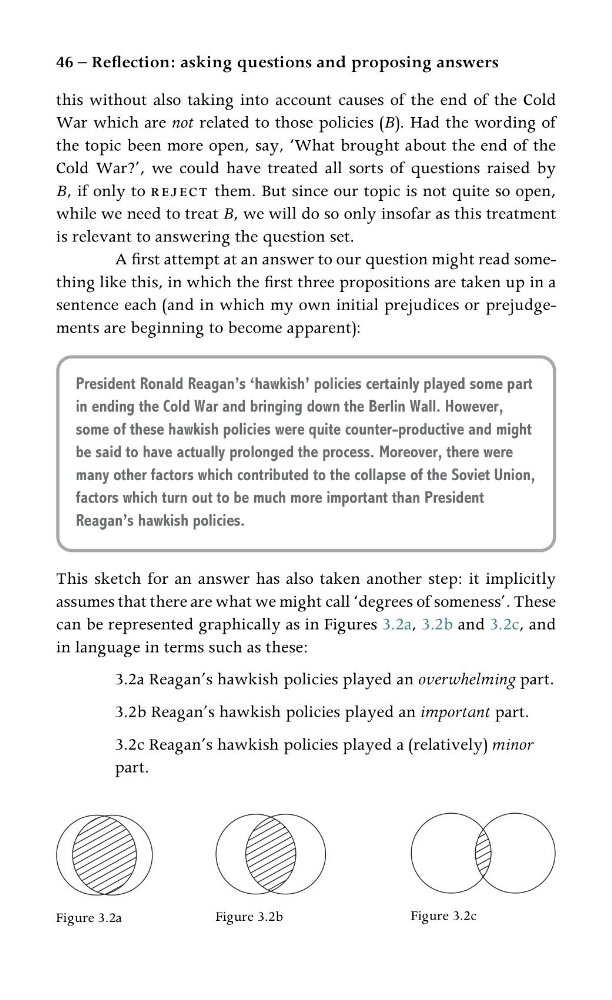
This sketch for an answer has also taken another step: it implicitly
assumes that there are what we might call ‘degrees of someness’. These
can be represented graphically as in Figures 3.2a, 3.2b and 3.2c, and
in language in terms such as these:
3.2a Reagan’s hawkish policies played an overwhelming part.
3.2b Reagan’s hawkish policies played an important part.
3.2c Reagan’s hawkish policies played a (relatively) minor
part.
Figure 3.2a
Figure 3.2b
Figure 3.2c
this without also taking into account causes of the end of the Cold
War which are not related to those policies (B). Had the wording of
the topic been more open, say, ‘What brought about the end of the
Cold War?’, we could have treated all sorts of questions raised by
B, if only to reject them. But since our topic is not quite so open,
while we need to treat B, we will do so only insofar as this treatment
is relevant to answering the question set.
A first attempt at an answer to our question might read something like this, in which the first three propositions are taken up in a
sentence each (and in which my own initial prejudices or prejudgements are beginning to become apparent):
President Ronald Reagan’s ‘hawkish’ policies certainly played some part
in ending the Cold War and bringing down the Berlin Wall. However,
some of these hawkish policies were quite counter-productive and might
be said to have actually prolonged the process. Moreover, there were
many other factors which contributed to the collapse of the Soviet Union,
factors which turn out to be much more important than President
Reagan’s hawkish policies.
This sketch for an answer has also taken another step: it implicitly
assumes that there are what we might call ‘degrees of someness’. These
can be represented graphically as in Figures 3.2a, 3.2b and 3.2c, and
in language in terms such as these:
3.2a Reagan’s hawkish policies played an overwhelming part.
3.2b Reagan’s hawkish policies played an important part.
3.2c Reagan’s hawkish policies played a (relatively) minor
part.
Figure 3.2a
Figure 3.2b
Figure 3.2c