

222 – Cohesion and texture
‘Learning is a major theme in the play; we learn that Miranda
is capable of it and Caliban not, and why this should be so;
but [in Prospero] we are also given a plan of the place of
learning in the dispositions of providence.’ (Frank
Kermode)
Discuss learning and knowledge as it is portrayed in The
Tempest.
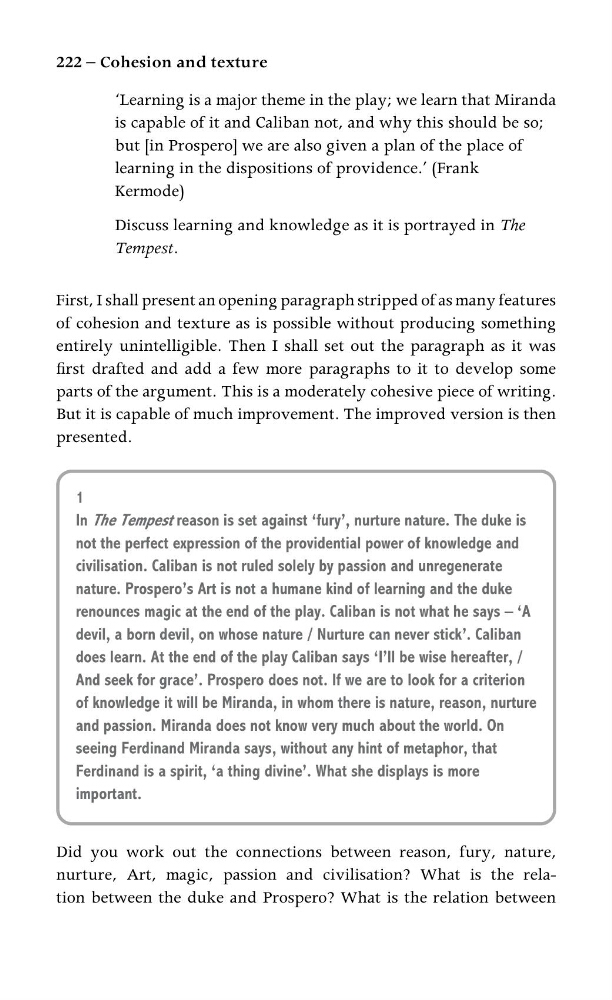
First, I shall present an opening paragraph stripped of as many features
of cohesion and texture as is possible without producing something
entirely unintelligible. Then I shall set out the paragraph as it was
first drafted and add a few more paragraphs to it to develop some
parts of the argument. This is a moderately cohesive piece of writing.
But it is capable of much improvement. The improved version is then
presented.
1
In The Tempest reason is set against ‘fury’, nurture nature. The duke is
not the perfect expression of the providential power of knowledge and
civilisation. Caliban is not ruled solely by passion and unregenerate
nature. Prospero’s Art is not a humane kind of learning and the duke
renounces magic at the end of the play. Caliban is not what he says – ‘A
devil, a born devil, on whose nature / Nurture can never stick’. Caliban
does learn. At the end of the play Caliban says ‘I’ll be wise hereafter, /
And seek for grace’. Prospero does not. If we are to look for a criterion
of knowledge it will be Miranda, in whom there is nature, reason, nurture
and passion. Miranda does not know very much about the world. On
seeing Ferdinand Miranda says, without any hint of metaphor, that
Ferdinand is a spirit, ‘a thing divine’. What she displays is more
important.
Did you work out the connections between reason, fury, nature,
nurture, Art, magic, passion and civilisation? What is the relation between the duke and Prospero? What is the relation between
‘Learning is a major theme in the play; we learn that Miranda
is capable of it and Caliban not, and why this should be so;
but [in Prospero] we are also given a plan of the place of
learning in the dispositions of providence.’ (Frank
Kermode)
Discuss learning and knowledge as it is portrayed in The
Tempest.
First, I shall present an opening paragraph stripped of as many features
of cohesion and texture as is possible without producing something
entirely unintelligible. Then I shall set out the paragraph as it was
first drafted and add a few more paragraphs to it to develop some
parts of the argument. This is a moderately cohesive piece of writing.
But it is capable of much improvement. The improved version is then
presented.
1
In The Tempest reason is set against ‘fury’, nurture nature. The duke is
not the perfect expression of the providential power of knowledge and
civilisation. Caliban is not ruled solely by passion and unregenerate
nature. Prospero’s Art is not a humane kind of learning and the duke
renounces magic at the end of the play. Caliban is not what he says – ‘A
devil, a born devil, on whose nature / Nurture can never stick’. Caliban
does learn. At the end of the play Caliban says ‘I’ll be wise hereafter, /
And seek for grace’. Prospero does not. If we are to look for a criterion
of knowledge it will be Miranda, in whom there is nature, reason, nurture
and passion. Miranda does not know very much about the world. On
seeing Ferdinand Miranda says, without any hint of metaphor, that
Ferdinand is a spirit, ‘a thing divine’. What she displays is more
important.
Did you work out the connections between reason, fury, nature,
nurture, Art, magic, passion and civilisation? What is the relation between the duke and Prospero? What is the relation between