

Determinants of cohesion and texture – 219
Coordination is typically performed by coordinate conjunctions, (by)
certain adverbials and (by) other devices.
But academic prose is in part characterised by the complexity of the
elements to be coordinated – in sentences, in paragraphs and over a
whole essay. It therefore becomes extremely important to develop a
consistency of structure and to draw attention to that consistency by
preserving the structural parallels and repeating the motifs that make
them apparent. The architecture of prose is in this respect similar to
that of a building or a piece of music.
In order to give you some idea of what can happen when
structural coordination is neglected, I shall re-write the three sentences immediately above in an uncoordinated way. Un-parallel forms
are italicised and omissions indicated with a caret:
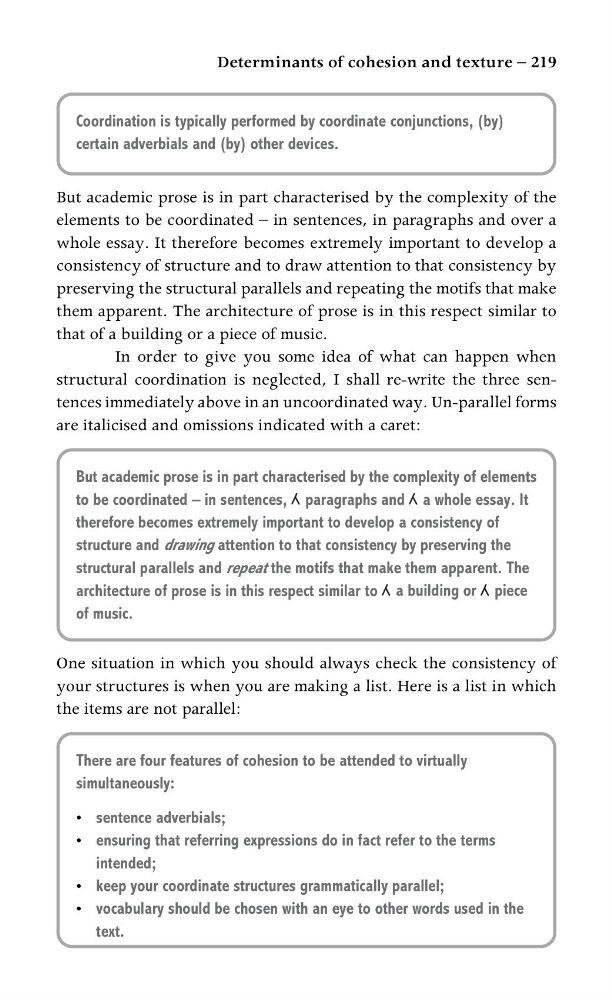
But academic prose is in part characterised by the complexity of elements
to be coordinated – in sentences, paragraphs and a whole essay. It
therefore becomes extremely important to develop a consistency of
structure and drawing attention to that consistency by preserving the
structural parallels and repeat the motifs that make them apparent. The
architecture of prose is in this respect similar to a building or piece
of music.
One situation in which you should always check the consistency of
your structures is when you are making a list. Here is a list in which
the items are not parallel:
There are four features of cohesion to be attended to virtually
simultaneously:
r sentence adverbials;
r ensuring that referring expressions do in fact refer to the terms
intended;
r keep your coordinate structures grammatically parallel;
r vocabulary should be chosen with an eye to other words used in the
text.
Coordination is typically performed by coordinate conjunctions, (by)
certain adverbials and (by) other devices.
But academic prose is in part characterised by the complexity of the
elements to be coordinated – in sentences, in paragraphs and over a
whole essay. It therefore becomes extremely important to develop a
consistency of structure and to draw attention to that consistency by
preserving the structural parallels and repeating the motifs that make
them apparent. The architecture of prose is in this respect similar to
that of a building or a piece of music.
In order to give you some idea of what can happen when
structural coordination is neglected, I shall re-write the three sentences immediately above in an uncoordinated way. Un-parallel forms
are italicised and omissions indicated with a caret:
But academic prose is in part characterised by the complexity of elements
to be coordinated – in sentences, paragraphs and a whole essay. It
therefore becomes extremely important to develop a consistency of
structure and drawing attention to that consistency by preserving the
structural parallels and repeat the motifs that make them apparent. The
architecture of prose is in this respect similar to a building or piece
of music.
One situation in which you should always check the consistency of
your structures is when you are making a list. Here is a list in which
the items are not parallel:
There are four features of cohesion to be attended to virtually
simultaneously:
r sentence adverbials;
r ensuring that referring expressions do in fact refer to the terms
intended;
r keep your coordinate structures grammatically parallel;
r vocabulary should be chosen with an eye to other words used in the
text.