

78
8 Linear Elastic Systems
8.2 Linear System
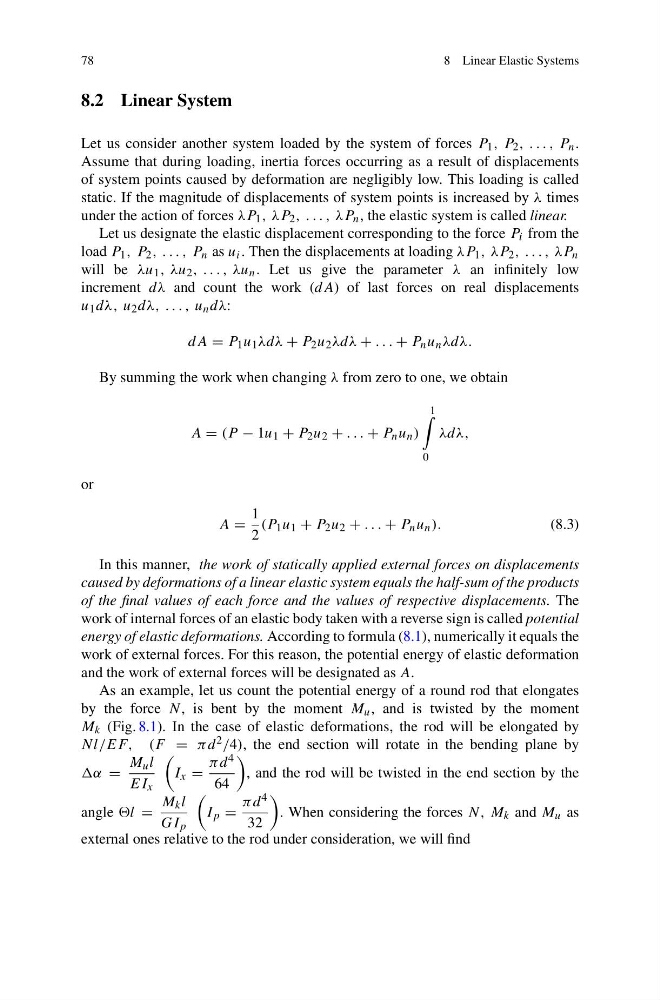
Let us consider another system loaded by the system of forces P 1 , P 2 , . . . , P n .
Assume that during loading, inertia forces occurring as a result of displacements
of system points caused by deformation are negligibly low. This loading is called
static. If the magnitude of displacements of system points is increased by λ times
under the action of forces λP 1 , λP 2 , . . . , λP n , the elastic system is called linear.
Let us designate the elastic displacement corresponding to the force P i from the
load P 1 , P 2 , . . . , P n as u i . Then the displacements at loading λP 1 , λP 2 , . . . , λP n
will be λu 1 , λu 2 , . . . , λu n . Let us give the parameter λ an infinitely low
increment dλ and count the work (dA) of last forces on real displacements
u 1 dλ, u 2 dλ, . . . , u n dλ:
dA = P 1 u 1 λdλ + P 2 u 2 λdλ + . . . + P n u n λdλ.
By summing the work when changing λ from zero to one, we obtain
A = (P − 1u 1 + P 2 u 2 + . . . + P n u n )
1
0
λdλ,
or
A =
1
2
(P 1 u 1 + P 2 u 2 + . . . + P n u n ).
(8.3)
In this manner, the work of statically applied external forces on displacements
caused by deformations of a linear elastic system equals the half-sum of the products
of the final values of each force and the values of respective displacements. The
work of internal forces of an elastic body taken with a reverse sign is called potential
energy of elastic deformations. According to formula (8.1), numerically it equals the
work of external forces. For this reason, the potential energy of elastic deformation
and the work of external forces will be designated as A.
As an example, let us count the potential energy of a round rod that elongates
by the force N, is bent by the moment M u , and is twisted by the moment
M k (Fig. 8.1). In the case of elastic deformations, the rod will be elongated by
Nl/EF, (F = πd 2 /4), the end section will rotate in the bending plane by
α =
M u l
EI x
I x =
πd 4
64
, and the rod will be twisted in the end section by the
angle l =
M k l
GI p
I p =
πd 4
32
. When considering the forces N, M k and M u as
external ones relative to the rod under consideration, we will find
8 Linear Elastic Systems
8.2 Linear System
Let us consider another system loaded by the system of forces P 1 , P 2 , . . . , P n .
Assume that during loading, inertia forces occurring as a result of displacements
of system points caused by deformation are negligibly low. This loading is called
static. If the magnitude of displacements of system points is increased by λ times
under the action of forces λP 1 , λP 2 , . . . , λP n , the elastic system is called linear.
Let us designate the elastic displacement corresponding to the force P i from the
load P 1 , P 2 , . . . , P n as u i . Then the displacements at loading λP 1 , λP 2 , . . . , λP n
will be λu 1 , λu 2 , . . . , λu n . Let us give the parameter λ an infinitely low
increment dλ and count the work (dA) of last forces on real displacements
u 1 dλ, u 2 dλ, . . . , u n dλ:
dA = P 1 u 1 λdλ + P 2 u 2 λdλ + . . . + P n u n λdλ.
By summing the work when changing λ from zero to one, we obtain
A = (P − 1u 1 + P 2 u 2 + . . . + P n u n )
1
0
λdλ,
or
A =
1
2
(P 1 u 1 + P 2 u 2 + . . . + P n u n ).
(8.3)
In this manner, the work of statically applied external forces on displacements
caused by deformations of a linear elastic system equals the half-sum of the products
of the final values of each force and the values of respective displacements. The
work of internal forces of an elastic body taken with a reverse sign is called potential
energy of elastic deformations. According to formula (8.1), numerically it equals the
work of external forces. For this reason, the potential energy of elastic deformation
and the work of external forces will be designated as A.
As an example, let us count the potential energy of a round rod that elongates
by the force N, is bent by the moment M u , and is twisted by the moment
M k (Fig. 8.1). In the case of elastic deformations, the rod will be elongated by
Nl/EF, (F = πd 2 /4), the end section will rotate in the bending plane by
α =
M u l
EI x
I x =
πd 4
64
, and the rod will be twisted in the end section by the
angle l =
M k l
GI p
I p =
πd 4
32
. When considering the forces N, M k and M u as
external ones relative to the rod under consideration, we will find