

72
7 Stressed State in a Body Point
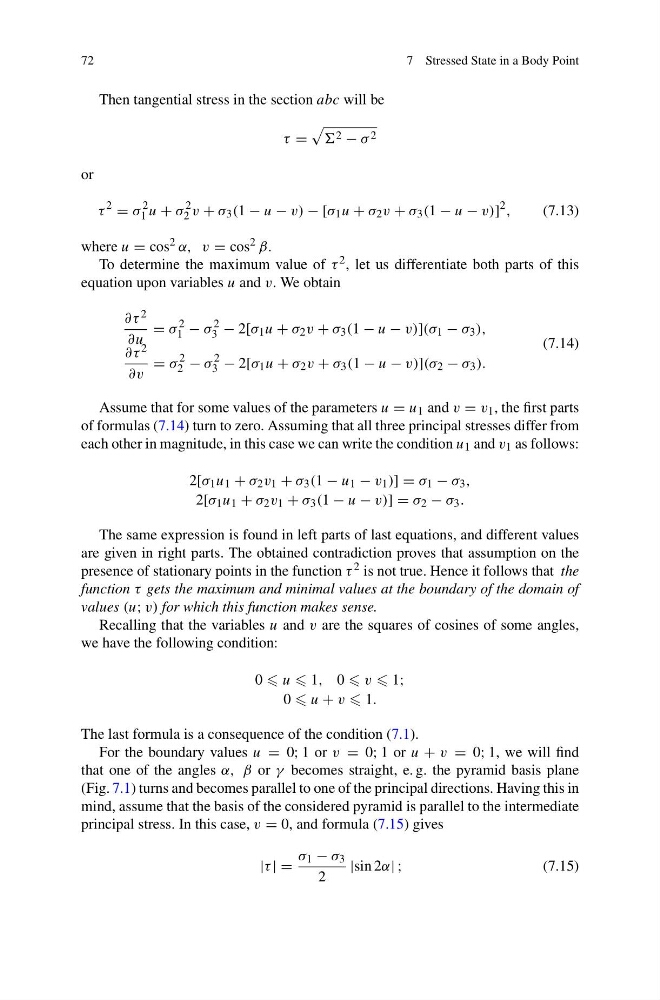
Then tangential stress in the section abc will be
τ =
2 − σ 2
or
τ
2
= σ
2
1 u + σ
2
2 v + σ 3 (1 − u − v) − [σ 1 u + σ 2 v + σ 3 (1 − u − v)]
2 ,
(7.13)
where u = cos 2 α, v = cos 2 β.
To determine the maximum value of τ 2 , let us differentiate both parts of this
equation upon variables u and v. We obtain
∂τ 2
∂u
= σ
2
1 − σ
2
3 − 2[σ 1 u + σ 2 v + σ 3 (1 − u − v)](σ 1 − σ 3 ),
∂τ 2
∂v
= σ
2
2 − σ
2
3 − 2[σ 1 u + σ 2 v + σ 3 (1 − u − v)](σ 2 − σ 3 ).
(7.14)
Assume that for some values of the parameters u = u 1 and v = v 1 , the first parts
of formulas (7.14) turn to zero. Assuming that all three principal stresses differ from
each other in magnitude, in this case we can write the condition u 1 and v 1 as follows:
2[σ 1 u 1 + σ 2 v 1 + σ 3 (1 − u 1 − v 1 )] = σ 1 − σ 3 ,
2[σ 1 u 1 + σ 2 v 1 + σ 3 (1 − u − v)] = σ 2 − σ 3 .
The same expression is found in left parts of last equations, and different values
are given in right parts. The obtained contradiction proves that assumption on the
presence of stationary points in the function τ 2 is not true. Hence it follows that the
function τ gets the maximum and minimal values at the boundary of the domain of
values (u; v) for which this function makes sense.
Recalling that the variables u and v are the squares of cosines of some angles,
we have the following condition:
0 u 1, 0 v 1;
0 u + v 1.
The last formula is a consequence of the condition (7.1).
For the boundary values u = 0; 1 or v = 0; 1 or u + v = 0; 1, we will find
that one of the angles α, β or γ becomes straight, e. g. the pyramid basis plane
(Fig. 7.1) turns and becomes parallel to one of the principal directions. Having this in
mind, assume that the basis of the considered pyramid is parallel to the intermediate
principal stress. In this case, v = 0, and formula (7.15) gives
|τ | =
σ 1 − σ 3
2
|sin 2α| ;
(7.15)
7 Stressed State in a Body Point
Then tangential stress in the section abc will be
τ =
2 − σ 2
or
τ
2
= σ
2
1 u + σ
2
2 v + σ 3 (1 − u − v) − [σ 1 u + σ 2 v + σ 3 (1 − u − v)]
2 ,
(7.13)
where u = cos 2 α, v = cos 2 β.
To determine the maximum value of τ 2 , let us differentiate both parts of this
equation upon variables u and v. We obtain
∂τ 2
∂u
= σ
2
1 − σ
2
3 − 2[σ 1 u + σ 2 v + σ 3 (1 − u − v)](σ 1 − σ 3 ),
∂τ 2
∂v
= σ
2
2 − σ
2
3 − 2[σ 1 u + σ 2 v + σ 3 (1 − u − v)](σ 2 − σ 3 ).
(7.14)
Assume that for some values of the parameters u = u 1 and v = v 1 , the first parts
of formulas (7.14) turn to zero. Assuming that all three principal stresses differ from
each other in magnitude, in this case we can write the condition u 1 and v 1 as follows:
2[σ 1 u 1 + σ 2 v 1 + σ 3 (1 − u 1 − v 1 )] = σ 1 − σ 3 ,
2[σ 1 u 1 + σ 2 v 1 + σ 3 (1 − u − v)] = σ 2 − σ 3 .
The same expression is found in left parts of last equations, and different values
are given in right parts. The obtained contradiction proves that assumption on the
presence of stationary points in the function τ 2 is not true. Hence it follows that the
function τ gets the maximum and minimal values at the boundary of the domain of
values (u; v) for which this function makes sense.
Recalling that the variables u and v are the squares of cosines of some angles,
we have the following condition:
0 u 1, 0 v 1;
0 u + v 1.
The last formula is a consequence of the condition (7.1).
For the boundary values u = 0; 1 or v = 0; 1 or u + v = 0; 1, we will find
that one of the angles α, β or γ becomes straight, e. g. the pyramid basis plane
(Fig. 7.1) turns and becomes parallel to one of the principal directions. Having this in
mind, assume that the basis of the considered pyramid is parallel to the intermediate
principal stress. In this case, v = 0, and formula (7.15) gives
|τ | =
σ 1 − σ 3
2
|sin 2α| ;
(7.15)