

6.7 Compression of Parallel Cylinders
67
M
N
=
2
η 2 ln 2η,
(6.46)
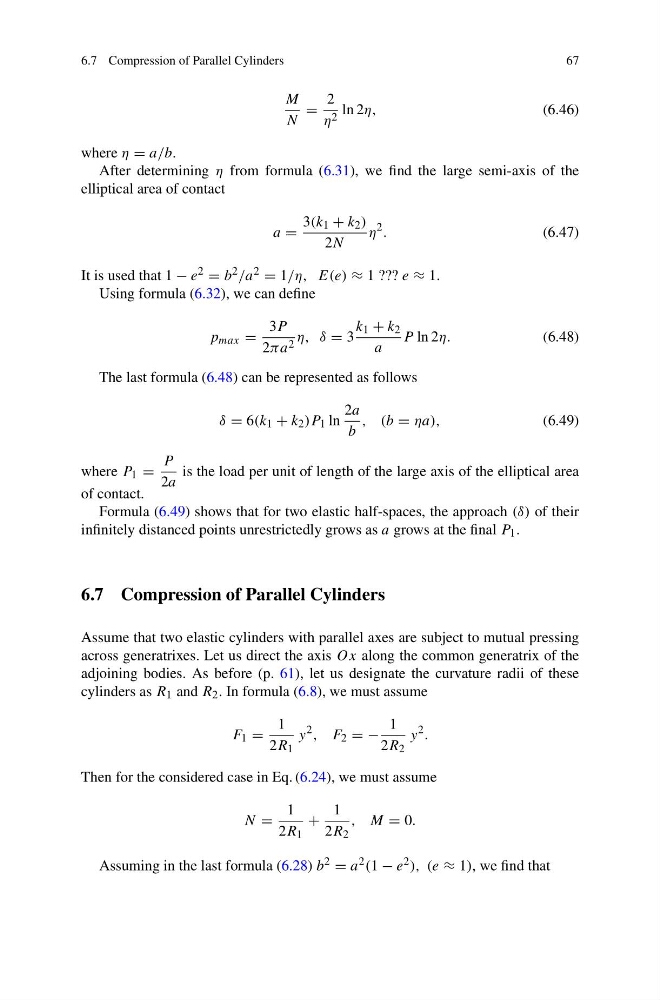
where η = a/b.
After determining η from formula (6.31), we find the large semi-axis of the
elliptical area of contact
a =
3(k 1 + k 2 )
2N
η
2 .
(6.47)
It is used that 1 − e 2 = b 2 /a 2 = 1/η, E(e) ≈ 1 ??? e ≈ 1.
Using formula (6.32), we can define
p max =
3P
2πa 2 η, δ = 3
k 1 + k 2
a
P ln 2η.
(6.48)
The last formula (6.48) can be represented as follows
δ = 6(k 1 + k 2 )P 1 ln
2a
b
, (b = ηa),
(6.49)
where P 1 =
P
2a
is the load per unit of length of the large axis of the elliptical area
of contact.
Formula (6.49) shows that for two elastic half-spaces, the approach (δ) of their
infinitely distanced points unrestrictedly grows as a grows at the final P 1 .
6.7 Compression of Parallel Cylinders
Assume that two elastic cylinders with parallel axes are subject to mutual pressing
across generatrixes. Let us direct the axis Ox along the common generatrix of the
adjoining bodies. As before (p. 61), let us designate the curvature radii of these
cylinders as R 1 and R 2 . In formula (6.8), we must assume
F 1 =
1
2R 1
y
2 , F 2 = −
1
2R 2
y
2 .
Then for the considered case in Eq. (6.24), we must assume
N =
1
2R 1
+
1
2R 2
, M = 0.
Assuming in the last formula (6.28) b 2 = a 2 (1 − e 2 ), (e ≈ 1), we find that
67
M
N
=
2
η 2 ln 2η,
(6.46)
where η = a/b.
After determining η from formula (6.31), we find the large semi-axis of the
elliptical area of contact
a =
3(k 1 + k 2 )
2N
η
2 .
(6.47)
It is used that 1 − e 2 = b 2 /a 2 = 1/η, E(e) ≈ 1 ??? e ≈ 1.
Using formula (6.32), we can define
p max =
3P
2πa 2 η, δ = 3
k 1 + k 2
a
P ln 2η.
(6.48)
The last formula (6.48) can be represented as follows
δ = 6(k 1 + k 2 )P 1 ln
2a
b
, (b = ηa),
(6.49)
where P 1 =
P
2a
is the load per unit of length of the large axis of the elliptical area
of contact.
Formula (6.49) shows that for two elastic half-spaces, the approach (δ) of their
infinitely distanced points unrestrictedly grows as a grows at the final P 1 .
6.7 Compression of Parallel Cylinders
Assume that two elastic cylinders with parallel axes are subject to mutual pressing
across generatrixes. Let us direct the axis Ox along the common generatrix of the
adjoining bodies. As before (p. 61), let us designate the curvature radii of these
cylinders as R 1 and R 2 . In formula (6.8), we must assume
F 1 =
1
2R 1
y
2 , F 2 = −
1
2R 2
y
2 .
Then for the considered case in Eq. (6.24), we must assume
N =
1
2R 1
+
1
2R 2
, M = 0.
Assuming in the last formula (6.28) b 2 = a 2 (1 − e 2 ), (e ≈ 1), we find that