

60
6 Herz’s Task
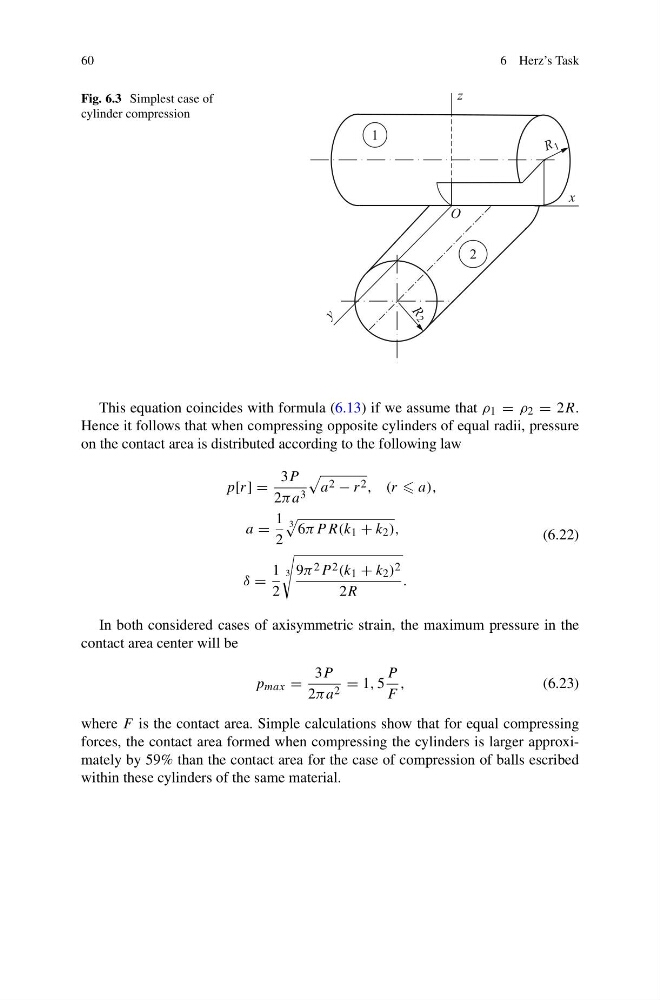
Fig. 6.3 Simplest case of
cylinder compression
This equation coincides with formula (6.13) if we assume that ρ 1 = ρ 2 = 2R.
Hence it follows that when compressing opposite cylinders of equal radii, pressure
on the contact area is distributed according to the following law
p[r] =
3P
2πa 3
a 2 − r 2 , (r a),
a =
1
2
3
6πP R(k 1 + k 2 ),
δ =
1
2
3
9π 2 P 2 (k 1 + k 2 ) 2
2R
.
(6.22)
In both considered cases of axisymmetric strain, the maximum pressure in the
contact area center will be
p max =
3P
2πa 2 = 1, 5
P
F
,
(6.23)
where F is the contact area. Simple calculations show that for equal compressing
forces, the contact area formed when compressing the cylinders is larger approximately by 59% than the contact area for the case of compression of balls escribed
within these cylinders of the same material.
6 Herz’s Task
Fig. 6.3 Simplest case of
cylinder compression
This equation coincides with formula (6.13) if we assume that ρ 1 = ρ 2 = 2R.
Hence it follows that when compressing opposite cylinders of equal radii, pressure
on the contact area is distributed according to the following law
p[r] =
3P
2πa 3
a 2 − r 2 , (r a),
a =
1
2
3
6πP R(k 1 + k 2 ),
δ =
1
2
3
9π 2 P 2 (k 1 + k 2 ) 2
2R
.
(6.22)
In both considered cases of axisymmetric strain, the maximum pressure in the
contact area center will be
p max =
3P
2πa 2 = 1, 5
P
F
,
(6.23)
where F is the contact area. Simple calculations show that for equal compressing
forces, the contact area formed when compressing the cylinders is larger approximately by 59% than the contact area for the case of compression of balls escribed
within these cylinders of the same material.