

References
53
ε =
b 2 x cos α + a 2 y sin α
a 2 sin
2 α + b 2 cos 2 α
.
(5.34)
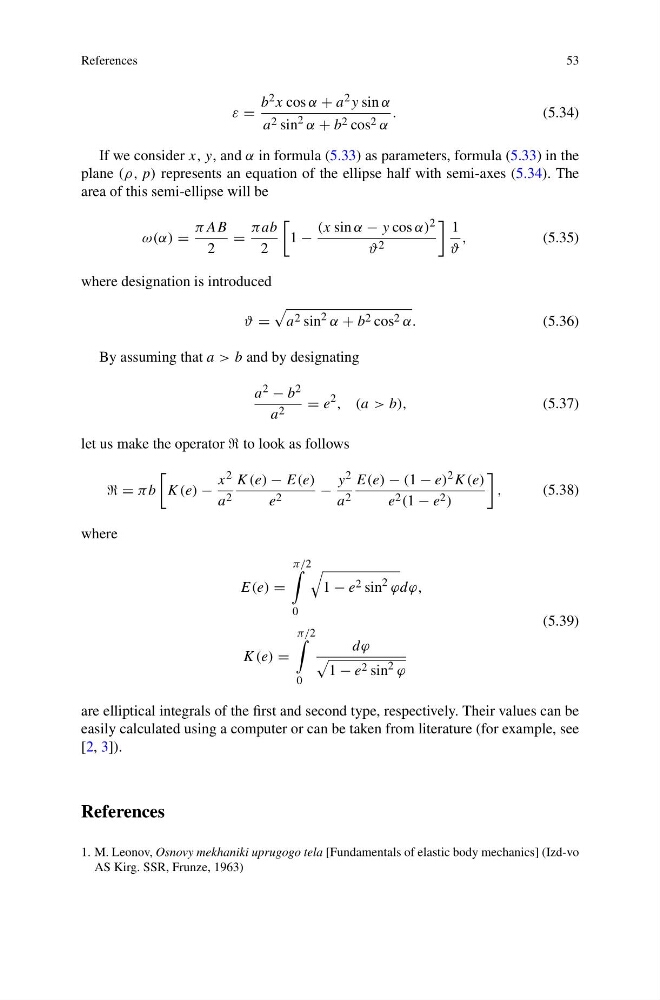
If we consider x, y, and α in formula (5.33) as parameters, formula (5.33) in the
plane (ρ, p) represents an equation of the ellipse half with semi-axes (5.34). The
area of this semi-ellipse will be
ω(α) =
πAB
2
=
πab
2
1 −
(x sin α − y cos α) 2
ϑ 2
1
ϑ
,
(5.35)
where designation is introduced
ϑ =
a 2 sin
2 α + b 2 cos 2 α.
(5.36)
By assuming that a > b and by designating
a 2 − b 2
a 2
= e
2 , (a > b),
(5.37)
let us make the operator to look as follows
= πb
K(e) −
x 2
a 2
K(e) − E(e)
e 2
−
y 2
a 2
E(e) − (1 − e) 2 K(e)
e 2 (1 − e 2 )
,
(5.38)
where
E(e) =
π/2
0
1 − e 2 sin
2 ϕdϕ,
K(e) =
π/2
0
dϕ
1 − e 2 sin
2 ϕ
(5.39)
are elliptical integrals of the first and second type, respectively. Their values can be
easily calculated using a computer or can be taken from literature (for example, see
[2, 3]).
References
1. M. Leonov, Osnovy mekhaniki uprugogo tela [Fundamentals of elastic body mechanics] (Izd-vo
AS Kirg. SSR, Frunze, 1963)
53
ε =
b 2 x cos α + a 2 y sin α
a 2 sin
2 α + b 2 cos 2 α
.
(5.34)
If we consider x, y, and α in formula (5.33) as parameters, formula (5.33) in the
plane (ρ, p) represents an equation of the ellipse half with semi-axes (5.34). The
area of this semi-ellipse will be
ω(α) =
πAB
2
=
πab
2
1 −
(x sin α − y cos α) 2
ϑ 2
1
ϑ
,
(5.35)
where designation is introduced
ϑ =
a 2 sin
2 α + b 2 cos 2 α.
(5.36)
By assuming that a > b and by designating
a 2 − b 2
a 2
= e
2 , (a > b),
(5.37)
let us make the operator to look as follows
= πb
K(e) −
x 2
a 2
K(e) − E(e)
e 2
−
y 2
a 2
E(e) − (1 − e) 2 K(e)
e 2 (1 − e 2 )
,
(5.38)
where
E(e) =
π/2
0
1 − e 2 sin
2 ϕdϕ,
K(e) =
π/2
0
dϕ
1 − e 2 sin
2 ϕ
(5.39)
are elliptical integrals of the first and second type, respectively. Their values can be
easily calculated using a computer or can be taken from literature (for example, see
[2, 3]).
References
1. M. Leonov, Osnovy mekhaniki uprugogo tela [Fundamentals of elastic body mechanics] (Izd-vo
AS Kirg. SSR, Frunze, 1963)