

5.4 Examples
51
p(x, y) =
a 2 − x 2 − y 2 at x 2 + y 2 a 2 ,
0
a tx 2 + y 2 > a 2 .
(5.25)
From the structure of formula (5.25), we can see that in the considered case, the
function p in the rectangular coordinates (x, y, p) depicts a semi-ball located
above the plane xOy, whereas the big circle of the semi-ball lies in the plane
xOy. Any cross-section of this semi-ball perpendicular to the plane of the big
circle is a semi-circle.
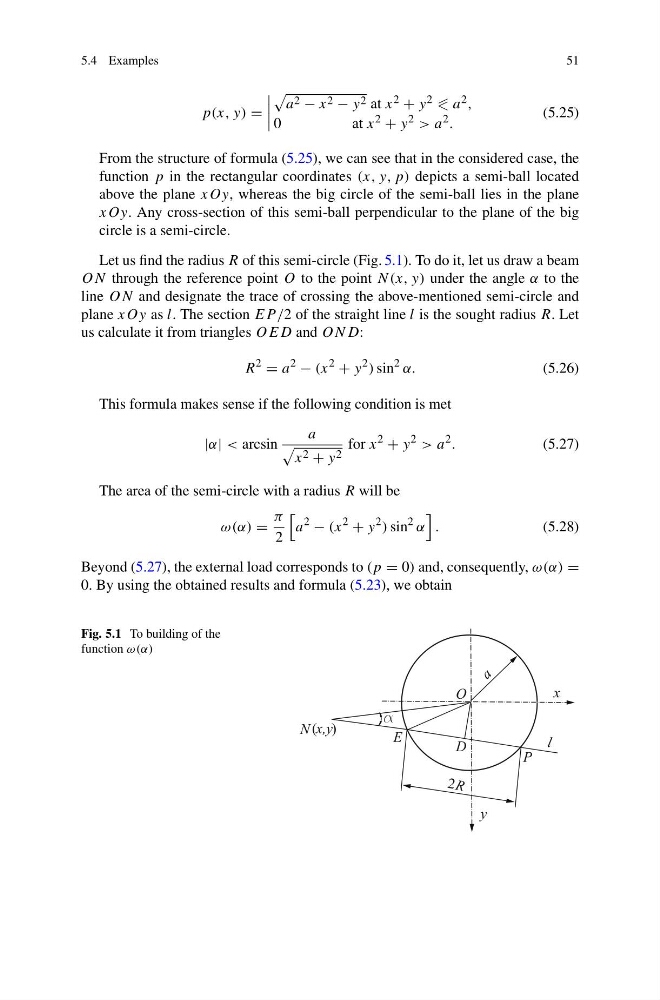
Let us find the radius R of this semi-circle (Fig. 5.1). To do it, let us draw a beam
ON through the reference point O to the point N(x, y) under the angle α to the
line ON and designate the trace of crossing the above-mentioned semi-circle and
plane xOy as l. The section EP /2 of the straight line l is the sought radius R. Let
us calculate it from triangles OED and OND:
R
2
= a
2
− (x
2
+ y
2 ) sin
2 α.
(5.26)
This formula makes sense if the following condition is met
|α| < arcsin
a
x 2 + y 2
for x
2
+ y
2 > a
2 .
(5.27)
The area of the semi-circle with a radius R will be
ω(α) =
π
2
a
2
− (x
2
+ y
2 ) sin
2 α
.
(5.28)
Beyond (5.27), the external load corresponds to (p = 0) and, consequently, ω(α) =
0. By using the obtained results and formula (5.23), we obtain
Fig. 5.1 To building of the
function ω(α)
51
p(x, y) =
a 2 − x 2 − y 2 at x 2 + y 2 a 2 ,
0
a tx 2 + y 2 > a 2 .
(5.25)
From the structure of formula (5.25), we can see that in the considered case, the
function p in the rectangular coordinates (x, y, p) depicts a semi-ball located
above the plane xOy, whereas the big circle of the semi-ball lies in the plane
xOy. Any cross-section of this semi-ball perpendicular to the plane of the big
circle is a semi-circle.
Let us find the radius R of this semi-circle (Fig. 5.1). To do it, let us draw a beam
ON through the reference point O to the point N(x, y) under the angle α to the
line ON and designate the trace of crossing the above-mentioned semi-circle and
plane xOy as l. The section EP /2 of the straight line l is the sought radius R. Let
us calculate it from triangles OED and OND:
R
2
= a
2
− (x
2
+ y
2 ) sin
2 α.
(5.26)
This formula makes sense if the following condition is met
|α| < arcsin
a
x 2 + y 2
for x
2
+ y
2 > a
2 .
(5.27)
The area of the semi-circle with a radius R will be
ω(α) =
π
2
a
2
− (x
2
+ y
2 ) sin
2 α
.
(5.28)
Beyond (5.27), the external load corresponds to (p = 0) and, consequently, ω(α) =
0. By using the obtained results and formula (5.23), we obtain
Fig. 5.1 To building of the
function ω(α)