

48
5 Elastic Half-Space
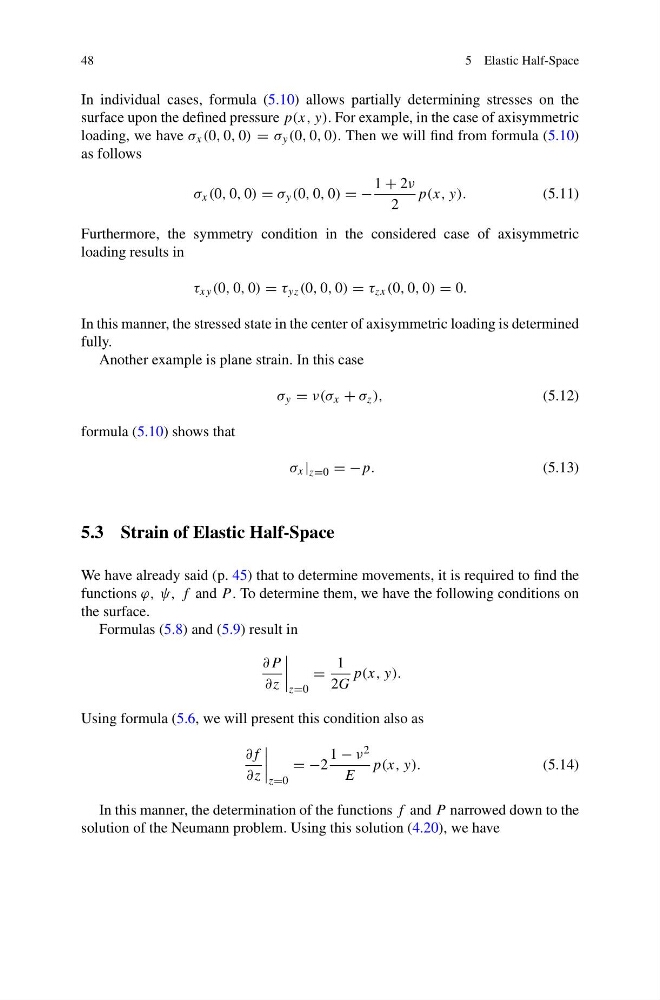
In individual cases, formula (5.10) allows partially determining stresses on the
surface upon the defined pressure p(x, y). For example, in the case of axisymmetric
loading, we have σ x (0, 0, 0) = σ y (0, 0, 0). Then we will find from formula (5.10)
as follows
σ x (0, 0, 0) = σ y (0, 0, 0) = −
1 + 2ν
2
p(x, y).
(5.11)
Furthermore, the symmetry condition in the considered case of axisymmetric
loading results in
τ xy (0, 0, 0) = τ yz (0, 0, 0) = τ zx (0, 0, 0) = 0.
In this manner, the stressed state in the center of axisymmetric loading is determined
fully.
Another example is plane strain. In this case
σ y = ν(σ x + σ z ),
(5.12)
formula (5.10) shows that
σ x | z=0 = −p.
(5.13)
5.3 Strain of Elastic Half-Space
We have already said (p. 45) that to determine movements, it is required to find the
functions ϕ, ψ, f and P . To determine them, we have the following conditions on
the surface.
Formulas (5.8) and (5.9) result in
∂P
∂z
z=0
=
1
2G
p(x, y).
Using formula (5.6, we will present this condition also as
∂f
∂z
z=0
= −2
1 − ν 2
E
p(x, y).
(5.14)
In this manner, the determination of the functions f and P narrowed down to the
solution of the Neumann problem. Using this solution (4.20), we have
5 Elastic Half-Space
In individual cases, formula (5.10) allows partially determining stresses on the
surface upon the defined pressure p(x, y). For example, in the case of axisymmetric
loading, we have σ x (0, 0, 0) = σ y (0, 0, 0). Then we will find from formula (5.10)
as follows
σ x (0, 0, 0) = σ y (0, 0, 0) = −
1 + 2ν
2
p(x, y).
(5.11)
Furthermore, the symmetry condition in the considered case of axisymmetric
loading results in
τ xy (0, 0, 0) = τ yz (0, 0, 0) = τ zx (0, 0, 0) = 0.
In this manner, the stressed state in the center of axisymmetric loading is determined
fully.
Another example is plane strain. In this case
σ y = ν(σ x + σ z ),
(5.12)
formula (5.10) shows that
σ x | z=0 = −p.
(5.13)
5.3 Strain of Elastic Half-Space
We have already said (p. 45) that to determine movements, it is required to find the
functions ϕ, ψ, f and P . To determine them, we have the following conditions on
the surface.
Formulas (5.8) and (5.9) result in
∂P
∂z
z=0
=
1
2G
p(x, y).
Using formula (5.6, we will present this condition also as
∂f
∂z
z=0
= −2
1 − ν 2
E
p(x, y).
(5.14)
In this manner, the determination of the functions f and P narrowed down to the
solution of the Neumann problem. Using this solution (4.20), we have