

42
4 Three-Dimensional Harmonic Function
where
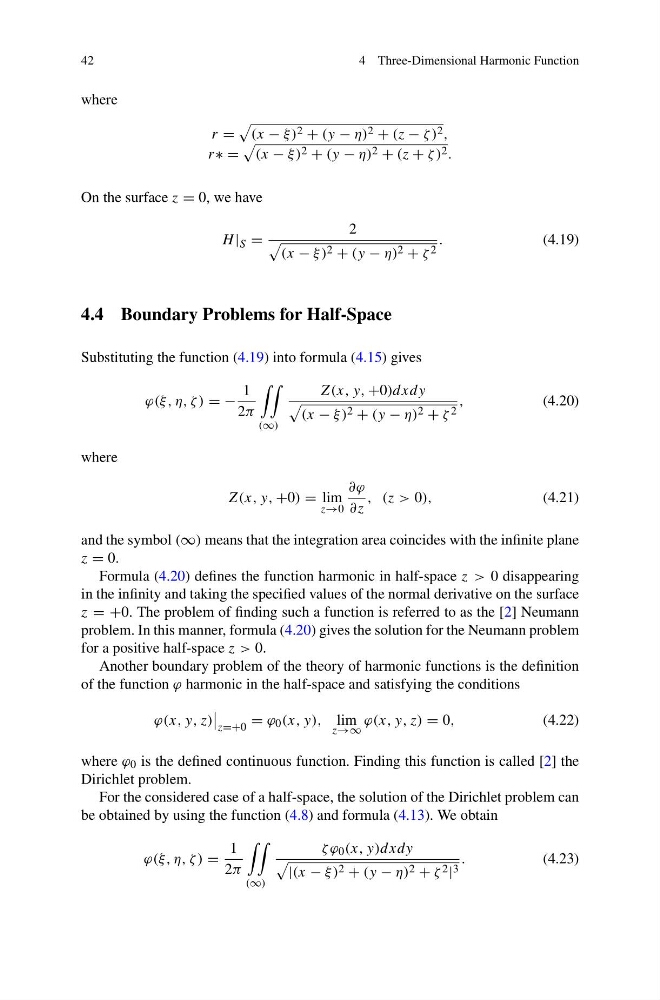
r =
(x − ξ) 2 + (y − η) 2 + (z − ζ ) 2 ,
r∗ =
(x − ξ) 2 + (y − η) 2 + (z + ζ ) 2 .
On the surface z = 0, we have
H | S =
2
(x − ξ) 2 + (y − η) 2 + ζ 2
.
(4.19)
4.4 Boundary Problems for Half-Space
Substituting the function (4.19) into formula (4.15) gives
ϕ(ξ, η, ζ ) = −
1
2π
(∞)
Z(x, y, +0)dxdy
(x − ξ) 2 + (y − η) 2 + ζ 2
,
(4.20)
where
Z(x, y, +0) = lim
z→0
∂ϕ
∂z
, (z > 0),
(4.21)
and the symbol (∞) means that the integration area coincides with the infinite plane
z = 0.
Formula (4.20) defines the function harmonic in half-space z > 0 disappearing
in the infinity and taking the specified values of the normal derivative on the surface
z = +0. The problem of finding such a function is referred to as the [2] Neumann
problem. In this manner, formula (4.20) gives the solution for the Neumann problem
for a positive half-space z > 0.
Another boundary problem of the theory of harmonic functions is the definition
of the function ϕ harmonic in the half-space and satisfying the conditions
ϕ(x, y, z)
z=+0
= ϕ 0 (x, y), lim
z→∞
ϕ(x, y, z) = 0,
(4.22)
where ϕ 0 is the defined continuous function. Finding this function is called [2] the
Dirichlet problem.
For the considered case of a half-space, the solution of the Dirichlet problem can
be obtained by using the function (4.8) and formula (4.13). We obtain
ϕ(ξ, η, ζ ) =
1
2π
(∞)
ζ ϕ 0 (x, y)dxdy
|(x − ξ) 2 + (y − η) 2 + ζ 2 | 3
.
(4.23)
4 Three-Dimensional Harmonic Function
where
r =
(x − ξ) 2 + (y − η) 2 + (z − ζ ) 2 ,
r∗ =
(x − ξ) 2 + (y − η) 2 + (z + ζ ) 2 .
On the surface z = 0, we have
H | S =
2
(x − ξ) 2 + (y − η) 2 + ζ 2
.
(4.19)
4.4 Boundary Problems for Half-Space
Substituting the function (4.19) into formula (4.15) gives
ϕ(ξ, η, ζ ) = −
1
2π
(∞)
Z(x, y, +0)dxdy
(x − ξ) 2 + (y − η) 2 + ζ 2
,
(4.20)
where
Z(x, y, +0) = lim
z→0
∂ϕ
∂z
, (z > 0),
(4.21)
and the symbol (∞) means that the integration area coincides with the infinite plane
z = 0.
Formula (4.20) defines the function harmonic in half-space z > 0 disappearing
in the infinity and taking the specified values of the normal derivative on the surface
z = +0. The problem of finding such a function is referred to as the [2] Neumann
problem. In this manner, formula (4.20) gives the solution for the Neumann problem
for a positive half-space z > 0.
Another boundary problem of the theory of harmonic functions is the definition
of the function ϕ harmonic in the half-space and satisfying the conditions
ϕ(x, y, z)
z=+0
= ϕ 0 (x, y), lim
z→∞
ϕ(x, y, z) = 0,
(4.22)
where ϕ 0 is the defined continuous function. Finding this function is called [2] the
Dirichlet problem.
For the considered case of a half-space, the solution of the Dirichlet problem can
be obtained by using the function (4.8) and formula (4.13). We obtain
ϕ(ξ, η, ζ ) =
1
2π
(∞)
ζ ϕ 0 (x, y)dxdy
|(x − ξ) 2 + (y − η) 2 + ζ 2 | 3
.
(4.23)