

3.5 Grodsky–Neyber–Papkovich Integral
35
u +
1
1 − 2ν
∂F
∂x
= 0,
v +
1
1 − 2ν
∂F
∂y
= 0,
z +
1
1 − 2ν
∂F
∂z
= 0.
(3.20)
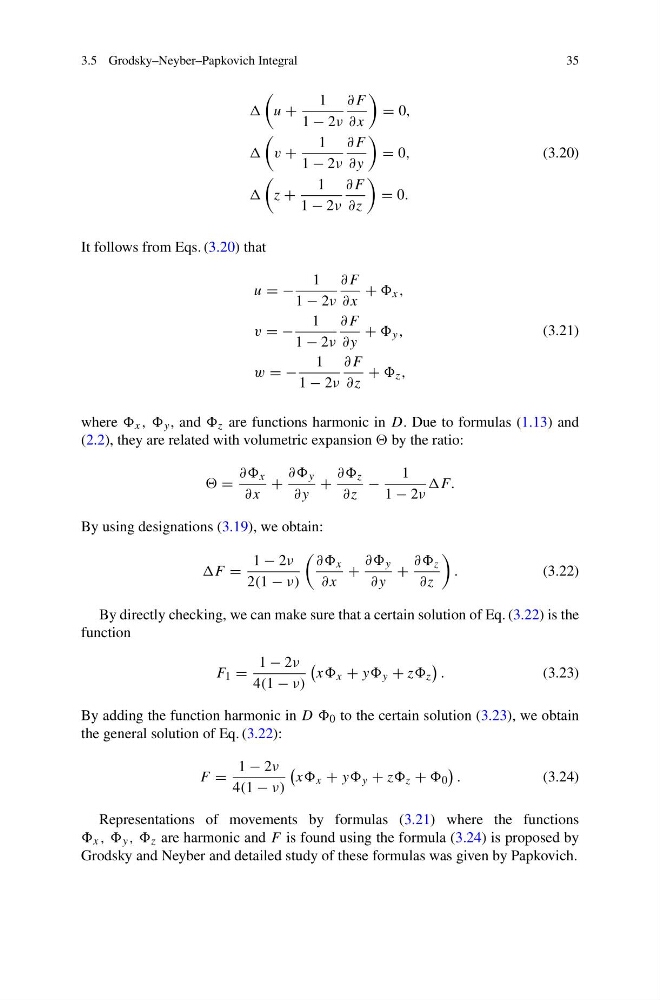
It follows from Eqs. (3.20) that
u = −
1
1 − 2ν
∂F
∂x
+ x ,
v = −
1
1 − 2ν
∂F
∂y
+ y ,
w = −
1
1 − 2ν
∂F
∂z
+ z ,
(3.21)
where x , , y , and z are functions harmonic in D. Due to formulas (1.13) and
(2.2), they are related with volumetric expansion by the ratio:
=
∂∂ x
∂x
+
∂∂ y
∂y
+
∂∂ z
∂z
−
1
1 − 2ν
F.
By using designations (3.19), we obtain:
F =
1 − 2ν
2(1 − ν)
∂∂ x
∂x
+
∂∂ y
∂y
+
∂∂ z
∂z
.
(3.22)
By directly checking, we can make sure that a certain solution of Eq. (3.22) is the
function
F 1 =
1 − 2ν
4(1 − ν)
xx x + yy y + zz z
.
(3.23)
By adding the function harmonic in D D 0 to the certain solution (3.23), we obtain
the general solution of Eq. (3.22):
F =
1 − 2ν
4(1 − ν)
xx x + yy y + zz z + 0
.
(3.24)
Representations of movements by formulas (3.21) where the functions
x , , y , , z are harmonic and F is found using the formula (3.24) is proposed by
Grodsky and Neyber and detailed study of these formulas was given by Papkovich.
35
u +
1
1 − 2ν
∂F
∂x
= 0,
v +
1
1 − 2ν
∂F
∂y
= 0,
z +
1
1 − 2ν
∂F
∂z
= 0.
(3.20)
It follows from Eqs. (3.20) that
u = −
1
1 − 2ν
∂F
∂x
+ x ,
v = −
1
1 − 2ν
∂F
∂y
+ y ,
w = −
1
1 − 2ν
∂F
∂z
+ z ,
(3.21)
where x , , y , and z are functions harmonic in D. Due to formulas (1.13) and
(2.2), they are related with volumetric expansion by the ratio:
=
∂∂ x
∂x
+
∂∂ y
∂y
+
∂∂ z
∂z
−
1
1 − 2ν
F.
By using designations (3.19), we obtain:
F =
1 − 2ν
2(1 − ν)
∂∂ x
∂x
+
∂∂ y
∂y
+
∂∂ z
∂z
.
(3.22)
By directly checking, we can make sure that a certain solution of Eq. (3.22) is the
function
F 1 =
1 − 2ν
4(1 − ν)
xx x + yy y + zz z
.
(3.23)
By adding the function harmonic in D D 0 to the certain solution (3.23), we obtain
the general solution of Eq. (3.22):
F =
1 − 2ν
4(1 − ν)
xx x + yy y + zz z + 0
.
(3.24)
Representations of movements by formulas (3.21) where the functions
x , , y , , z are harmonic and F is found using the formula (3.24) is proposed by
Grodsky and Neyber and detailed study of these formulas was given by Papkovich.