

28
2 The First Basic Problem of Elasticity Theory
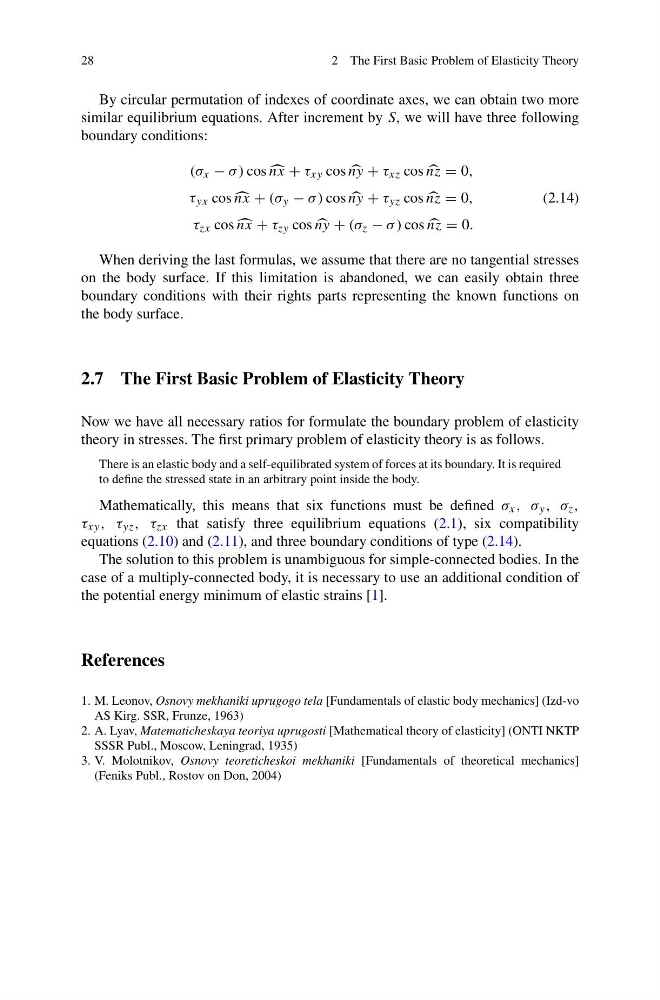
By circular permutation of indexes of coordinate axes, we can obtain two more
similar equilibrium equations. After increment by S, we will have three following
boundary conditions:
(σ x − σ ) cos
nx + τ xy cos
ny + τ xz cos
nz = 0,
τ yx cos
nx + (σ y − σ ) cos
ny + τ yz cos
nz = 0,
τ zx cos
nx + τ zy cos
ny + (σ z − σ ) cos
nz = 0.
(2.14)
When deriving the last formulas, we assume that there are no tangential stresses
on the body surface. If this limitation is abandoned, we can easily obtain three
boundary conditions with their rights parts representing the known functions on
the body surface.
2.7 The First Basic Problem of Elasticity Theory
Now we have all necessary ratios for formulate the boundary problem of elasticity
theory in stresses. The first primary problem of elasticity theory is as follows.
There is an elastic body and a self-equilibrated system of forces at its boundary. It is required
to define the stressed state in an arbitrary point inside the body.
Mathematically, this means that six functions must be defined σ x , σ y , σ z ,
τ xy , τ yz , τ zx that satisfy three equilibrium equations (2.1), six compatibility
equations (2.10) and (2.11), and three boundary conditions of type (2.14).
The solution to this problem is unambiguous for simple-connected bodies. In the
case of a multiply-connected body, it is necessary to use an additional condition of
the potential energy minimum of elastic strains [1].
References
1. M. Leonov, Osnovy mekhaniki uprugogo tela [Fundamentals of elastic body mechanics] (Izd-vo
AS Kirg. SSR, Frunze, 1963)
2. A. Lyav, Matematicheskaya teoriya uprugosti [Mathematical theory of elasticity] (ONTI NKTP
SSSR Publ., Moscow, Leningrad, 1935)
3. V. Molotnikov, Osnovy teoreticheskoi mekhaniki [Fundamentals of theoretical mechanics]
(Feniks Publ., Rostov on Don, 2004)
2 The First Basic Problem of Elasticity Theory
By circular permutation of indexes of coordinate axes, we can obtain two more
similar equilibrium equations. After increment by S, we will have three following
boundary conditions:
(σ x − σ ) cos
nx + τ xy cos
ny + τ xz cos
nz = 0,
τ yx cos
nx + (σ y − σ ) cos
ny + τ yz cos
nz = 0,
τ zx cos
nx + τ zy cos
ny + (σ z − σ ) cos
nz = 0.
(2.14)
When deriving the last formulas, we assume that there are no tangential stresses
on the body surface. If this limitation is abandoned, we can easily obtain three
boundary conditions with their rights parts representing the known functions on
the body surface.
2.7 The First Basic Problem of Elasticity Theory
Now we have all necessary ratios for formulate the boundary problem of elasticity
theory in stresses. The first primary problem of elasticity theory is as follows.
There is an elastic body and a self-equilibrated system of forces at its boundary. It is required
to define the stressed state in an arbitrary point inside the body.
Mathematically, this means that six functions must be defined σ x , σ y , σ z ,
τ xy , τ yz , τ zx that satisfy three equilibrium equations (2.1), six compatibility
equations (2.10) and (2.11), and three boundary conditions of type (2.14).
The solution to this problem is unambiguous for simple-connected bodies. In the
case of a multiply-connected body, it is necessary to use an additional condition of
the potential energy minimum of elastic strains [1].
References
1. M. Leonov, Osnovy mekhaniki uprugogo tela [Fundamentals of elastic body mechanics] (Izd-vo
AS Kirg. SSR, Frunze, 1963)
2. A. Lyav, Matematicheskaya teoriya uprugosti [Mathematical theory of elasticity] (ONTI NKTP
SSSR Publ., Moscow, Leningrad, 1935)
3. V. Molotnikov, Osnovy teoreticheskoi mekhaniki [Fundamentals of theoretical mechanics]
(Feniks Publ., Rostov on Don, 2004)