

24
2 The First Basic Problem of Elasticity Theory
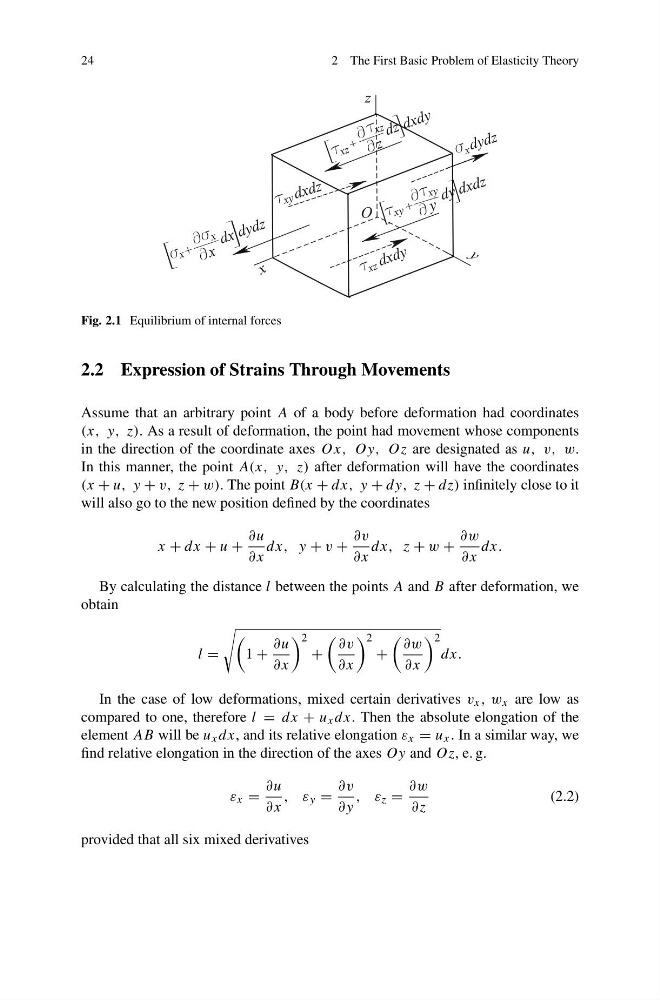
Fig. 2.1 Equilibrium of internal forces
2.2 Expression of Strains Through Movements
Assume that an arbitrary point A of a body before deformation had coordinates
(x, y, z). As a result of deformation, the point had movement whose components
in the direction of the coordinate axes Ox, Oy, Oz are designated as u, v, w.
In this manner, the point A(x, y, z) after deformation will have the coordinates
(x + u, y + v, z + w). The point B(x + dx, y + dy, z + dz) infinitely close to it
will also go to the new position defined by the coordinates
x + dx + u +
∂u
∂x
dx, y + v +
∂v
∂x
dx, z + w +
∂w
∂x
dx.
By calculating the distance l between the points A and B after deformation, we
obtain
l =
1 +
∂u
∂x
2
+
∂v
∂x
2
+
∂w
∂x
2
dx.
In the case of low deformations, mixed certain derivatives v x , w x are low as
compared to one, therefore l = dx + u x dx. Then the absolute elongation of the
element AB will be u x dx, and its relative elongation ε x = u x . In a similar way, we
find relative elongation in the direction of the axes Oy and Oz, e. g.
ε x =
∂u
∂x
, ε y =
∂v
∂y
, ε z =
∂w
∂z
(2.2)
provided that all six mixed derivatives
2 The First Basic Problem of Elasticity Theory
Fig. 2.1 Equilibrium of internal forces
2.2 Expression of Strains Through Movements
Assume that an arbitrary point A of a body before deformation had coordinates
(x, y, z). As a result of deformation, the point had movement whose components
in the direction of the coordinate axes Ox, Oy, Oz are designated as u, v, w.
In this manner, the point A(x, y, z) after deformation will have the coordinates
(x + u, y + v, z + w). The point B(x + dx, y + dy, z + dz) infinitely close to it
will also go to the new position defined by the coordinates
x + dx + u +
∂u
∂x
dx, y + v +
∂v
∂x
dx, z + w +
∂w
∂x
dx.
By calculating the distance l between the points A and B after deformation, we
obtain
l =
1 +
∂u
∂x
2
+
∂v
∂x
2
+
∂w
∂x
2
dx.
In the case of low deformations, mixed certain derivatives v x , w x are low as
compared to one, therefore l = dx + u x dx. Then the absolute elongation of the
element AB will be u x dx, and its relative elongation ε x = u x . In a similar way, we
find relative elongation in the direction of the axes Oy and Oz, e. g.
ε x =
∂u
∂x
, ε y =
∂v
∂y
, ε z =
∂w
∂z
(2.2)
provided that all six mixed derivatives