

420
32 On Boundary Value Problems of Inelastic Body Mechanics
a
b
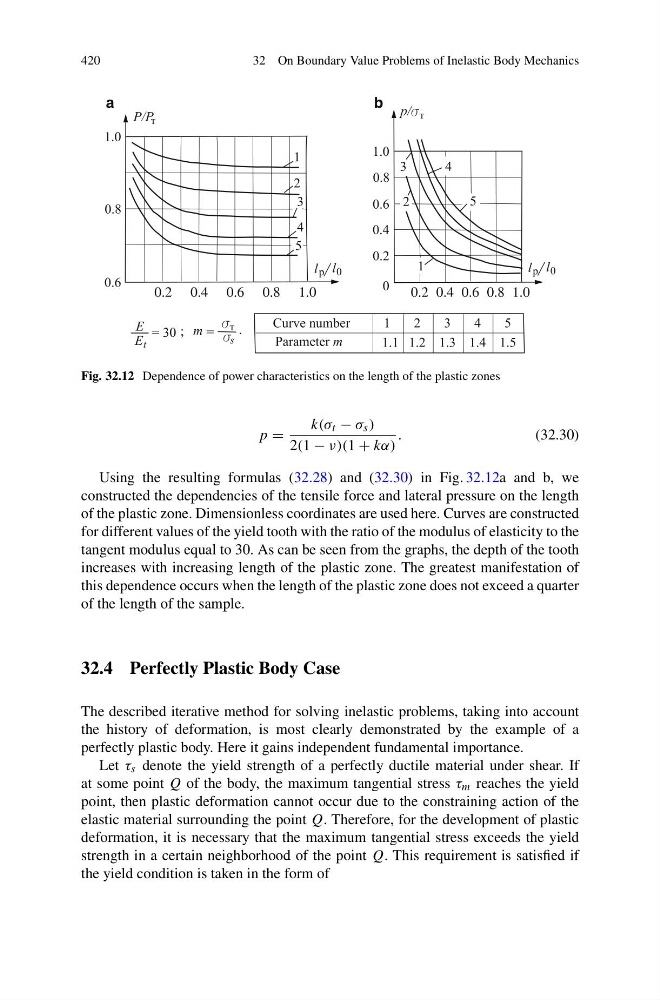
Fig. 32.12 Dependence of power characteristics on the length of the plastic zones
p =
k(σ t − σ s )
2(1 − ν)(1 + kα)
.
(32.30)
Using the resulting formulas (32.28) and (32.30) in Fig. 32.12a and b, we
constructed the dependencies of the tensile force and lateral pressure on the length
of the plastic zone. Dimensionless coordinates are used here. Curves are constructed
for different values of the yield tooth with the ratio of the modulus of elasticity to the
tangent modulus equal to 30. As can be seen from the graphs, the depth of the tooth
increases with increasing length of the plastic zone. The greatest manifestation of
this dependence occurs when the length of the plastic zone does not exceed a quarter
of the length of the sample.
32.4 Perfectly Plastic Body Case
The described iterative method for solving inelastic problems, taking into account
the history of deformation, is most clearly demonstrated by the example of a
perfectly plastic body. Here it gains independent fundamental importance.
Let τ s denote the yield strength of a perfectly ductile material under shear. If
at some point Q of the body, the maximum tangential stress τ m reaches the yield
point, then plastic deformation cannot occur due to the constraining action of the
elastic material surrounding the point Q. Therefore, for the development of plastic
deformation, it is necessary that the maximum tangential stress exceeds the yield
strength in a certain neighborhood of the point Q. This requirement is satisfied if
the yield condition is taken in the form of
32 On Boundary Value Problems of Inelastic Body Mechanics
a
b
Fig. 32.12 Dependence of power characteristics on the length of the plastic zones
p =
k(σ t − σ s )
2(1 − ν)(1 + kα)
.
(32.30)
Using the resulting formulas (32.28) and (32.30) in Fig. 32.12a and b, we
constructed the dependencies of the tensile force and lateral pressure on the length
of the plastic zone. Dimensionless coordinates are used here. Curves are constructed
for different values of the yield tooth with the ratio of the modulus of elasticity to the
tangent modulus equal to 30. As can be seen from the graphs, the depth of the tooth
increases with increasing length of the plastic zone. The greatest manifestation of
this dependence occurs when the length of the plastic zone does not exceed a quarter
of the length of the sample.
32.4 Perfectly Plastic Body Case
The described iterative method for solving inelastic problems, taking into account
the history of deformation, is most clearly demonstrated by the example of a
perfectly plastic body. Here it gains independent fundamental importance.
Let τ s denote the yield strength of a perfectly ductile material under shear. If
at some point Q of the body, the maximum tangential stress τ m reaches the yield
point, then plastic deformation cannot occur due to the constraining action of the
elastic material surrounding the point Q. Therefore, for the development of plastic
deformation, it is necessary that the maximum tangential stress exceeds the yield
strength in a certain neighborhood of the point Q. This requirement is satisfied if
the yield condition is taken in the form of