

408
32 On Boundary Value Problems of Inelastic Body Mechanics
e ij =
1
2
(u i,j + u j,i ) − ε
y
ij ,
(32.3)
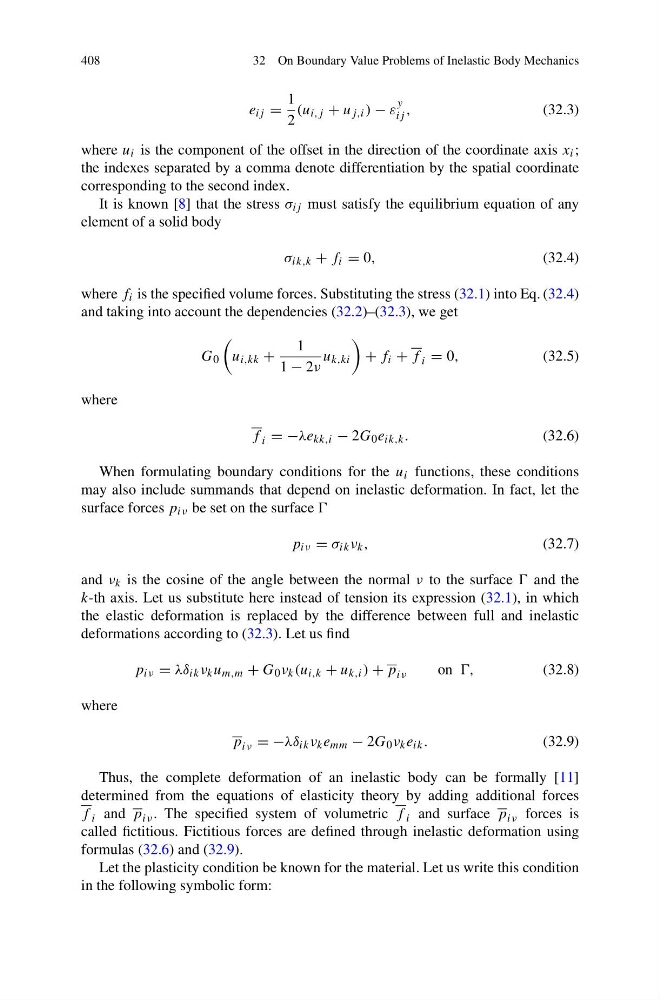
where u i is the component of the offset in the direction of the coordinate axis x i ;
the indexes separated by a comma denote differentiation by the spatial coordinate
corresponding to the second index.
It is known [8] that the stress σ ij must satisfy the equilibrium equation of any
element of a solid body
σ ik,k + f i = 0,
(32.4)
where f i is the specified volume forces. Substituting the stress (32.1) into Eq. (32.4)
and taking into account the dependencies (32.2)–(32.3), we get
G 0
u i,kk +
1
1 − 2ν
u k,ki
+ f i + f i = 0,
(32.5)
where
f i = −λe kk,i − 2G 0 e ik,k .
(32.6)
When formulating boundary conditions for the u i functions, these conditions
may also include summands that depend on inelastic deformation. In fact, let the
surface forces p iν be set on the surface
p iν = σ ik ν k ,
(32.7)
and ν k is the cosine of the angle between the normal ν to the surface and the
k-th axis. Let us substitute here instead of tension its expression (32.1), in which
the elastic deformation is replaced by the difference between full and inelastic
deformations according to (32.3). Let us find
p iν = λδ ik ν k u m,m + G 0 ν k (u i,k + u k,i ) + p iν
on ,
(32.8)
where
p iν = −λδ ik ν k e mm − 2G 0 ν k e ik .
(32.9)
Thus, the complete deformation of an inelastic body can be formally [11]
determined from the equations of elasticity theory by adding additional forces
f i and p iν . The specified system of volumetric f i and surface p iν forces is
called fictitious. Fictitious forces are defined through inelastic deformation using
formulas (32.6) and (32.9).
Let the plasticity condition be known for the material. Let us write this condition
in the following symbolic form:
32 On Boundary Value Problems of Inelastic Body Mechanics
e ij =
1
2
(u i,j + u j,i ) − ε
y
ij ,
(32.3)
where u i is the component of the offset in the direction of the coordinate axis x i ;
the indexes separated by a comma denote differentiation by the spatial coordinate
corresponding to the second index.
It is known [8] that the stress σ ij must satisfy the equilibrium equation of any
element of a solid body
σ ik,k + f i = 0,
(32.4)
where f i is the specified volume forces. Substituting the stress (32.1) into Eq. (32.4)
and taking into account the dependencies (32.2)–(32.3), we get
G 0
u i,kk +
1
1 − 2ν
u k,ki
+ f i + f i = 0,
(32.5)
where
f i = −λe kk,i − 2G 0 e ik,k .
(32.6)
When formulating boundary conditions for the u i functions, these conditions
may also include summands that depend on inelastic deformation. In fact, let the
surface forces p iν be set on the surface
p iν = σ ik ν k ,
(32.7)
and ν k is the cosine of the angle between the normal ν to the surface and the
k-th axis. Let us substitute here instead of tension its expression (32.1), in which
the elastic deformation is replaced by the difference between full and inelastic
deformations according to (32.3). Let us find
p iν = λδ ik ν k u m,m + G 0 ν k (u i,k + u k,i ) + p iν
on ,
(32.8)
where
p iν = −λδ ik ν k e mm − 2G 0 ν k e ik .
(32.9)
Thus, the complete deformation of an inelastic body can be formally [11]
determined from the equations of elasticity theory by adding additional forces
f i and p iν . The specified system of volumetric f i and surface p iν forces is
called fictitious. Fictitious forces are defined through inelastic deformation using
formulas (32.6) and (32.9).
Let the plasticity condition be known for the material. Let us write this condition
in the following symbolic form: