

402
31 Simple Loadings of Geomaterials
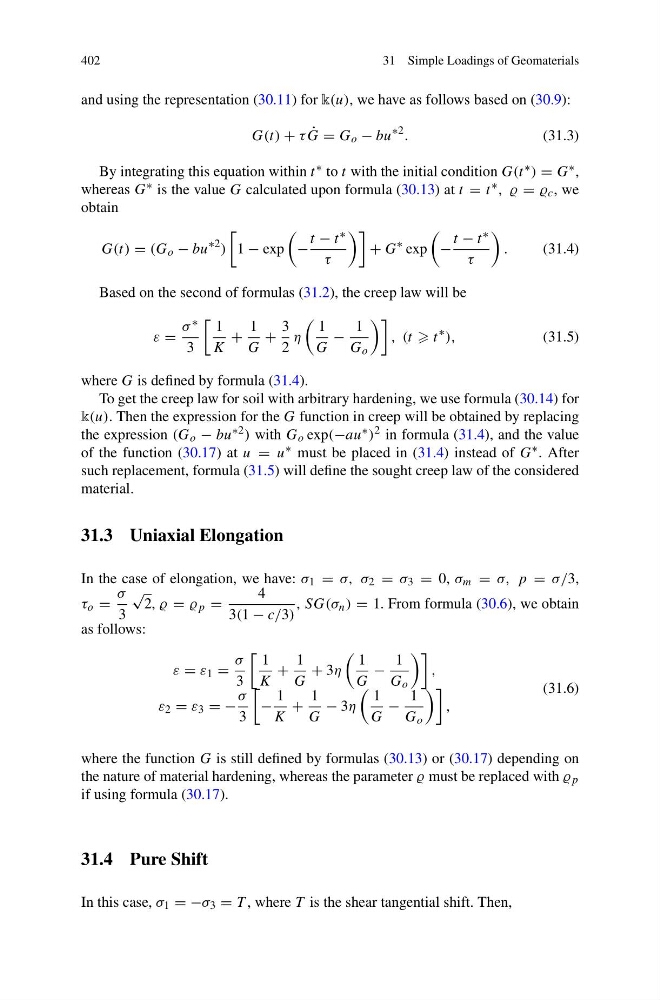
and using the representation (30.11) for k(u), we have as follows based on (30.9):
G(t) + τ ˙
G = G o − bu
∗2 .
(31.3)
By integrating this equation within t ∗ to t with the initial condition G(t ∗ ) = G ∗ ,
whereas G ∗ is the value G calculated upon formula (30.13) at t = t ∗ , , = c , we
obtain
G(t) = (G o − bu
∗2 )
1 − exp
−
t − t ∗
τ
+ G
∗ exp
−
t − t ∗
τ
.
(31.4)
Based on the second of formulas (31.2), the creep law will be
ε =
σ ∗
3
1
K
+
1
G
+
3
2
η
1
G
−
1
G o
, (t t
∗ ),
(31.5)
where G is defined by formula (31.4).
To get the creep law for soil with arbitrary hardening, we use formula (30.14) for
k(u). Then the expression for the G function in creep will be obtained by replacing
the expression (G o − bu ∗2 ) with G o exp(−au ∗ ) 2 in formula (31.4), and the value
of the function (30.17) at u = u ∗ must be placed in (31.4) instead of G ∗ . After
such replacement, formula (31.5) will define the sought creep law of the considered
material.
31.3 Uniaxial Elongation
In the case of elongation, we have: σ 1 = σ, σ 2 = σ 3 = 0, σ m = σ, p = σ/3,
τ o =
σ
3
√
2, = p =
4
3(1 − c/3)
, SG(σ n ) = 1. From formula (30.6), we obtain
as follows:
ε = ε 1 =
σ
3
1
K
+
1
G
+ 3η
1
G
−
1
G o
,
ε 2 = ε 3 = −
σ
3
−
1
K
+
1
G
− 3η
1
G
−
1
G o
,
(31.6)
where the function G is still defined by formulas (30.13) or (30.17) depending on
the nature of material hardening, whereas the parameter must be replaced with p
if using formula (30.17).
31.4 Pure Shift
In this case, σ 1 = −σ 3 = T , where T is the shear tangential shift. Then,
31 Simple Loadings of Geomaterials
and using the representation (30.11) for k(u), we have as follows based on (30.9):
G(t) + τ ˙
G = G o − bu
∗2 .
(31.3)
By integrating this equation within t ∗ to t with the initial condition G(t ∗ ) = G ∗ ,
whereas G ∗ is the value G calculated upon formula (30.13) at t = t ∗ , , = c , we
obtain
G(t) = (G o − bu
∗2 )
1 − exp
−
t − t ∗
τ
+ G
∗ exp
−
t − t ∗
τ
.
(31.4)
Based on the second of formulas (31.2), the creep law will be
ε =
σ ∗
3
1
K
+
1
G
+
3
2
η
1
G
−
1
G o
, (t t
∗ ),
(31.5)
where G is defined by formula (31.4).
To get the creep law for soil with arbitrary hardening, we use formula (30.14) for
k(u). Then the expression for the G function in creep will be obtained by replacing
the expression (G o − bu ∗2 ) with G o exp(−au ∗ ) 2 in formula (31.4), and the value
of the function (30.17) at u = u ∗ must be placed in (31.4) instead of G ∗ . After
such replacement, formula (31.5) will define the sought creep law of the considered
material.
31.3 Uniaxial Elongation
In the case of elongation, we have: σ 1 = σ, σ 2 = σ 3 = 0, σ m = σ, p = σ/3,
τ o =
σ
3
√
2, = p =
4
3(1 − c/3)
, SG(σ n ) = 1. From formula (30.6), we obtain
as follows:
ε = ε 1 =
σ
3
1
K
+
1
G
+ 3η
1
G
−
1
G o
,
ε 2 = ε 3 = −
σ
3
−
1
K
+
1
G
− 3η
1
G
−
1
G o
,
(31.6)
where the function G is still defined by formulas (30.13) or (30.17) depending on
the nature of material hardening, whereas the parameter must be replaced with p
if using formula (30.17).
31.4 Pure Shift
In this case, σ 1 = −σ 3 = T , where T is the shear tangential shift. Then,