

29.3 Monotonous Plane-Plastic Strain
385
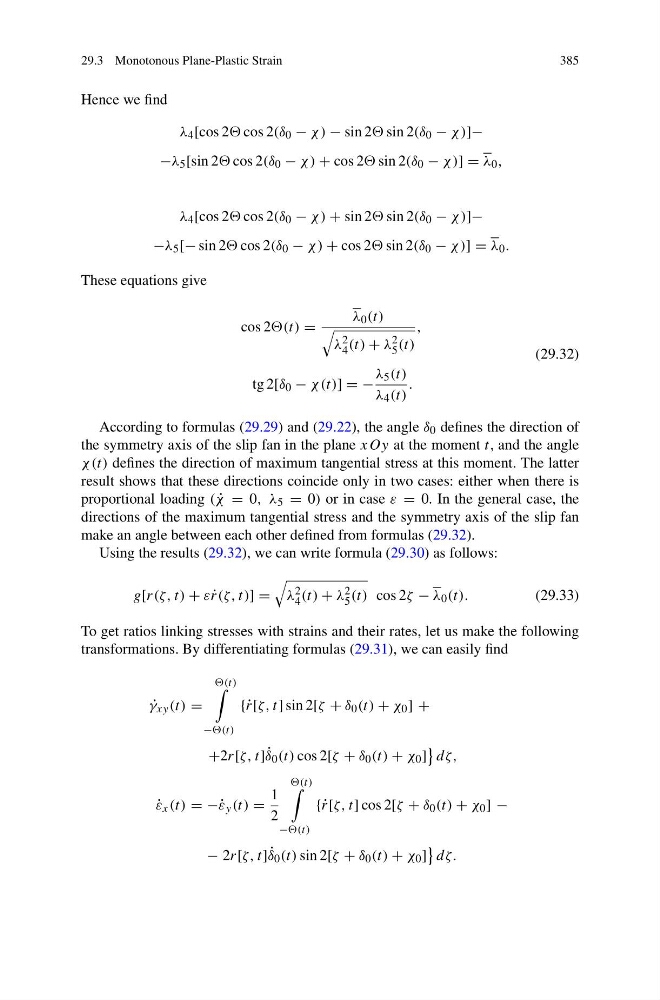
Hence we find
λ 4 [cos 2 cos 2(δ 0 − χ) − sin 2 sin 2(δ 0 − χ)]−
−λ 5 [sin 2 cos 2(δ 0 − χ) + cos 2 sin 2(δ 0 − χ)] = λ 0 ,
λ 4 [cos 2 cos 2(δ 0 − χ) + sin 2 sin 2(δ 0 − χ)]−
−λ 5 [− sin 2 cos 2(δ 0 − χ) + cos 2 sin 2(δ 0 − χ)] = λ 0 .
These equations give
cos 2 =
λ 0 (t)
λ 2
4 (t) + λ 2
5 (t)
,
tg 2[δ 0 − χ (t)] = −
λ 5 (t)
λ 4 (t)
.
(29.32)
According to formulas (29.29) and (29.22), the angle δ 0 defines the direction of
the symmetry axis of the slip fan in the plane xOy at the moment t, and the angle
χ (t) defines the direction of maximum tangential stress at this moment. The latter
result shows that these directions coincide only in two cases: either when there is
proportional loading ( ˙
χ = 0, λ 5 = 0) or in case ε = 0. In the general case, the
directions of the maximum tangential stress and the symmetry axis of the slip fan
make an angle between each other defined from formulas (29.32).
Using the results (29.32), we can write formula (29.30) as follows:
g[r(ζ, t) + ε ˙
r(ζ, t)] =
λ 2
4 (t) + λ 2
5 (t) cos 2ζ − λ 0 (t).
(29.33)
To get ratios linking stresses with strains and their rates, let us make the following
transformations. By differentiating formulas (29.31), we can easily find
˙
γ xy (t) =
(t)
−
{˙ r[ζ, t] sin 2[ζ + δ 0 (t) + χ 0 ] +
+2r[ζ, t] ˙
δ 0 (t) cos 2[ζ + δ 0 (t) + χ 0 ]
dζ,
˙
ε x (t) = −˙ ε y (t) =
1
2
(t)
−(t)
{˙ r[ζ, t] cos 2[ζ + δ 0 (t) + χ 0 ] −
− 2r[ζ, t] ˙
δ 0 (t) sin 2[ζ + δ 0 (t) + χ 0 ]
dζ.
385
Hence we find
λ 4 [cos 2 cos 2(δ 0 − χ) − sin 2 sin 2(δ 0 − χ)]−
−λ 5 [sin 2 cos 2(δ 0 − χ) + cos 2 sin 2(δ 0 − χ)] = λ 0 ,
λ 4 [cos 2 cos 2(δ 0 − χ) + sin 2 sin 2(δ 0 − χ)]−
−λ 5 [− sin 2 cos 2(δ 0 − χ) + cos 2 sin 2(δ 0 − χ)] = λ 0 .
These equations give
cos 2 =
λ 0 (t)
λ 2
4 (t) + λ 2
5 (t)
,
tg 2[δ 0 − χ (t)] = −
λ 5 (t)
λ 4 (t)
.
(29.32)
According to formulas (29.29) and (29.22), the angle δ 0 defines the direction of
the symmetry axis of the slip fan in the plane xOy at the moment t, and the angle
χ (t) defines the direction of maximum tangential stress at this moment. The latter
result shows that these directions coincide only in two cases: either when there is
proportional loading ( ˙
χ = 0, λ 5 = 0) or in case ε = 0. In the general case, the
directions of the maximum tangential stress and the symmetry axis of the slip fan
make an angle between each other defined from formulas (29.32).
Using the results (29.32), we can write formula (29.30) as follows:
g[r(ζ, t) + ε ˙
r(ζ, t)] =
λ 2
4 (t) + λ 2
5 (t) cos 2ζ − λ 0 (t).
(29.33)
To get ratios linking stresses with strains and their rates, let us make the following
transformations. By differentiating formulas (29.31), we can easily find
˙
γ xy (t) =
(t)
−
{˙ r[ζ, t] sin 2[ζ + δ 0 (t) + χ 0 ] +
+2r[ζ, t] ˙
δ 0 (t) cos 2[ζ + δ 0 (t) + χ 0 ]
dζ,
˙
ε x (t) = −˙ ε y (t) =
1
2
(t)
−(t)
{˙ r[ζ, t] cos 2[ζ + δ 0 (t) + χ 0 ] −
− 2r[ζ, t] ˙
δ 0 (t) sin 2[ζ + δ 0 (t) + χ 0 ]
dζ.