

378
29 Plane-Plastic Strain
r x y = 2
α 2
α 1
sin
2 α 0 dα 0
2
1
ϕ(α 0 , β 0 , ω 0 ) sin ω 0 dω 0 ,
r x x = −2
α 2
α 1
cos α 0 sin
2 α 0 dα 0
2
1
ϕ(α 0 , β 0 , ω 0 ) cos ω 0 dω 0 ,
α 1 = α 1 (β 0 ), α 2 = α 2 (β 0 ), , 1 = 1 (α 0 , β 0 ), , 2 = 2 (α 0 , β 0 )
,
(29.2)
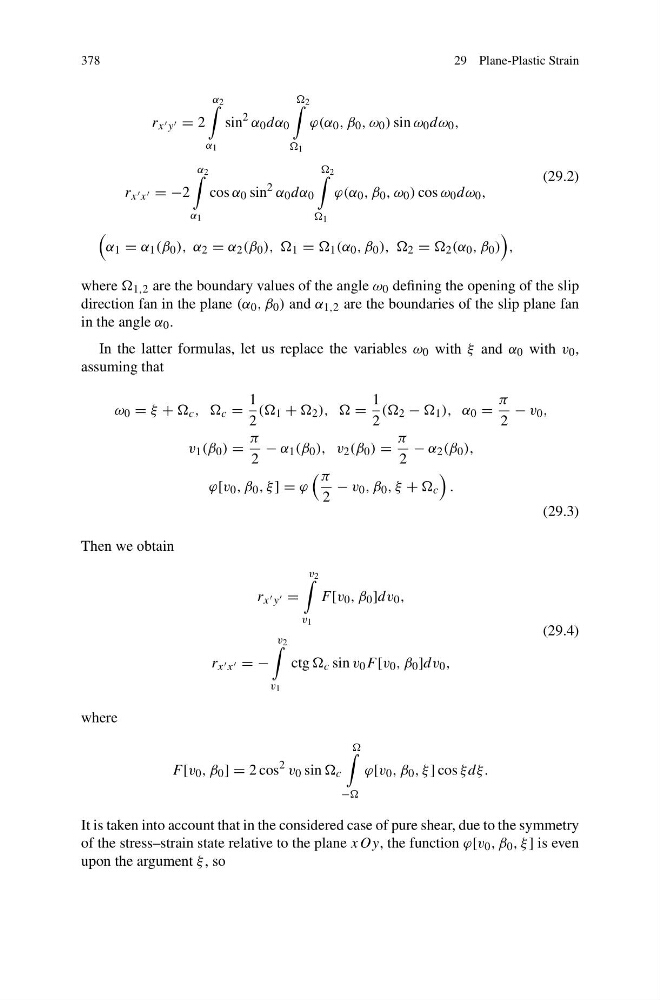
where 1,2 are the boundary values of the angle ω 0 defining the opening of the slip
direction fan in the plane (α 0 , β 0 ) and α 1,2 are the boundaries of the slip plane fan
in the angle α 0 .
In the latter formulas, let us replace the variables ω 0 with ξ and α 0 with v 0 ,
assuming that
ω 0 = ξ + c , , c =
1
2
(( 1 + 2 ), , =
1
2
(( 2 − 1 ), α 0 =
π
2
− v 0 ,
v 1 (β 0 ) =
π
2
− α 1 (β 0 ), v 2 (β 0 ) =
π
2
− α 2 (β 0 ),
ϕ[v 0 , β 0 , ξ] = ϕ
π
2
− v 0 , β 0 , ξ + c
.
(29.3)
Then we obtain
r x y =
v 2
v 1
F [v 0 , β 0 ]dv 0 ,
r x x = −
v 2
v 1
ctg c sin v 0 F [v 0 , β 0 ]dv 0 ,
(29.4)
where
F [v 0 , β 0 ] = 2 cos
2 v 0 sin c
−
ϕ[v 0 , β 0 , ξ] cos ξdξ.
It is taken into account that in the considered case of pure shear, due to the symmetry
of the stress–strain state relative to the plane xOy, the function ϕ[v 0 , β 0 , ξ] is even
upon the argument ξ , so
29 Plane-Plastic Strain
r x y = 2
α 2
α 1
sin
2 α 0 dα 0
2
1
ϕ(α 0 , β 0 , ω 0 ) sin ω 0 dω 0 ,
r x x = −2
α 2
α 1
cos α 0 sin
2 α 0 dα 0
2
1
ϕ(α 0 , β 0 , ω 0 ) cos ω 0 dω 0 ,
α 1 = α 1 (β 0 ), α 2 = α 2 (β 0 ), , 1 = 1 (α 0 , β 0 ), , 2 = 2 (α 0 , β 0 )
,
(29.2)
where 1,2 are the boundary values of the angle ω 0 defining the opening of the slip
direction fan in the plane (α 0 , β 0 ) and α 1,2 are the boundaries of the slip plane fan
in the angle α 0 .
In the latter formulas, let us replace the variables ω 0 with ξ and α 0 with v 0 ,
assuming that
ω 0 = ξ + c , , c =
1
2
(( 1 + 2 ), , =
1
2
(( 2 − 1 ), α 0 =
π
2
− v 0 ,
v 1 (β 0 ) =
π
2
− α 1 (β 0 ), v 2 (β 0 ) =
π
2
− α 2 (β 0 ),
ϕ[v 0 , β 0 , ξ] = ϕ
π
2
− v 0 , β 0 , ξ + c
.
(29.3)
Then we obtain
r x y =
v 2
v 1
F [v 0 , β 0 ]dv 0 ,
r x x = −
v 2
v 1
ctg c sin v 0 F [v 0 , β 0 ]dv 0 ,
(29.4)
where
F [v 0 , β 0 ] = 2 cos
2 v 0 sin c
−
ϕ[v 0 , β 0 , ξ] cos ξdξ.
It is taken into account that in the considered case of pure shear, due to the symmetry
of the stress–strain state relative to the plane xOy, the function ϕ[v 0 , β 0 , ξ] is even
upon the argument ξ , so