

25.3 Special Cases
343
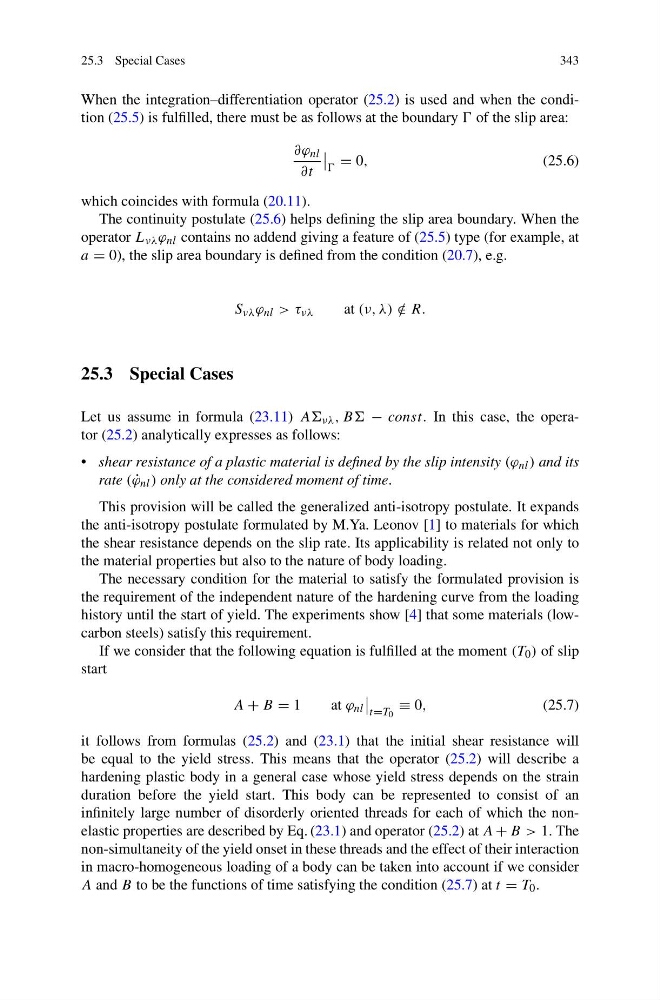
When the integration–differentiation operator (25.2) is used and when the condition (25.5) is fulfilled, there must be as follows at the boundary of the slip area:
∂ϕ nl
∂t
= 0,
(25.6)
which coincides with formula (20.11).
The continuity postulate (25.6) helps defining the slip area boundary. When the
operator L νλ ϕ nl contains no addend giving a feature of (25.5) type (for example, at
a = 0), the slip area boundary is defined from the condition (20.7), e.g.
S νλ ϕ nl > τ νλ
at (ν, λ) /
∈ R.
25.3 Special Cases
Let us assume in formula (23.11) AA νλ , BB − const. In this case, the operator (25.2) analytically expresses as follows:
• shear resistance of a plastic material is defined by the slip intensity (ϕ nl ) and its
rate ( ˙
ϕ nl ) only at the considered moment of time.
This provision will be called the generalized anti-isotropy postulate. It expands
the anti-isotropy postulate formulated by M.Ya. Leonov [1] to materials for which
the shear resistance depends on the slip rate. Its applicability is related not only to
the material properties but also to the nature of body loading.
The necessary condition for the material to satisfy the formulated provision is
the requirement of the independent nature of the hardening curve from the loading
history until the start of yield. The experiments show [4] that some materials (lowcarbon steels) satisfy this requirement.
If we consider that the following equation is fulfilled at the moment (T 0 ) of slip
start
A + B = 1
atϕ nl
t=T 0
≡ 0,
(25.7)
it follows from formulas (25.2) and (23.1) that the initial shear resistance will
be equal to the yield stress. This means that the operator (25.2) will describe a
hardening plastic body in a general case whose yield stress depends on the strain
duration before the yield start. This body can be represented to consist of an
infinitely large number of disorderly oriented threads for each of which the nonelastic properties are described by Eq. (23.1) and operator (25.2) at A + B > 1. The
non-simultaneity of the yield onset in these threads and the effect of their interaction
in macro-homogeneous loading of a body can be taken into account if we consider
A and B to be the functions of time satisfying the condition (25.7) at t = T 0 .
343
When the integration–differentiation operator (25.2) is used and when the condition (25.5) is fulfilled, there must be as follows at the boundary of the slip area:
∂ϕ nl
∂t
= 0,
(25.6)
which coincides with formula (20.11).
The continuity postulate (25.6) helps defining the slip area boundary. When the
operator L νλ ϕ nl contains no addend giving a feature of (25.5) type (for example, at
a = 0), the slip area boundary is defined from the condition (20.7), e.g.
S νλ ϕ nl > τ νλ
at (ν, λ) /
∈ R.
25.3 Special Cases
Let us assume in formula (23.11) AA νλ , BB − const. In this case, the operator (25.2) analytically expresses as follows:
• shear resistance of a plastic material is defined by the slip intensity (ϕ nl ) and its
rate ( ˙
ϕ nl ) only at the considered moment of time.
This provision will be called the generalized anti-isotropy postulate. It expands
the anti-isotropy postulate formulated by M.Ya. Leonov [1] to materials for which
the shear resistance depends on the slip rate. Its applicability is related not only to
the material properties but also to the nature of body loading.
The necessary condition for the material to satisfy the formulated provision is
the requirement of the independent nature of the hardening curve from the loading
history until the start of yield. The experiments show [4] that some materials (lowcarbon steels) satisfy this requirement.
If we consider that the following equation is fulfilled at the moment (T 0 ) of slip
start
A + B = 1
atϕ nl
t=T 0
≡ 0,
(25.7)
it follows from formulas (25.2) and (23.1) that the initial shear resistance will
be equal to the yield stress. This means that the operator (25.2) will describe a
hardening plastic body in a general case whose yield stress depends on the strain
duration before the yield start. This body can be represented to consist of an
infinitely large number of disorderly oriented threads for each of which the nonelastic properties are described by Eq. (23.1) and operator (25.2) at A + B > 1. The
non-simultaneity of the yield onset in these threads and the effect of their interaction
in macro-homogeneous loading of a body can be taken into account if we consider
A and B to be the functions of time satisfying the condition (25.7) at t = T 0 .