

23.4 Almost Simple Strain
331
direction (−λ). Such aging will be called anti-isotropic, and the value of softening
that occurs in this case will be called the anti-isotropic component of aging. It is then
believed that the anti-isotropic component of aging can be represented as a function
of the following argument:
νλ =
γ νλ
γ m
,
(23.10)
where is the primary argument of isotropic aging, and γ m and γ νλ are the
maximum plastic shear and the component of plastic strain in the axes ν and λ,
respectively.
23.4 Almost Simple Strain
Let us consider such loadings for which the maximum plastic shear (γ m ) for
continuous plastic strain is almost a monotonous function of time. This strain will
be called almost simple.
The requirement of the continuity of plastic strain is associated with the fact that
stops in loading and keeping the plastically deformed material under constant load
or in the case of its partial or full loading is accompanied by material “recovery”
caused by diffusion processes.
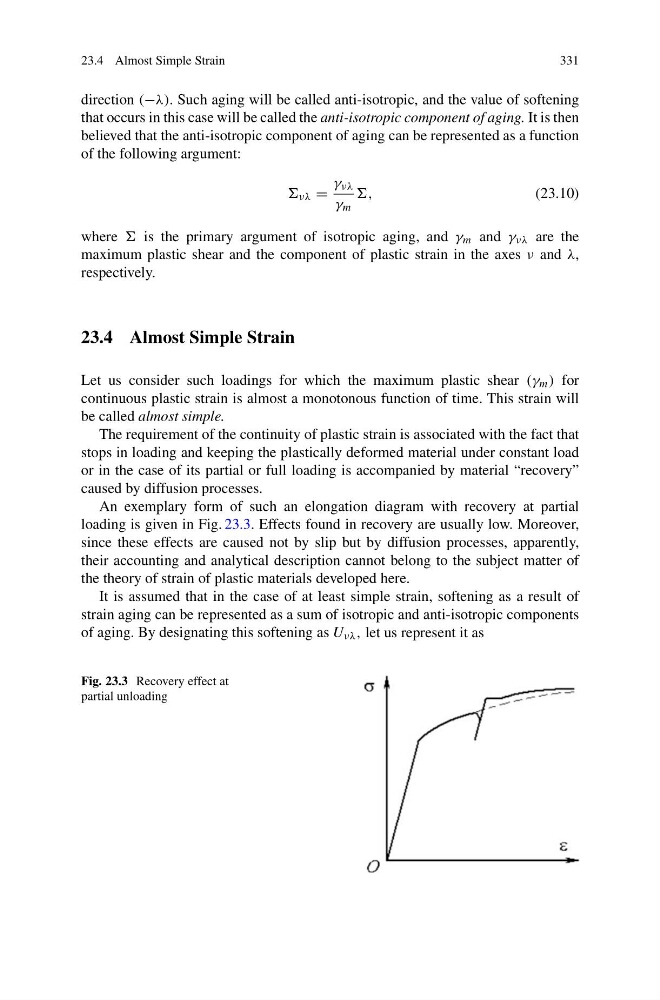
An exemplary form of such an elongation diagram with recovery at partial
loading is given in Fig. 23.3. Effects found in recovery are usually low. Moreover,
since these effects are caused not by slip but by diffusion processes, apparently,
their accounting and analytical description cannot belong to the subject matter of
the theory of strain of plastic materials developed here.
It is assumed that in the case of at least simple strain, softening as a result of
strain aging can be represented as a sum of isotropic and anti-isotropic components
of aging. By designating this softening as U νλ , let us represent it as
Fig. 23.3 Recovery effect at
partial unloading
331
direction (−λ). Such aging will be called anti-isotropic, and the value of softening
that occurs in this case will be called the anti-isotropic component of aging. It is then
believed that the anti-isotropic component of aging can be represented as a function
of the following argument:
νλ =
γ νλ
γ m
,
(23.10)
where is the primary argument of isotropic aging, and γ m and γ νλ are the
maximum plastic shear and the component of plastic strain in the axes ν and λ,
respectively.
23.4 Almost Simple Strain
Let us consider such loadings for which the maximum plastic shear (γ m ) for
continuous plastic strain is almost a monotonous function of time. This strain will
be called almost simple.
The requirement of the continuity of plastic strain is associated with the fact that
stops in loading and keeping the plastically deformed material under constant load
or in the case of its partial or full loading is accompanied by material “recovery”
caused by diffusion processes.
An exemplary form of such an elongation diagram with recovery at partial
loading is given in Fig. 23.3. Effects found in recovery are usually low. Moreover,
since these effects are caused not by slip but by diffusion processes, apparently,
their accounting and analytical description cannot belong to the subject matter of
the theory of strain of plastic materials developed here.
It is assumed that in the case of at least simple strain, softening as a result of
strain aging can be represented as a sum of isotropic and anti-isotropic components
of aging. By designating this softening as U νλ , let us represent it as
Fig. 23.3 Recovery effect at
partial unloading