

324
22 Axioms of the Inelastic Body Model
the case of their instantaneous deformation does not depend on the first invariant of
the stress tensor, and it can be represented as
F (J 2 , J 3 ) = 0,
(22.1)
where F is the function of the second (J 2 ) and third (J 3 ) invariants of the stress
tensor. These invariants can be expressed through the maximum (τ m ) and octahedral
(τ i ) tangential stresses. Therefore, the condition ( 22.1) can be rewritten as follows:
S
∞
m = f (τ i ),
(22.2)
where f is the function set for a specific material defining the effects of the stressed
state type on the condition of yield occurrence with an infinitely high rate. Since
stresses are unambiguously related to elastic strains before the fulfillment of the
yield condition ( 22.2), we will state below that the function f defines the effects
of elastic strain on the instantaneous yield stress, and we will call it the function of
elastic softening.
Due to Axiom 22.4, the function f (τ i ) defines the initial shear resistance in the
case of instantaneous material strain. From Axiom 22.3, it follows that this function
is decreasing.
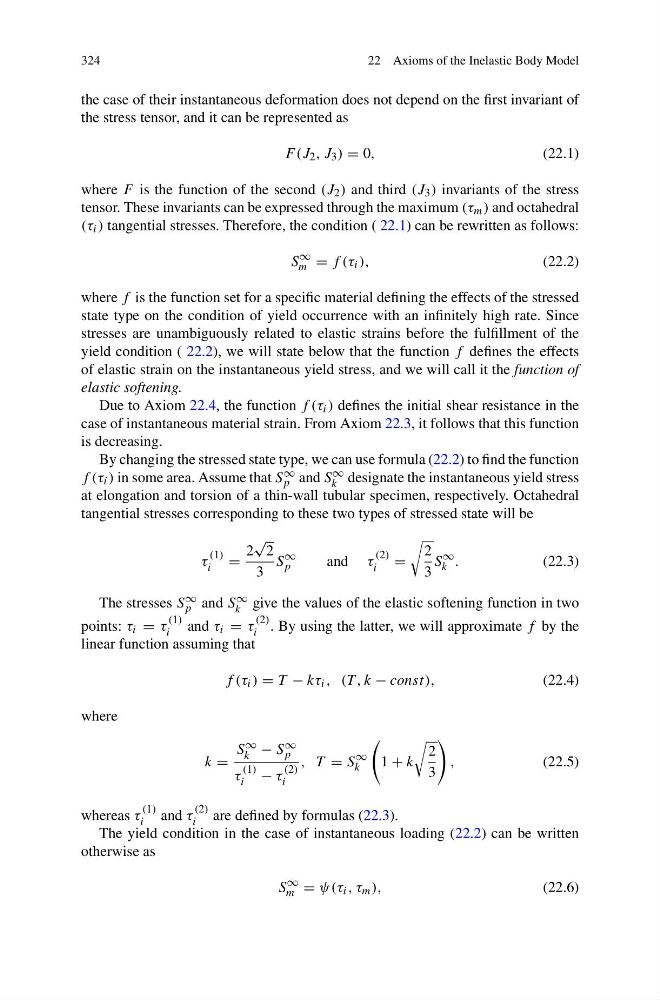
By changing the stressed state type, we can use formula (22.2) to find the function
f (τ i ) in some area. Assume that S ∞
p and S ∞
k designate the instantaneous yield stress
at elongation and torsion of a thin-wall tubular specimen, respectively. Octahedral
tangential stresses corresponding to these two types of stressed state will be
τ
(1)
i
=
2
√
2
3
S
∞
p
and τ
(2)
i
=
2
3
S
∞
k .
(22.3)
The stresses S ∞
p and S ∞
k give the values of the elastic softening function in two
points: τ i = τ
(1)
i
and τ i = τ
(2)
i . By using the latter, we will approximate f by the
linear function assuming that
f (τ i ) = T − kτ i , (T,k − const),
(22.4)
where
k =
S ∞
k − S ∞
p
τ
(1)
i − τ
(2)
i
, T = S
∞
k
1 + k
2
3
,
(22.5)
whereas τ
(1)
i and τ
(2)
i are defined by formulas (22.3).
The yield condition in the case of instantaneous loading (22.2) can be written
otherwise as
S
∞
m = ψ(τ i , τ m ),
(22.6)
22 Axioms of the Inelastic Body Model
the case of their instantaneous deformation does not depend on the first invariant of
the stress tensor, and it can be represented as
F (J 2 , J 3 ) = 0,
(22.1)
where F is the function of the second (J 2 ) and third (J 3 ) invariants of the stress
tensor. These invariants can be expressed through the maximum (τ m ) and octahedral
(τ i ) tangential stresses. Therefore, the condition ( 22.1) can be rewritten as follows:
S
∞
m = f (τ i ),
(22.2)
where f is the function set for a specific material defining the effects of the stressed
state type on the condition of yield occurrence with an infinitely high rate. Since
stresses are unambiguously related to elastic strains before the fulfillment of the
yield condition ( 22.2), we will state below that the function f defines the effects
of elastic strain on the instantaneous yield stress, and we will call it the function of
elastic softening.
Due to Axiom 22.4, the function f (τ i ) defines the initial shear resistance in the
case of instantaneous material strain. From Axiom 22.3, it follows that this function
is decreasing.
By changing the stressed state type, we can use formula (22.2) to find the function
f (τ i ) in some area. Assume that S ∞
p and S ∞
k designate the instantaneous yield stress
at elongation and torsion of a thin-wall tubular specimen, respectively. Octahedral
tangential stresses corresponding to these two types of stressed state will be
τ
(1)
i
=
2
√
2
3
S
∞
p
and τ
(2)
i
=
2
3
S
∞
k .
(22.3)
The stresses S ∞
p and S ∞
k give the values of the elastic softening function in two
points: τ i = τ
(1)
i
and τ i = τ
(2)
i . By using the latter, we will approximate f by the
linear function assuming that
f (τ i ) = T − kτ i , (T,k − const),
(22.4)
where
k =
S ∞
k − S ∞
p
τ
(1)
i − τ
(2)
i
, T = S
∞
k
1 + k
2
3
,
(22.5)
whereas τ
(1)
i and τ
(2)
i are defined by formulas (22.3).
The yield condition in the case of instantaneous loading (22.2) can be written
otherwise as
S
∞
m = ψ(τ i , τ m ),
(22.6)