

322
22 Axioms of the Inelastic Body Model
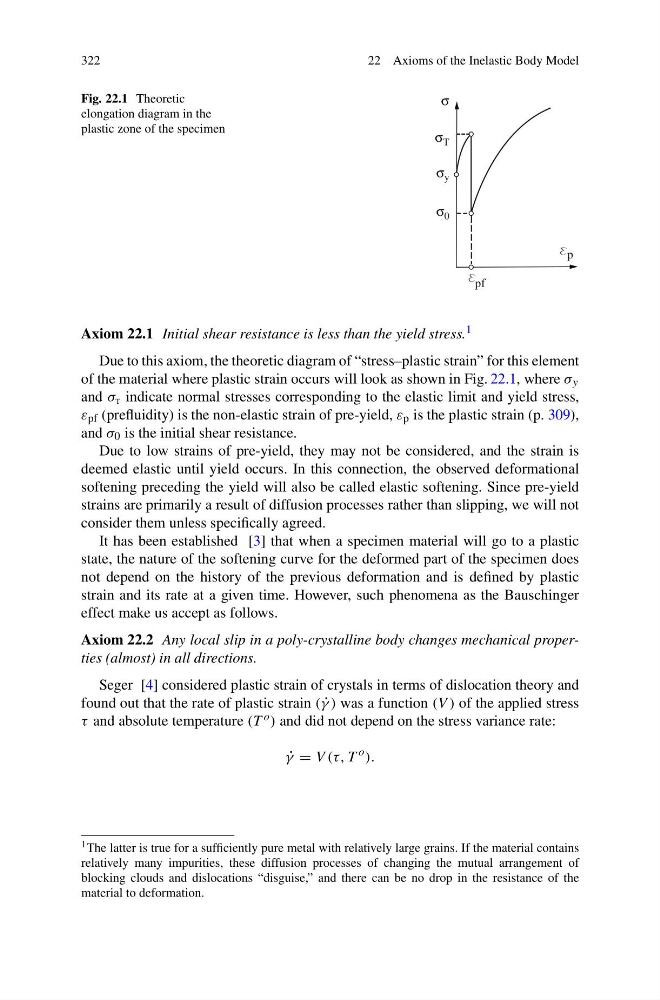
Fig. 22.1 Theoretic
elongation diagram in the
plastic zone of the specimen
σ
σ T
σ y
σ 0
Axiom 22.1 Initial shear resistance is less than the yield stress. 1
Due to this axiom, the theoretic diagram of “stress–plastic strain” for this element
of the material where plastic strain occurs will look as shown in Fig. 22.1, where σ y
and σ T indicate normal stresses corresponding to the elastic limit and yield stress,
ε pf (prefluidity) is the non-elastic strain of pre-yield, ε p is the plastic strain (p. 309),
and σ 0 is the initial shear resistance.
Due to low strains of pre-yield, they may not be considered, and the strain is
deemed elastic until yield occurs. In this connection, the observed deformational
softening preceding the yield will also be called elastic softening. Since pre-yield
strains are primarily a result of diffusion processes rather than slipping, we will not
consider them unless specifically agreed.
It has been established [3] that when a specimen material will go to a plastic
state, the nature of the softening curve for the deformed part of the specimen does
not depend on the history of the previous deformation and is defined by plastic
strain and its rate at a given time. However, such phenomena as the Bauschinger
effect make us accept as follows.
Axiom 22.2 Any local slip in a poly-crystalline body changes mechanical properties (almost) in all directions.
Seger [4] considered plastic strain of crystals in terms of dislocation theory and
found out that the rate of plastic strain ( ˙
γ ) was a function (V ) of the applied stress
τ and absolute temperature (T o ) and did not depend on the stress variance rate:
˙
γ = V (τ, T
o ).
1 The latter is true for a sufficiently pure metal with relatively large grains. If the material contains
relatively many impurities, these diffusion processes of changing the mutual arrangement of
blocking clouds and dislocations “disguise,” and there can be no drop in the resistance of the
material to deformation.
22 Axioms of the Inelastic Body Model
Fig. 22.1 Theoretic
elongation diagram in the
plastic zone of the specimen
σ
σ T
σ y
σ 0
Axiom 22.1 Initial shear resistance is less than the yield stress. 1
Due to this axiom, the theoretic diagram of “stress–plastic strain” for this element
of the material where plastic strain occurs will look as shown in Fig. 22.1, where σ y
and σ T indicate normal stresses corresponding to the elastic limit and yield stress,
ε pf (prefluidity) is the non-elastic strain of pre-yield, ε p is the plastic strain (p. 309),
and σ 0 is the initial shear resistance.
Due to low strains of pre-yield, they may not be considered, and the strain is
deemed elastic until yield occurs. In this connection, the observed deformational
softening preceding the yield will also be called elastic softening. Since pre-yield
strains are primarily a result of diffusion processes rather than slipping, we will not
consider them unless specifically agreed.
It has been established [3] that when a specimen material will go to a plastic
state, the nature of the softening curve for the deformed part of the specimen does
not depend on the history of the previous deformation and is defined by plastic
strain and its rate at a given time. However, such phenomena as the Bauschinger
effect make us accept as follows.
Axiom 22.2 Any local slip in a poly-crystalline body changes mechanical properties (almost) in all directions.
Seger [4] considered plastic strain of crystals in terms of dislocation theory and
found out that the rate of plastic strain ( ˙
γ ) was a function (V ) of the applied stress
τ and absolute temperature (T o ) and did not depend on the stress variance rate:
˙
γ = V (τ, T
o ).
1 The latter is true for a sufficiently pure metal with relatively large grains. If the material contains
relatively many impurities, these diffusion processes of changing the mutual arrangement of
blocking clouds and dislocations “disguise,” and there can be no drop in the resistance of the
material to deformation.