

20.4 Definition of Principal Strains
311
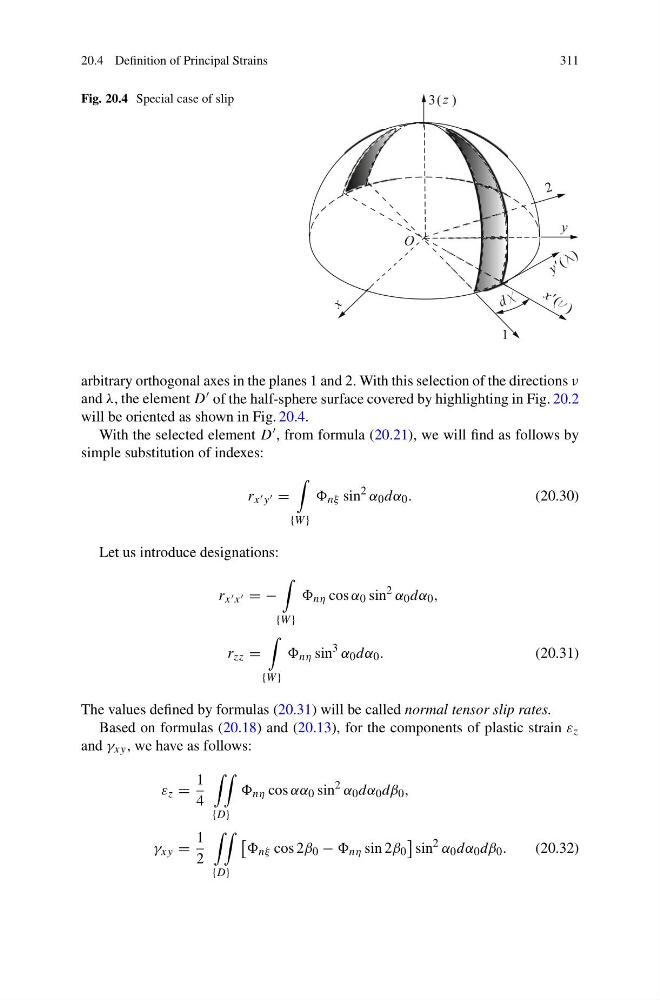
Fig. 20.4 Special case of slip
arbitrary orthogonal axes in the planes 1 and 2. With this selection of the directions ν
and λ, the element D of the half-sphere surface covered by highlighting in Fig. 20.2
will be oriented as shown in Fig. 20.4.
With the selected element D , from formula (20.21), we will find as follows by
simple substitution of indexes:
r x y =
{W }
nξ sin
2 α 0 dα 0 .
(20.30)
Let us introduce designations:
r x x = −
{W }
nη cos α 0 sin
2 α 0 dα 0 ,
r zz =
{W }
nη sin
3 α 0 dα 0 .
(20.31)
The values defined by formulas (20.31) will be called normal tensor slip rates.
Based on formulas (20.18) and (20.13), for the components of plastic strain ε z
and γ xy , we have as follows:
ε z =
1
4
{D}
nη cos αα 0 sin
2 α 0 dα 0 dβ 0 ,
γ xy =
1
2
{D}
nξ cos 2β 0 − nη sin 2β 0
sin
2 α 0 dα 0 dβ 0 .
(20.32)
311
Fig. 20.4 Special case of slip
arbitrary orthogonal axes in the planes 1 and 2. With this selection of the directions ν
and λ, the element D of the half-sphere surface covered by highlighting in Fig. 20.2
will be oriented as shown in Fig. 20.4.
With the selected element D , from formula (20.21), we will find as follows by
simple substitution of indexes:
r x y =
{W }
nξ sin
2 α 0 dα 0 .
(20.30)
Let us introduce designations:
r x x = −
{W }
nη cos α 0 sin
2 α 0 dα 0 ,
r zz =
{W }
nη sin
3 α 0 dα 0 .
(20.31)
The values defined by formulas (20.31) will be called normal tensor slip rates.
Based on formulas (20.18) and (20.13), for the components of plastic strain ε z
and γ xy , we have as follows:
ε z =
1
4
{D}
nη cos αα 0 sin
2 α 0 dα 0 dβ 0 ,
γ xy =
1
2
{D}
nξ cos 2β 0 − nη sin 2β 0
sin
2 α 0 dα 0 dβ 0 .
(20.32)