

304
20 Problem Setting
even in terms of convenience of computational kind. Relative displacements of
atoms in planes with plastic strain (slip) are one thousand times longer than such
displacements in volumes with purely elastic strain within the applicability of
Hooke’s law. At the same time, the total strain is low. It means that the volume
where macro-structural changes take place is usually rather low as compared to the
volume where purely elastic strain occurs.
Axiom 20.2 Plastic strain changes only structurally sensitive characteristics of the
material.
Consequence Elasticity coefficients do not depend on plastic strain. Structurally
sensitive (strength) characteristics are shift and tear resistance. Let us go over to
their definition.
20.2 Shift Resistance
Let us consider homogeneous macro-strain of a poly-crystalline body with a
disorderly crystal orientation. In each crystal, plastic strain is the result of slips
of atomic layers over specific planes and in known directions with the maximum
density of atom packing when reaching a specific value by a respective component
of tangential stresses. The specified planes in a poly-crystalline material form a fan
of slip planes whose opening depends on the stress level.
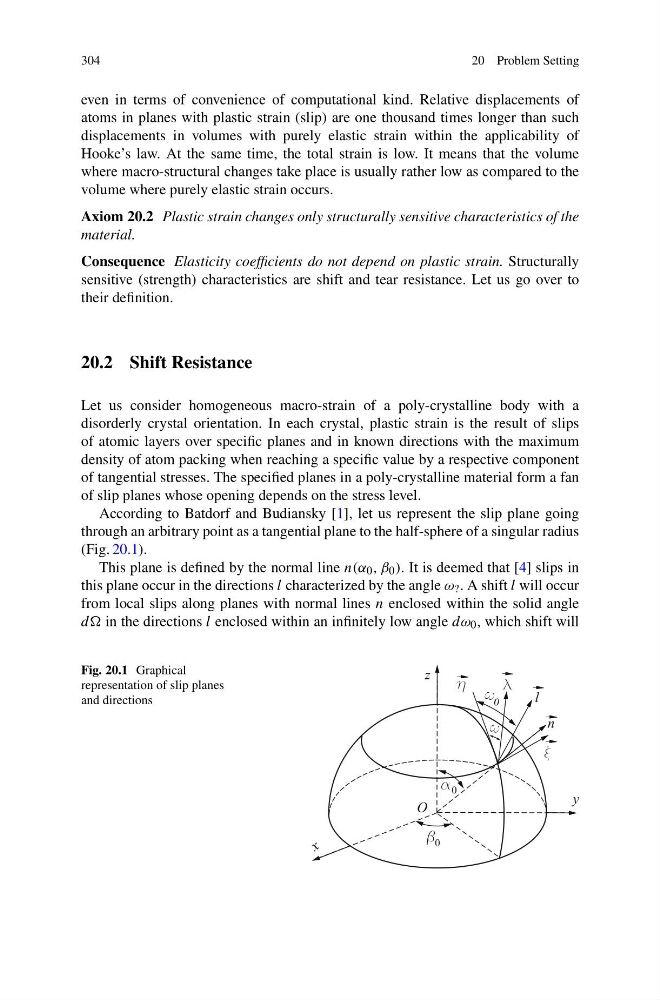
According to Batdorf and Budiansky [1], let us represent the slip plane going
through an arbitrary point as a tangential plane to the half-sphere of a singular radius
(Fig. 20.1).
This plane is defined by the normal line n(α 0 , β 0 ). It is deemed that [4] slips in
this plane occur in the directions l characterized by the angle ω ? . A shift l will occur
from local slips along planes with normal lines n enclosed within the solid angle
dd in the directions l enclosed within an infinitely low angle dω 0 , which shift will
Fig. 20.1 Graphical
representation of slip planes
and directions
20 Problem Setting
even in terms of convenience of computational kind. Relative displacements of
atoms in planes with plastic strain (slip) are one thousand times longer than such
displacements in volumes with purely elastic strain within the applicability of
Hooke’s law. At the same time, the total strain is low. It means that the volume
where macro-structural changes take place is usually rather low as compared to the
volume where purely elastic strain occurs.
Axiom 20.2 Plastic strain changes only structurally sensitive characteristics of the
material.
Consequence Elasticity coefficients do not depend on plastic strain. Structurally
sensitive (strength) characteristics are shift and tear resistance. Let us go over to
their definition.
20.2 Shift Resistance
Let us consider homogeneous macro-strain of a poly-crystalline body with a
disorderly crystal orientation. In each crystal, plastic strain is the result of slips
of atomic layers over specific planes and in known directions with the maximum
density of atom packing when reaching a specific value by a respective component
of tangential stresses. The specified planes in a poly-crystalline material form a fan
of slip planes whose opening depends on the stress level.
According to Batdorf and Budiansky [1], let us represent the slip plane going
through an arbitrary point as a tangential plane to the half-sphere of a singular radius
(Fig. 20.1).
This plane is defined by the normal line n(α 0 , β 0 ). It is deemed that [4] slips in
this plane occur in the directions l characterized by the angle ω ? . A shift l will occur
from local slips along planes with normal lines n enclosed within the solid angle
dd in the directions l enclosed within an infinitely low angle dω 0 , which shift will
Fig. 20.1 Graphical
representation of slip planes
and directions