

1.10 Elastic Shear Deformation
11
a
b
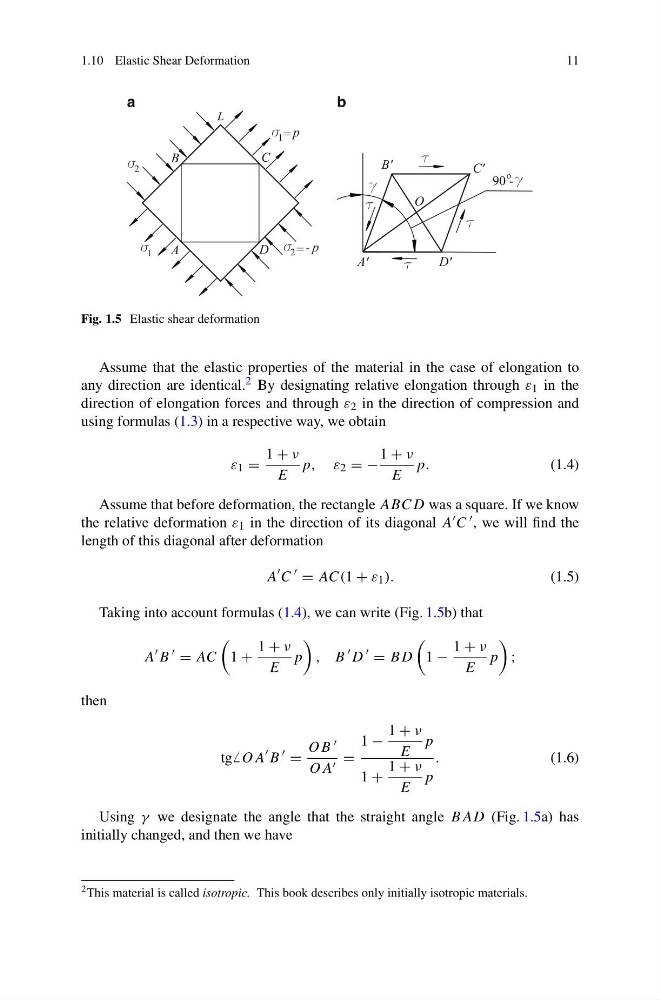
Fig. 1.5 Elastic shear deformation
Assume that the elastic properties of the material in the case of elongation to
any direction are identical. 2 By designating relative elongation through ε 1 in the
direction of elongation forces and through ε 2 in the direction of compression and
using formulas (1.3) in a respective way, we obtain
ε 1 =
1 + ν
E
p, ε 2 = −
1 + ν
E
p.
(1.4)
Assume that before deformation, the rectangle ABCD was a square. If we know
the relative deformation ε 1 in the direction of its diagonal A C , we will find the
length of this diagonal after deformation
A
C
= AC(1 + ε 1 ).
(1.5)
Taking into account formulas (1.4), we can write (Fig. 1.5b) that
A
B
= AC
1 +
1 + ν
E
p
, B
D
= BD
1 −
1 + ν
E
p
;
then
tg OA
B
=
OB
OA =
1 −
1 + ν
E
p
1 +
1 + ν
E
p
.
(1.6)
Using γ we designate the angle that the straight angle BAD (Fig. 1.5a) has
initially changed, and then we have
2 This material is called isotropic. This book describes only initially isotropic materials.
11
a
b
Fig. 1.5 Elastic shear deformation
Assume that the elastic properties of the material in the case of elongation to
any direction are identical. 2 By designating relative elongation through ε 1 in the
direction of elongation forces and through ε 2 in the direction of compression and
using formulas (1.3) in a respective way, we obtain
ε 1 =
1 + ν
E
p, ε 2 = −
1 + ν
E
p.
(1.4)
Assume that before deformation, the rectangle ABCD was a square. If we know
the relative deformation ε 1 in the direction of its diagonal A C , we will find the
length of this diagonal after deformation
A
C
= AC(1 + ε 1 ).
(1.5)
Taking into account formulas (1.4), we can write (Fig. 1.5b) that
A
B
= AC
1 +
1 + ν
E
p
, B
D
= BD
1 −
1 + ν
E
p
;
then
tg OA
B
=
OB
OA =
1 −
1 + ν
E
p
1 +
1 + ν
E
p
.
(1.6)
Using γ we designate the angle that the straight angle BAD (Fig. 1.5a) has
initially changed, and then we have
2 This material is called isotropic. This book describes only initially isotropic materials.