

286
19 Other Variants of Plasticity Theories
The solution is obtained when setting F (τ ) in the form of the following row:
F (τ ) =
N
1
a n
τ
τ s
− 1
n
.
The dependency of plastic strain on the elongating stress σ 11 is obtained as
e
p
11 =
N
1
a n g n
σ 11
2τ s
,
where the parameters g n are found (for N = 5) by time-consuming numerical
integration.
According to slip theory, plastic strain starts developing when the tangential
stress in any of the slip systems reaches the yield stress. It follows that the initial
loading surface complies with the Tresca condition of the maximum tangential
stress. Indeed, if τ max = τ s , there will always be a group of crystalline grains for
which this stress will be tangential in the slip system. For further loading surfaces,
the loading point in the Batdorf–Budiansky model will be conic.
As shown in the example of uniaxial elongation, the studies based on formulas (19.1) are extremely complicated even at proportional loading. For a case of
complicated loading of Cicala [7], analytical solutions were achieved for the case
when a thin-wall tube specimen was elongated beyond the yield stress and then
twisted. Rather complicated calculations related to the solution of this task based on
the modified slip model are given in detail in Chap. 27. To avoid repetition, we will
not reproduce them here and will give only the final results.
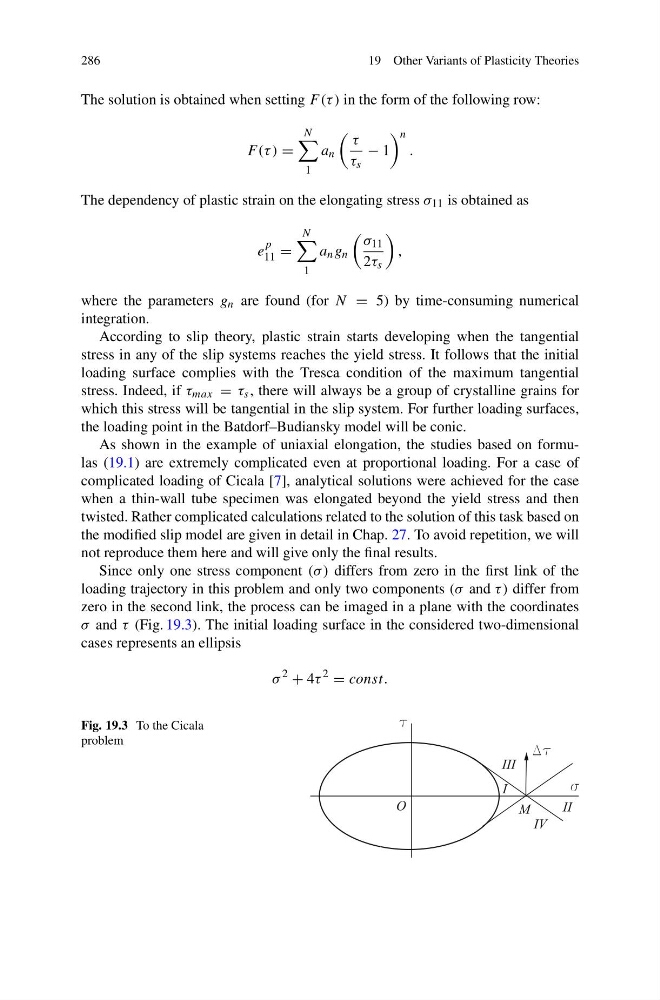
Since only one stress component (σ ) differs from zero in the first link of the
loading trajectory in this problem and only two components (σ and τ ) differ from
zero in the second link, the process can be imaged in a plane with the coordinates
σ and τ (Fig. 19.3). The initial loading surface in the considered two-dimensional
cases represents an ellipsis
σ
2
+ 4τ
2
= const.
Fig. 19.3 To the Cicala
problem
19 Other Variants of Plasticity Theories
The solution is obtained when setting F (τ ) in the form of the following row:
F (τ ) =
N
1
a n
τ
τ s
− 1
n
.
The dependency of plastic strain on the elongating stress σ 11 is obtained as
e
p
11 =
N
1
a n g n
σ 11
2τ s
,
where the parameters g n are found (for N = 5) by time-consuming numerical
integration.
According to slip theory, plastic strain starts developing when the tangential
stress in any of the slip systems reaches the yield stress. It follows that the initial
loading surface complies with the Tresca condition of the maximum tangential
stress. Indeed, if τ max = τ s , there will always be a group of crystalline grains for
which this stress will be tangential in the slip system. For further loading surfaces,
the loading point in the Batdorf–Budiansky model will be conic.
As shown in the example of uniaxial elongation, the studies based on formulas (19.1) are extremely complicated even at proportional loading. For a case of
complicated loading of Cicala [7], analytical solutions were achieved for the case
when a thin-wall tube specimen was elongated beyond the yield stress and then
twisted. Rather complicated calculations related to the solution of this task based on
the modified slip model are given in detail in Chap. 27. To avoid repetition, we will
not reproduce them here and will give only the final results.
Since only one stress component (σ ) differs from zero in the first link of the
loading trajectory in this problem and only two components (σ and τ ) differ from
zero in the second link, the process can be imaged in a plane with the coordinates
σ and τ (Fig. 19.3). The initial loading surface in the considered two-dimensional
cases represents an ellipsis
σ
2
+ 4τ
2
= const.
Fig. 19.3 To the Cicala
problem