

284
19 Other Variants of Plasticity Theories
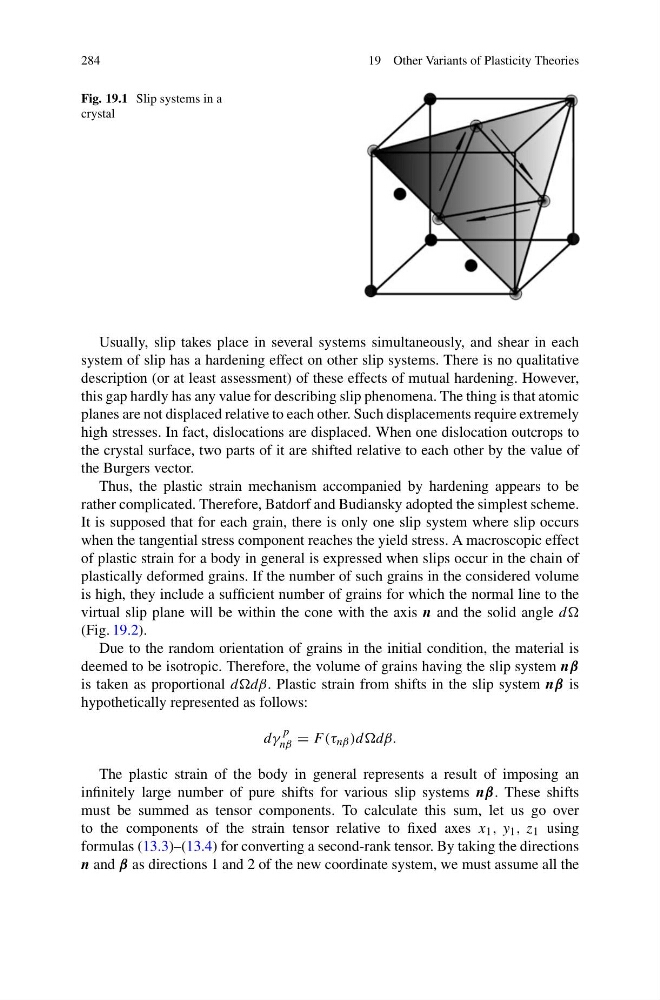
Fig. 19.1 Slip systems in a
crystal
Usually, slip takes place in several systems simultaneously, and shear in each
system of slip has a hardening effect on other slip systems. There is no qualitative
description (or at least assessment) of these effects of mutual hardening. However,
this gap hardly has any value for describing slip phenomena. The thing is that atomic
planes are not displaced relative to each other. Such displacements require extremely
high stresses. In fact, dislocations are displaced. When one dislocation outcrops to
the crystal surface, two parts of it are shifted relative to each other by the value of
the Burgers vector.
Thus, the plastic strain mechanism accompanied by hardening appears to be
rather complicated. Therefore, Batdorf and Budiansky adopted the simplest scheme.
It is supposed that for each grain, there is only one slip system where slip occurs
when the tangential stress component reaches the yield stress. A macroscopic effect
of plastic strain for a body in general is expressed when slips occur in the chain of
plastically deformed grains. If the number of such grains in the considered volume
is high, they include a sufficient number of grains for which the normal line to the
virtual slip plane will be within the cone with the axis n and the solid angle dd
(Fig. 19.2).
Due to the random orientation of grains in the initial condition, the material is
deemed to be isotropic. Therefore, the volume of grains having the slip system nβ
is taken as proportional dddβ. Plastic strain from shifts in the slip system nβ is
hypothetically represented as follows:
dγ
p
nβ = F (τ nβ )dddβ.
The plastic strain of the body in general represents a result of imposing an
infinitely large number of pure shifts for various slip systems nβ. These shifts
must be summed as tensor components. To calculate this sum, let us go over
to the components of the strain tensor relative to fixed axes x 1 , y 1 , z 1 using
formulas (13.3)–(13.4) for converting a second-rank tensor. By taking the directions
n and β as directions 1 and 2 of the new coordinate system, we must assume all the
19 Other Variants of Plasticity Theories
Fig. 19.1 Slip systems in a
crystal
Usually, slip takes place in several systems simultaneously, and shear in each
system of slip has a hardening effect on other slip systems. There is no qualitative
description (or at least assessment) of these effects of mutual hardening. However,
this gap hardly has any value for describing slip phenomena. The thing is that atomic
planes are not displaced relative to each other. Such displacements require extremely
high stresses. In fact, dislocations are displaced. When one dislocation outcrops to
the crystal surface, two parts of it are shifted relative to each other by the value of
the Burgers vector.
Thus, the plastic strain mechanism accompanied by hardening appears to be
rather complicated. Therefore, Batdorf and Budiansky adopted the simplest scheme.
It is supposed that for each grain, there is only one slip system where slip occurs
when the tangential stress component reaches the yield stress. A macroscopic effect
of plastic strain for a body in general is expressed when slips occur in the chain of
plastically deformed grains. If the number of such grains in the considered volume
is high, they include a sufficient number of grains for which the normal line to the
virtual slip plane will be within the cone with the axis n and the solid angle dd
(Fig. 19.2).
Due to the random orientation of grains in the initial condition, the material is
deemed to be isotropic. Therefore, the volume of grains having the slip system nβ
is taken as proportional dddβ. Plastic strain from shifts in the slip system nβ is
hypothetically represented as follows:
dγ
p
nβ = F (τ nβ )dddβ.
The plastic strain of the body in general represents a result of imposing an
infinitely large number of pure shifts for various slip systems nβ. These shifts
must be summed as tensor components. To calculate this sum, let us go over
to the components of the strain tensor relative to fixed axes x 1 , y 1 , z 1 using
formulas (13.3)–(13.4) for converting a second-rank tensor. By taking the directions
n and β as directions 1 and 2 of the new coordinate system, we must assume all the