

18.6 Yield for Plane Loading Surfaces
273
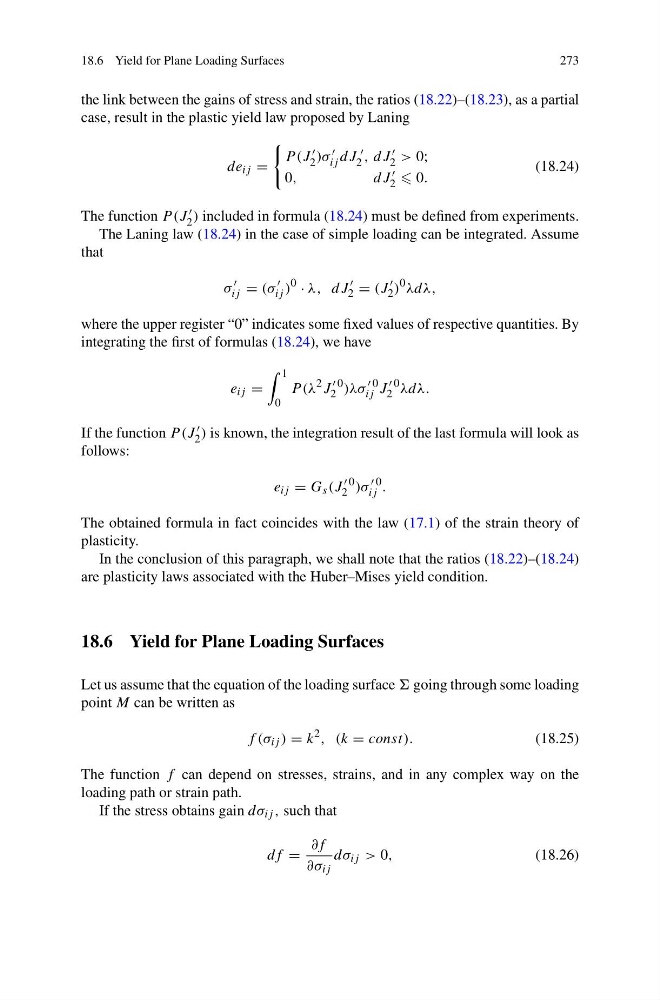
the link between the gains of stress and strain, the ratios (18.22)–(18.23), as a partial
case, result in the plastic yield law proposed by Laning
de ij =
P (J
2 )σ
ij dJ
2 , dJ
2 > 0;
0,
d J
2 0.
(18.24)
The function P (J
2 ) included in formula (18.24) must be defined from experiments.
The Laning law (18.24) in the case of simple loading can be integrated. Assume
that
σ
ij = (σ
ij )
0
· λ, dJ
2 = (J
2 )
0 λdλ,
where the upper register “0” indicates some fixed values of respective quantities. By
integrating the first of formulas (18.24), we have
e ij =
1
0
P (λ
2 J
0
2 )λσ
0
ij J
0
2 λdλ.
If the function P (J
2 ) is known, the integration result of the last formula will look as
follows:
e ij = G s (J
0
2 )σ
0
ij .
The obtained formula in fact coincides with the law (17.1) of the strain theory of
plasticity.
In the conclusion of this paragraph, we shall note that the ratios (18.22)–(18.24)
are plasticity laws associated with the Huber–Mises yield condition.
18.6 Yield for Plane Loading Surfaces
Let us assume that the equation of the loading surface going through some loading
point M can be written as
f (σ ij ) = k
2 , (k = const).
(18.25)
The function f can depend on stresses, strains, and in any complex way on the
loading path or strain path.
If the stress obtains gain dσ ij , such that
df =
∂f
∂σ ij
dσ ij > 0,
(18.26)
273
the link between the gains of stress and strain, the ratios (18.22)–(18.23), as a partial
case, result in the plastic yield law proposed by Laning
de ij =
P (J
2 )σ
ij dJ
2 , dJ
2 > 0;
0,
d J
2 0.
(18.24)
The function P (J
2 ) included in formula (18.24) must be defined from experiments.
The Laning law (18.24) in the case of simple loading can be integrated. Assume
that
σ
ij = (σ
ij )
0
· λ, dJ
2 = (J
2 )
0 λdλ,
where the upper register “0” indicates some fixed values of respective quantities. By
integrating the first of formulas (18.24), we have
e ij =
1
0
P (λ
2 J
0
2 )λσ
0
ij J
0
2 λdλ.
If the function P (J
2 ) is known, the integration result of the last formula will look as
follows:
e ij = G s (J
0
2 )σ
0
ij .
The obtained formula in fact coincides with the law (17.1) of the strain theory of
plasticity.
In the conclusion of this paragraph, we shall note that the ratios (18.22)–(18.24)
are plasticity laws associated with the Huber–Mises yield condition.
18.6 Yield for Plane Loading Surfaces
Let us assume that the equation of the loading surface going through some loading
point M can be written as
f (σ ij ) = k
2 , (k = const).
(18.25)
The function f can depend on stresses, strains, and in any complex way on the
loading path or strain path.
If the stress obtains gain dσ ij , such that
df =
∂f
∂σ ij
dσ ij > 0,
(18.26)