

264
17 Additions and Generalizations to the Strain Theory of Plasticity
cos δ sin β
or
N 2 cos 2 α
1 + (N 2 − 1) cos 2 α
sin
2 β.
The obtained expression can be revised as follows:
N 2
N 2 + tg 2 α
tg 2 β
1 + tg 2 β
.
Hence we obtain
tg α
N
tg β
.
(17.35)
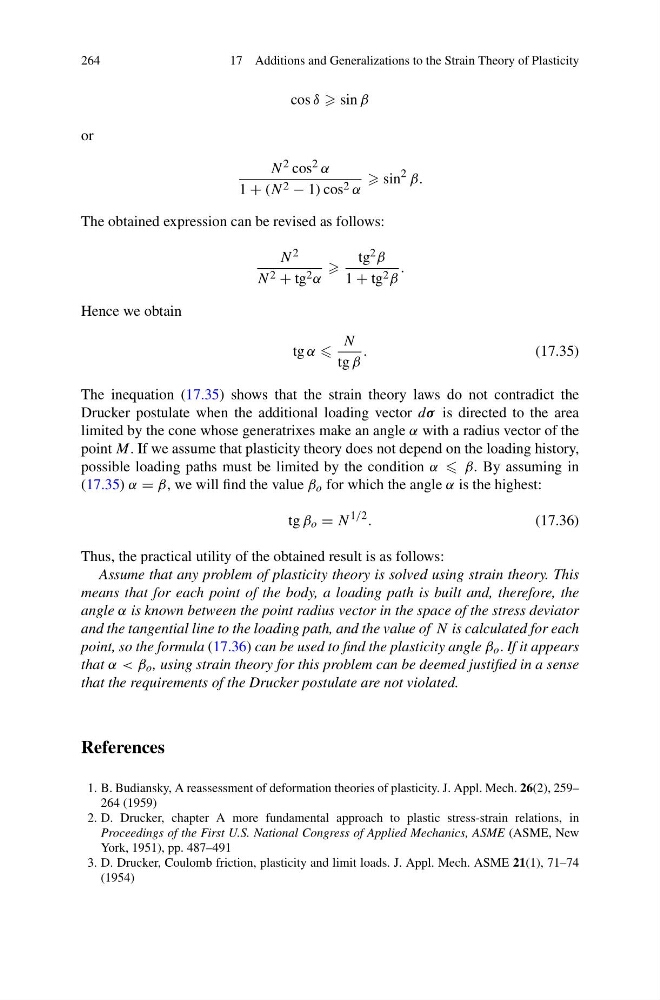
The inequation (17.35) shows that the strain theory laws do not contradict the
Drucker postulate when the additional loading vector dσ is directed to the area
limited by the cone whose generatrixes make an angle α with a radius vector of the
point M. If we assume that plasticity theory does not depend on the loading history,
possible loading paths must be limited by the condition α β. By assuming in
(17.35) α = β, we will find the value β o for which the angle α is the highest:
tg β o = N
1/2 .
(17.36)
Thus, the practical utility of the obtained result is as follows:
Assume that any problem of plasticity theory is solved using strain theory. This
means that for each point of the body, a loading path is built and, therefore, the
angle α is known between the point radius vector in the space of the stress deviator
and the tangential line to the loading path, and the value of N is calculated for each
point, so the formula (17.36) can be used to find the plasticity angle β o . If it appears
that α < β o , using strain theory for this problem can be deemed justified in a sense
that the requirements of the Drucker postulate are not violated.
References
1. B. Budiansky, A reassessment of deformation theories of plasticity. J. Appl. Mech. 26(2), 259–
264 (1959)
2. D. Drucker, chapter A more fundamental approach to plastic stress-strain relations, in
Proceedings of the First U.S. National Congress of Applied Mechanics, ASME (ASME, New
York, 1951), pp. 487–491
3. D. Drucker, Coulomb friction, plasticity and limit loads. J. Appl. Mech. ASME 21(1), 71–74
(1954)
17 Additions and Generalizations to the Strain Theory of Plasticity
cos δ sin β
or
N 2 cos 2 α
1 + (N 2 − 1) cos 2 α
sin
2 β.
The obtained expression can be revised as follows:
N 2
N 2 + tg 2 α
tg 2 β
1 + tg 2 β
.
Hence we obtain
tg α
N
tg β
.
(17.35)
The inequation (17.35) shows that the strain theory laws do not contradict the
Drucker postulate when the additional loading vector dσ is directed to the area
limited by the cone whose generatrixes make an angle α with a radius vector of the
point M. If we assume that plasticity theory does not depend on the loading history,
possible loading paths must be limited by the condition α β. By assuming in
(17.35) α = β, we will find the value β o for which the angle α is the highest:
tg β o = N
1/2 .
(17.36)
Thus, the practical utility of the obtained result is as follows:
Assume that any problem of plasticity theory is solved using strain theory. This
means that for each point of the body, a loading path is built and, therefore, the
angle α is known between the point radius vector in the space of the stress deviator
and the tangential line to the loading path, and the value of N is calculated for each
point, so the formula (17.36) can be used to find the plasticity angle β o . If it appears
that α < β o , using strain theory for this problem can be deemed justified in a sense
that the requirements of the Drucker postulate are not violated.
References
1. B. Budiansky, A reassessment of deformation theories of plasticity. J. Appl. Mech. 26(2), 259–
264 (1959)
2. D. Drucker, chapter A more fundamental approach to plastic stress-strain relations, in
Proceedings of the First U.S. National Congress of Applied Mechanics, ASME (ASME, New
York, 1951), pp. 487–491
3. D. Drucker, Coulomb friction, plasticity and limit loads. J. Appl. Mech. ASME 21(1), 71–74
(1954)