

17.9 On the Applicability Limits of the Strain Theory of Plasticity
261
ε
y
ij =
1
2G
σ
ij .
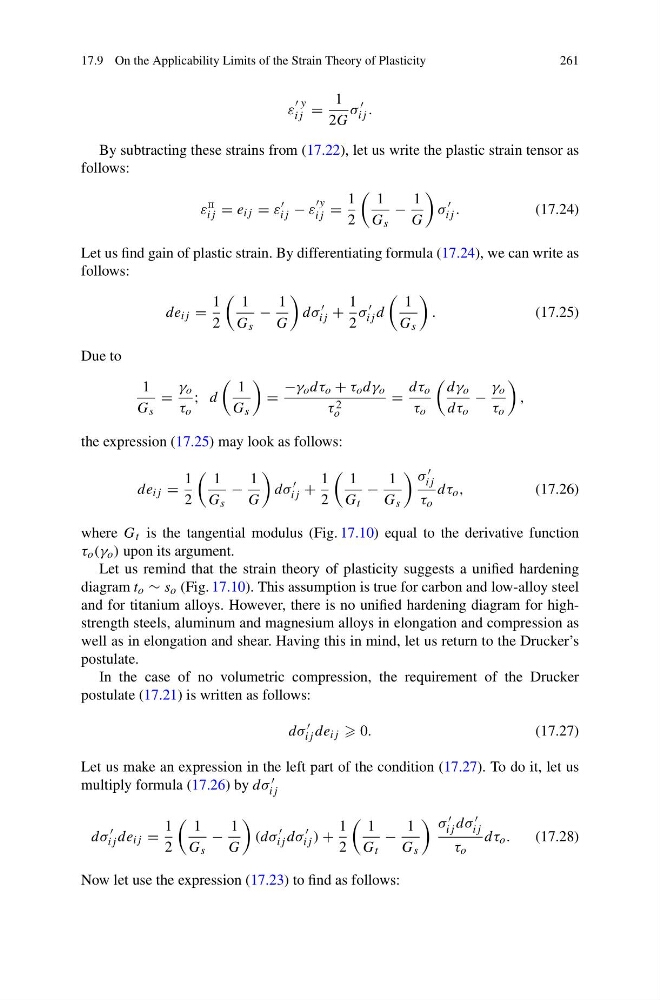
By subtracting these strains from (17.22), let us write the plastic strain tensor as
follows:
ε
p
ij = e ij = ε
ij − ε
y
ij =
1
2
1
G s
−
1
G
σ
ij .
(17.24)
Let us find gain of plastic strain. By differentiating formula (17.24), we can write as
follows:
de ij =
1
2
1
G s
−
1
G
dσ
ij +
1
2
σ
ij d
1
G s
.
(17.25)
Due to
1
G s
=
γ o
τ o
; d
1
G s
=
−γ o dτ o + τ o dγ o
τ 2
o
=
dτ o
τ o
dγ o
dτ o
−
γ o
τ o
,
the expression (17.25) may look as follows:
de ij =
1
2
1
G s
−
1
G
dσ
ij +
1
2
1
G t
−
1
G s
σ
ij
τ o
dτ o ,
(17.26)
where G t is the tangential modulus (Fig. 17.10) equal to the derivative function
τ o (γ o ) upon its argument.
Let us remind that the strain theory of plasticity suggests a unified hardening
diagram t o ∼ s o (Fig. 17.10). This assumption is true for carbon and low-alloy steel
and for titanium alloys. However, there is no unified hardening diagram for highstrength steels, aluminum and magnesium alloys in elongation and compression as
well as in elongation and shear. Having this in mind, let us return to the Drucker’s
postulate.
In the case of no volumetric compression, the requirement of the Drucker
postulate (17.21) is written as follows:
dσ
ij de ij 0.
(17.27)
Let us make an expression in the left part of the condition (17.27). To do it, let us
multiply formula (17.26) by dσ
ij
dσ
ij de ij =
1
2
1
G s
−
1
G
(dσ
ij dσ
ij ) +
1
2
1
G t
−
1
G s
σ
ij dσ
ij
τ o
dτ o .
(17.28)
Now let use the expression (17.23) to find as follows:
261
ε
y
ij =
1
2G
σ
ij .
By subtracting these strains from (17.22), let us write the plastic strain tensor as
follows:
ε
p
ij = e ij = ε
ij − ε
y
ij =
1
2
1
G s
−
1
G
σ
ij .
(17.24)
Let us find gain of plastic strain. By differentiating formula (17.24), we can write as
follows:
de ij =
1
2
1
G s
−
1
G
dσ
ij +
1
2
σ
ij d
1
G s
.
(17.25)
Due to
1
G s
=
γ o
τ o
; d
1
G s
=
−γ o dτ o + τ o dγ o
τ 2
o
=
dτ o
τ o
dγ o
dτ o
−
γ o
τ o
,
the expression (17.25) may look as follows:
de ij =
1
2
1
G s
−
1
G
dσ
ij +
1
2
1
G t
−
1
G s
σ
ij
τ o
dτ o ,
(17.26)
where G t is the tangential modulus (Fig. 17.10) equal to the derivative function
τ o (γ o ) upon its argument.
Let us remind that the strain theory of plasticity suggests a unified hardening
diagram t o ∼ s o (Fig. 17.10). This assumption is true for carbon and low-alloy steel
and for titanium alloys. However, there is no unified hardening diagram for highstrength steels, aluminum and magnesium alloys in elongation and compression as
well as in elongation and shear. Having this in mind, let us return to the Drucker’s
postulate.
In the case of no volumetric compression, the requirement of the Drucker
postulate (17.21) is written as follows:
dσ
ij de ij 0.
(17.27)
Let us make an expression in the left part of the condition (17.27). To do it, let us
multiply formula (17.26) by dσ
ij
dσ
ij de ij =
1
2
1
G s
−
1
G
(dσ
ij dσ
ij ) +
1
2
1
G t
−
1
G s
σ
ij dσ
ij
τ o
dτ o .
(17.28)
Now let use the expression (17.23) to find as follows: