

17.8 Drucker Postulate
259
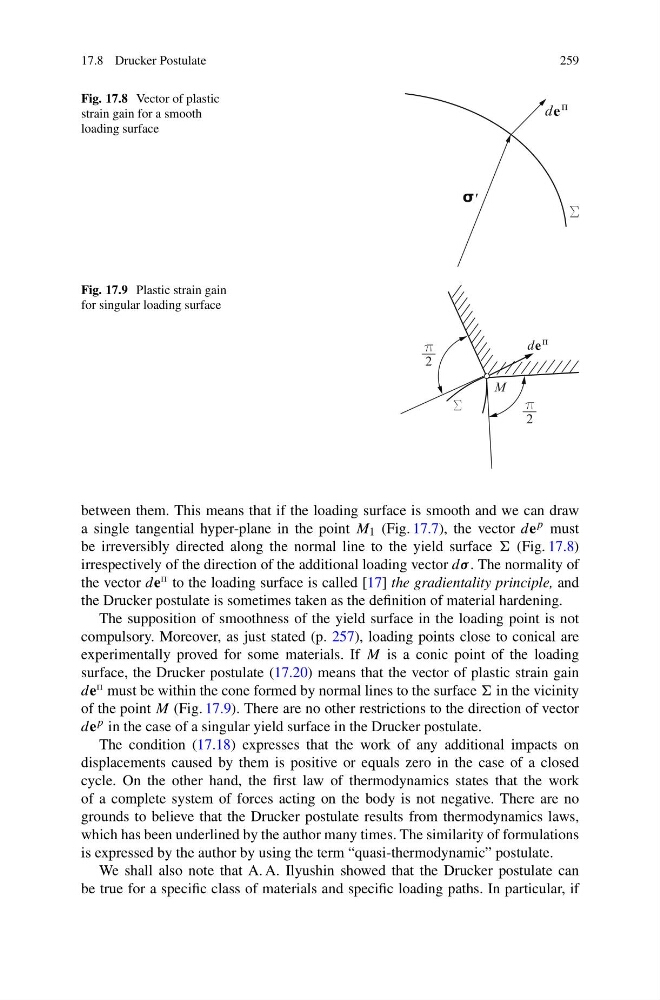
Fig. 17.8 Vector of plastic
strain gain for a smooth
loading surface
Fig. 17.9 Plastic strain gain
for singular loading surface
between them. This means that if the loading surface is smooth and we can draw
a single tangential hyper-plane in the point M 1 (Fig. 17.7), the vector de p must
be irreversibly directed along the normal line to the yield surface (Fig. 17.8)
irrespectively of the direction of the additional loading vector dσ . The normality of
the vector de p to the loading surface is called [17] the gradientality principle, and
the Drucker postulate is sometimes taken as the definition of material hardening.
The supposition of smoothness of the yield surface in the loading point is not
compulsory. Moreover, as just stated (p. 257), loading points close to conical are
experimentally proved for some materials. If M is a conic point of the loading
surface, the Drucker postulate (17.20) means that the vector of plastic strain gain
de p must be within the cone formed by normal lines to the surface in the vicinity
of the point M (Fig. 17.9). There are no other restrictions to the direction of vector
de p in the case of a singular yield surface in the Drucker postulate.
The condition (17.18) expresses that the work of any additional impacts on
displacements caused by them is positive or equals zero in the case of a closed
cycle. On the other hand, the first law of thermodynamics states that the work
of a complete system of forces acting on the body is not negative. There are no
grounds to believe that the Drucker postulate results from thermodynamics laws,
which has been underlined by the author many times. The similarity of formulations
is expressed by the author by using the term “quasi-thermodynamic” postulate.
We shall also note that A. A. Ilyushin showed that the Drucker postulate can
be true for a specific class of materials and specific loading paths. In particular, if
259
Fig. 17.8 Vector of plastic
strain gain for a smooth
loading surface
Fig. 17.9 Plastic strain gain
for singular loading surface
between them. This means that if the loading surface is smooth and we can draw
a single tangential hyper-plane in the point M 1 (Fig. 17.7), the vector de p must
be irreversibly directed along the normal line to the yield surface (Fig. 17.8)
irrespectively of the direction of the additional loading vector dσ . The normality of
the vector de p to the loading surface is called [17] the gradientality principle, and
the Drucker postulate is sometimes taken as the definition of material hardening.
The supposition of smoothness of the yield surface in the loading point is not
compulsory. Moreover, as just stated (p. 257), loading points close to conical are
experimentally proved for some materials. If M is a conic point of the loading
surface, the Drucker postulate (17.20) means that the vector of plastic strain gain
de p must be within the cone formed by normal lines to the surface in the vicinity
of the point M (Fig. 17.9). There are no other restrictions to the direction of vector
de p in the case of a singular yield surface in the Drucker postulate.
The condition (17.18) expresses that the work of any additional impacts on
displacements caused by them is positive or equals zero in the case of a closed
cycle. On the other hand, the first law of thermodynamics states that the work
of a complete system of forces acting on the body is not negative. There are no
grounds to believe that the Drucker postulate results from thermodynamics laws,
which has been underlined by the author many times. The similarity of formulations
is expressed by the author by using the term “quasi-thermodynamic” postulate.
We shall also note that A. A. Ilyushin showed that the Drucker postulate can
be true for a specific class of materials and specific loading paths. In particular, if