

1.6 Stress Vector
7
a
b
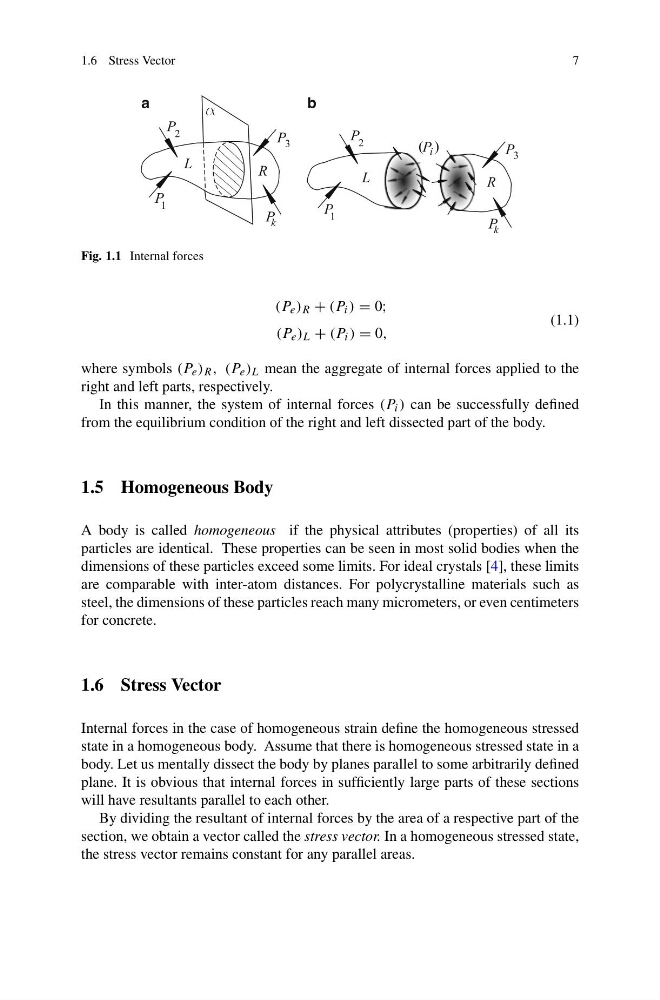
Fig. 1.1 Internal forces
(P e ) R + (P i ) = 0;
(P e ) L + (P i ) = 0,
(1.1)
where symbols (P e ) R , (P e ) L mean the aggregate of internal forces applied to the
right and left parts, respectively.
In this manner, the system of internal forces (P i ) can be successfully defined
from the equilibrium condition of the right and left dissected part of the body.
1.5 Homogeneous Body
A body is called homogeneous if the physical attributes (properties) of all its
particles are identical. These properties can be seen in most solid bodies when the
dimensions of these particles exceed some limits. For ideal crystals [4], these limits
are comparable with inter-atom distances. For polycrystalline materials such as
steel, the dimensions of these particles reach many micrometers, or even centimeters
for concrete.
1.6 Stress Vector
Internal forces in the case of homogeneous strain define the homogeneous stressed
state in a homogeneous body. Assume that there is homogeneous stressed state in a
body. Let us mentally dissect the body by planes parallel to some arbitrarily defined
plane. It is obvious that internal forces in sufficiently large parts of these sections
will have resultants parallel to each other.
By dividing the resultant of internal forces by the area of a respective part of the
section, we obtain a vector called the stress vector. In a homogeneous stressed state,
the stress vector remains constant for any parallel areas.
7
a
b
Fig. 1.1 Internal forces
(P e ) R + (P i ) = 0;
(P e ) L + (P i ) = 0,
(1.1)
where symbols (P e ) R , (P e ) L mean the aggregate of internal forces applied to the
right and left parts, respectively.
In this manner, the system of internal forces (P i ) can be successfully defined
from the equilibrium condition of the right and left dissected part of the body.
1.5 Homogeneous Body
A body is called homogeneous if the physical attributes (properties) of all its
particles are identical. These properties can be seen in most solid bodies when the
dimensions of these particles exceed some limits. For ideal crystals [4], these limits
are comparable with inter-atom distances. For polycrystalline materials such as
steel, the dimensions of these particles reach many micrometers, or even centimeters
for concrete.
1.6 Stress Vector
Internal forces in the case of homogeneous strain define the homogeneous stressed
state in a homogeneous body. Assume that there is homogeneous stressed state in a
body. Let us mentally dissect the body by planes parallel to some arbitrarily defined
plane. It is obvious that internal forces in sufficiently large parts of these sections
will have resultants parallel to each other.
By dividing the resultant of internal forces by the area of a respective part of the
section, we obtain a vector called the stress vector. In a homogeneous stressed state,
the stress vector remains constant for any parallel areas.