

17.5 Ilyushin’s Isotropy Postulate
253
only if the operation L is vector-linear relative to the vector Э, e.g.
L(Э) = AЭ + B
dЭ
d¸
+ . . . , +
t
t 0
CЭd¸,
where the coefficients A, B, . . . , C are the functions of internal parameters of the
trajectory (¸, χ 1 , χ 2 , . . .) and any operators of these parameters.
Consequence 2 The plasticity law
S = L(Э)
has a property of isomorphism.
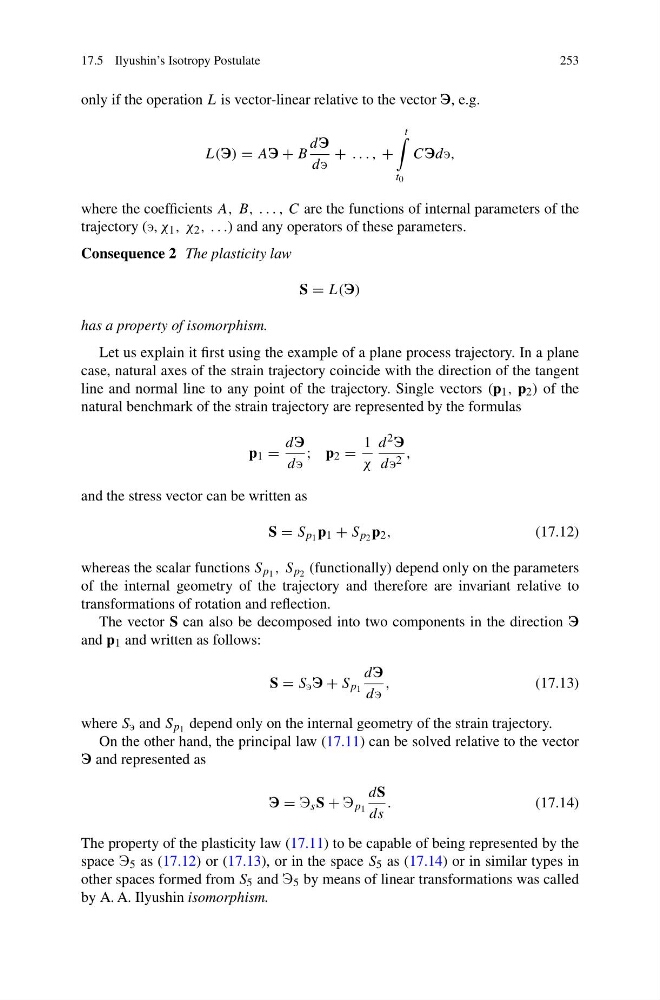
Let us explain it first using the example of a plane process trajectory. In a plane
case, natural axes of the strain trajectory coincide with the direction of the tangent
line and normal line to any point of the trajectory. Single vectors (p 1 , p 2 ) of the
natural benchmark of the strain trajectory are represented by the formulas
p 1 =
dЭ
d¸
; p 2 =
1
χ
d 2 Э
d¸ 2 ,
and the stress vector can be written as
S = S p 1 p 1 + S p 2 p 2 ,
(17.12)
whereas the scalar functions S p 1 , S p 2 (functionally) depend only on the parameters
of the internal geometry of the trajectory and therefore are invariant relative to
transformations of rotation and reflection.
The vector S can also be decomposed into two components in the direction Э
and p 1 and written as follows:
S = S ¸ Э + S p 1
dЭ
d¸
,
(17.13)
where S ¸ and S p 1 depend only on the internal geometry of the strain trajectory.
On the other hand, the principal law (17.11) can be solved relative to the vector
Э and represented as
Э = ˜ s S + ˜ p 1
dS
ds
.
(17.14)
The property of the plasticity law (17.11) to be capable of being represented by the
space ˜ 5 as (17.12) or (17.13), or in the space S 5 as (17.14) or in similar types in
other spaces formed from S 5 and ˜ 5 by means of linear transformations was called
by A. A. Ilyushin isomorphism.
253
only if the operation L is vector-linear relative to the vector Э, e.g.
L(Э) = AЭ + B
dЭ
d¸
+ . . . , +
t
t 0
CЭd¸,
where the coefficients A, B, . . . , C are the functions of internal parameters of the
trajectory (¸, χ 1 , χ 2 , . . .) and any operators of these parameters.
Consequence 2 The plasticity law
S = L(Э)
has a property of isomorphism.
Let us explain it first using the example of a plane process trajectory. In a plane
case, natural axes of the strain trajectory coincide with the direction of the tangent
line and normal line to any point of the trajectory. Single vectors (p 1 , p 2 ) of the
natural benchmark of the strain trajectory are represented by the formulas
p 1 =
dЭ
d¸
; p 2 =
1
χ
d 2 Э
d¸ 2 ,
and the stress vector can be written as
S = S p 1 p 1 + S p 2 p 2 ,
(17.12)
whereas the scalar functions S p 1 , S p 2 (functionally) depend only on the parameters
of the internal geometry of the trajectory and therefore are invariant relative to
transformations of rotation and reflection.
The vector S can also be decomposed into two components in the direction Э
and p 1 and written as follows:
S = S ¸ Э + S p 1
dЭ
d¸
,
(17.13)
where S ¸ and S p 1 depend only on the internal geometry of the strain trajectory.
On the other hand, the principal law (17.11) can be solved relative to the vector
Э and represented as
Э = ˜ s S + ˜ p 1
dS
ds
.
(17.14)
The property of the plasticity law (17.11) to be capable of being represented by the
space ˜ 5 as (17.12) or (17.13), or in the space S 5 as (17.14) or in similar types in
other spaces formed from S 5 and ˜ 5 by means of linear transformations was called
by A. A. Ilyushin isomorphism.